 She Thought Her Neighbor's Party Was Bad
Chapter 4
The Devastating Aftermath
The drive back home felt twice as long as the trip up. Every mile brought me closer to the confrontation I knew was coming, and the anticipation acted like a slow-burning fuse in my chest. By the time we pulled our car into the driveway, the sun was beginning to dip below the horizon, casting long, bruised shadows across the front yard.
Out front, things looked deceptively normal. The lawn was trimmed, the bushes were neat, and the front porch was as quiet as ever. But I knew better than to judge a book by its cover.
My sister stayed in the car with the luggage while I walked around to the side gate to survey the backyard. The festivities were long over, but the devastating aftermath remained, waiting for me like a crime scene.
I pushed open the side gate—or rather, what was left of it—and stepped into the yard. The damage was staggering.
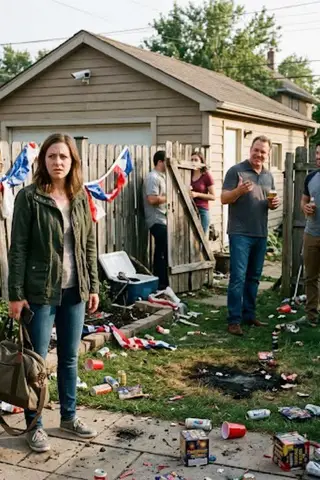
Shattered pieces of my expensive patio furniture were scattered haphazardly in the bushes, the aluminum frames bent out of shape and the cushions soaked through with stagnant rainwater and spilled beer. Ugly, black burnt patches scarred my once-pristine lawn, looking like cigarette burns on a pristine carpet, where people had clearly dropped hot coals or extinguished fireworks directly onto the grass.
Empty plastic coolers, red plastic cups, and crushed beer cans were left to rot in the sun, tucked into corners of the garden beds and hidden beneath trampled shrubbery. The burnt husks of firework litter—cardboard tubes, metallic wrappers, and used sparklers—covered every single inch of the grass like a toxic snowfall.
Worst of all, my heavy wooden garden gate, which had been securely bolted to the brick pillars, had been physically ripped from its hinges. The wood was splintered around the screw holes where someone had applied brute force to wrench it open, creating a wide-open gap to allow the mob easier access from the street without having to walk around.
I walked slowly through the wreckage, my eyes taking in every broken plant, every ruined square foot of turf, and every piece of destroyed property. My anger was immeasurable, burning so hot and bright that it had transformed into something cold, heavy, and silent. This wasn't just a noisy party; it was an act of destruction. It was a complete and utter violation of my space, my boundaries, and my hard work.
I took a deep breath, filling my lungs with the smell of stale beer, burnt grass, and ruined soil, and turned back toward the house. I didn't cry. I didn't scream. I knew that screaming at this point was a waste of energy. What I needed wasn't an argument; it was evidence. And luckily, I had a silent, unblinking witness watching over the entire property.
The End









