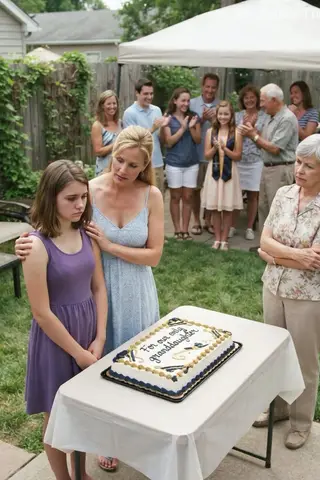
 She Thought Her Grandparents Were Just Forgetful. Then She Walked Into the Backyard and Saw the Cake That Broke Everything
Chapter 3
The Inheritance of Silence
The drive home was suffocatingly quiet. Marcus kept his eyes straight ahead on the asphalt, his jaw clenched so tightly the muscle ticked visibly. In the backseat, Mia stared out the window, her reflection ghosting against the glass as suburban houses blurred past like forgotten memories. I gripped the steering wheel with both hands, my knuckles turning white as the full weight of what had just happened settled over us.
For years, I had justified my parents' behavior under the guise of family harmony. “That’s just how they are,” I would tell myself whenever they missed a birthday or ignored an achievement. I had accepted the crumbs they tossed my way, convincing myself that keeping the peace was more important than standing up for my own dignity. But watching my brilliant, compassionate daughter humiliated on what should have been her day of glory burned away every last excuse I had left.
“We’re not doing this again,” I finally said, the words cutting through the heavy silence of the car like a razor.
Mia turned her head slowly from the window, looking at me with a soft, melancholic understanding in her eyes. She didn't say a word, but she didn't need to. The unspoken contract of our family dynamic had just been shredded.
When we walked through our front door, the house felt different—sanctuary-like, safe, and entirely free of conditional love. But beneath my calm exterior, a strategic fire was burning. My parents' house—the sprawling, two-story colonial where I had grown up—had originally belonged to my maternal grandmother. When she passed away decades ago, she left the property divided equally among her three children: my mother, my uncle, and me. One-third each.
Yet, for as long as I could remember, my mother treated my legal ownership as a joke. Whenever financial discussions arose, she would wave her hand dismissively and refer to my share as “technical.” Nothing real. Nothing I should ever dream of exercising or making an issue of. Whenever I brought it up, she would guilt-trip me into submission, weaponizing family loyalty to keep me tethered to her control.
That night, peace stopped being the goal. Justice was.
I sat down at the dining room table with Marcus, laying out the legal reality of the property deed. Marcus, possessing a cool, analytical mind and a deep well of protective fury, pulled out his laptop. “If you own one-third of that estate, you have every legal right to force a partition sale,” he explained calmly, his fingers flying across the keyboard. “They can’t ignore a legal demand forever, and if they refuse to buy you out at market value, the court forces the sale of the house.”
Working together through the evening hours, Marcus drafted a letter. It wasn't emotional, angry, or vindictive in its tone. It was calm, polite, precise, and legally bulletproof. It stated clearly that as a one-third owner of the grandmother’s estate, I was exercising my right to liquidate my assets.
I read through the final draft twice. Every word felt like dropping an anchor into deep water. I signed my name at the bottom with a steady, unhesitating hand. The era of keeping the peace at the expense of my daughter’s soul was officially over.
The End









