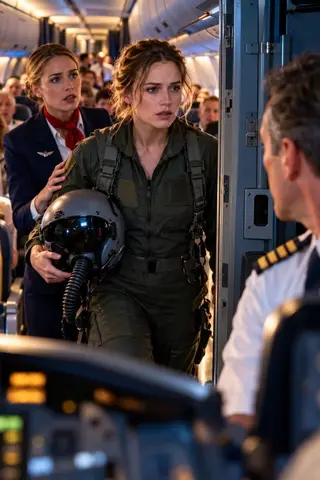
 SHE SWORE SHE'D NEVER FLY AGAIN: Why This Ex-Fighter Pilot In Seat 12A Is The Only Reason 300 Passengers Are Still Alive!
Chapter 1
The Ghost of the Skies
The heavy steel door of the Boeing 777 sealed shut with a soft hydraulic hiss, plunging the cabin into a thick, artificial twilight. Outside, the rain lashed against the windows of Minneapolis-Saint Paul International Airport, blurring the ground crew into colorful smudges. Flight 842 was bound for Madrid, a seven-hour journey across the black expanse of the Atlantic Ocean. For most of the three hundred souls on board, it was a routine transatlantic hop—a chance to sleep, watch a movie, or dream about European cobblestone streets.
For Caroline Miller, however, it was an escape.
Seated in 12A, a window seat near the front of economy class, Caroline pulled a charcoal-gray wool blanket tight around her shoulders. She wore a faded green sweater, her dark hair tied back in a loose, practical ponytail devoid of styling products. Her hands, resting in her lap, were bare of jewelry save for a single, worn silver band on her left ring finger—not a wedding ring, but a memorial. To the elderly couple across the aisle, she was just another tired traveler nursing a paper cup of water. To the college students two rows back, absorbed in their smartphones, she was invisible.
That was precisely how she wanted it.
Five years ago, Caroline’s world had been measured in Mach numbers, G-force tolerances, and the deafening roar of Pratt & Whitney F100 engines. As a decorated Captain in the United States Air Force, she had pushed F-16 Fighting Falcons to their absolute limits, navigating through hostile airspace and executing precision maneuvers that tested human endurance to the breaking point. She had lived in a universe of adrenaline, split-second decisions, and absolute clarity.
Then came the deployment over the Horn of Africa. A routine escort mission gone catastrophically wrong. A rogue missile system, bad intelligence, and a burning wingman that she couldn't save.
The military called it an unavoidable tragedy. Caroline called it her failure.
When she handed in her wings, she didn't just leave the Air Force; she exiled herself from the sky. She traded the cockpit for a quiet life in Minnesota, working as a remote data analyst for a logistics firm—a job where human lives never hung in the balance of her keystrokes. She stopped watching the news. She avoided air shows. She built an impenetrable wall of ordinary routine around her shattered confidence.
Flight 842 was supposed to be a simple vacation to visit her sister in Spain, her first time stepping onto a commercial airliner in six years. She had carefully chosen seat 12A because it offered a wall to lean against and minimal interaction with the rest of the world.
As the giant aircraft taxied toward the runway, the cabin lights dimmed completely. The engines spooled up with a rising, subterranean howl that vibrated right through the aluminum frame and into Caroline’s bones. Every instinct honed by a decade of military training flared to life. Her shoulders stiffened. Her eyes scanned the cabin lights, registering the safety exits, calculating the takeoff vector.
Stop it, she told herself, pressing her fingernails into her palms. You're a passenger. Just a passenger.
The plane surged forward down the runway, pressing her back into the seat as the wheels left the asphalt and tucked neatly into their wells. Within minutes, they broke through the dense cloud layer, emerging into the cold, silent brilliance of the stratosphere. The moon hung like a silver coin against the velvet blackness of the night sky.
For the first two hours, the flight was uneventful. The dinner carts rattled down the aisles, the scent of chicken and warm rolls drifted through the air, and eventually, the cabin settled into a deep, peaceful slumber. Caroline opened her book—a thick historical biography—and tried to lose herself in the text. But the words blurred together. The rhythmic, hypnotic hum of the dual turbofans acted as a white noise machine, lulling her toward an uneasy sleep.
She was just drifting off when the atmosphere in the cabin shifted. It wasn't turbulence. It was something far more subtle, yet infinitely more terrifying.
The steady drone of the engines flickered. Just for a fraction of a second, the pitch dropped, sputtering with an unnatural, coughing stutter that anyone who had spent time around turbine machinery instantly recognized. A second later, the overhead emergency lights flared amber before stabilizing back to a dim white.
Caroline’s eyes snapped wide open. Her book slipped from her fingers, landing softly on her blanket.
In the cockpit up front, warning systems were screaming in a language only trained aviators could translate. And down the aisle, a panicked flight attendant was already beginning to walk with a terrifying, hurried purpose.
The End









