 SHE SWORE SHE’D NEVER FLY AGAIN
Chapter 3
The Dead Zone
The temperature inside the flight deck had risen noticeably, driven by the strain of overloaded electrical circuits and the sheer panic radiating from the crew. Maya’s fingers hovered over the manual override panel, her tactical mind dissecting the chaotic stream of sensor data with ruthless efficiency.
"We're burning sixty gallons a minute out of the port wing," Maya noted, her voice flat, devoid of fear, operating purely in the zone of high-stakes problem-solving. "If the fuel differential hits critical mass, the outer wing spar will shear under the torsional stress before we even reach the Irish coast."
"And we can't talk to ground control to coordinate an emergency vector," Vance added, his knuckles white as he wrestled with the heavy yoke. "Our VHF and satellite radios are just spitting out white noise. We are completely isolated in the middle of the Atlantic airspace corridor."
"Not completely," Maya corrected softly. She leaned closer to the analog instrument cluster, her eyes tracking the precise needle movements of the backup magnetic compass and the barometric altimeter. "We have eyes, we have hands, and we have physics. Computers are nice when they work, but they make pilots lazy. We’re going back to basics, Colonel."
Vance managed a grim, appreciative smile—a ghost of the confident squadron leader he used to be. "That’s why I prayed your name on that manifest wasn't a coincidence. What’s your first move, Major?"
"First, we kill the phantom loops," Maya ordered. She reached out and deliberately threw three heavy master circuit breakers on the overhead panel, cutting power to the corrupted avionics bays. A chorus of warning chimes died instantly, replaced by an eerie, heavy silence in the cockpit. "Stopping the software bleed. We isolate the flight management system entirely. From this second onward, this Boeing 777 isn't a smart computer network; it’s a heavy glider with two very loud engines attached to the wings."
The First Officer gasped, horrified by the drastic measure. "You just severed our autopilot and flight computer backup completely! How are we supposed to navigate across two thousand miles of open ocean without GPS?"
"Celestial navigation, dead reckoning, and raw tactical vectoring," Maya said smoothly, pulling a small, laminated aviation chart out of her back pocket—a relic from her personal flight bag that she had inexplicably packed into her carry-on bag out of sheer habit. She unfolded it across her knees. "I’ve got the star Polaris off our port quarter, adjusted for our current latitude and drift angle. We aren't flying by digital waypoints anymore; we're flying by the stars, just like the old transatlantic mail pilots used to do."
Vance nodded in absolute sync. "She's right. Keep your eyes on the artificial horizon backup and match my pitch. Maya, take the throttles. Balance that fuel flow manually using the emergency mechanical valves located behind the center console."
Maya didn't hesitate. She reached down, unclipped the manual mechanical cable housing for the port fuel valve, and began pulling back with steady, calculated pressure. It required physical strength—muscles she hadn't flexed in years burning with immediate fatigue as she fought against the high-pressure hydraulic resistance of the massive airliner's fuel system.
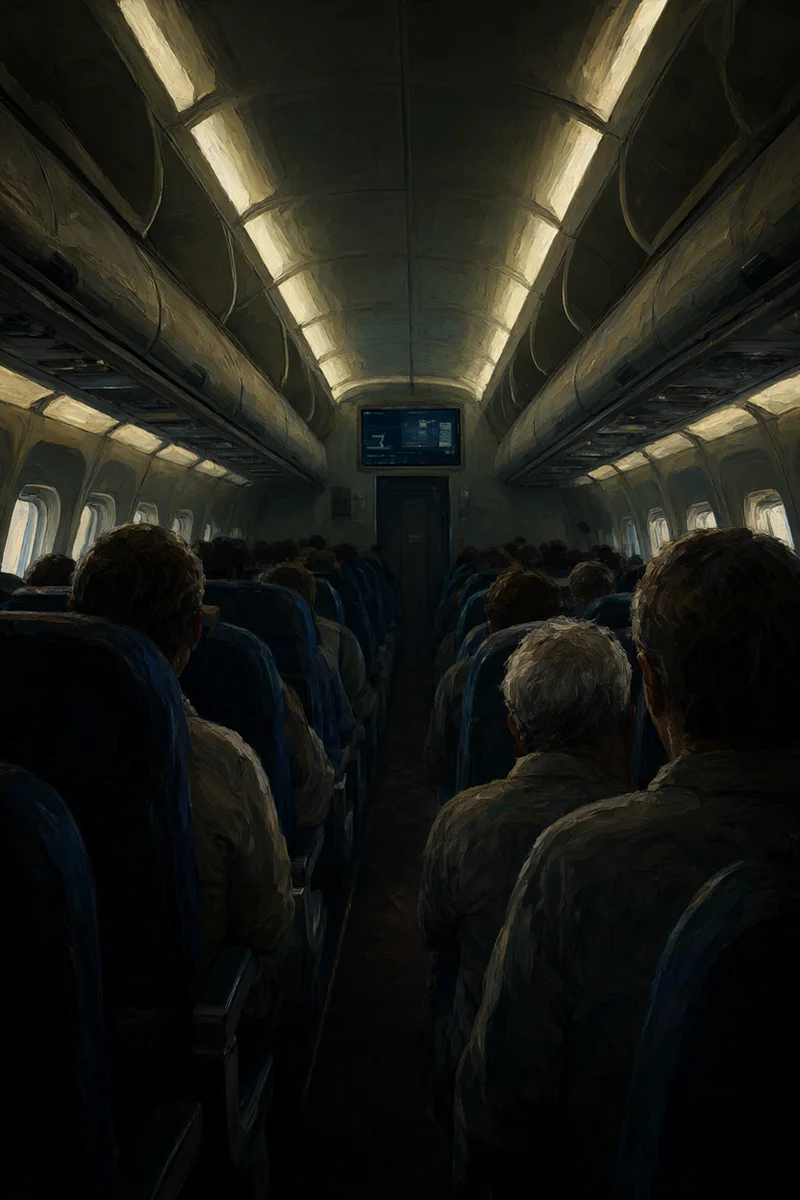
For five agonizing minutes, the cockpit was a symphony of intense physical labor and hyper-focused concentration. Maya's breath came in slow, measured rhythms, blocking out the background anxiety of the three hundred sleeping passengers just feet away on the other side of the reinforced door.
"Fuel imbalance stabilizing," Maya reported, sweat trickling down her temple as she locked the manual valve into a secure intermediate position. "Port and starboard wing weights are within tolerance. The airframe isn't going to snap in half."
"Good work," Vance breathed, wiping his brow with the back of his sleeve. "Now, look at the weather radar backup screen. We aren't out of the woods yet. There's a massive, unforecasted low-pressure storm cell building directly ahead of our flight path—a squall line packing severe turbulence and severe icing conditions right over our emergency diversion corridor."
Maya squinted at the flickering green sweep of the analog weather radar scope. A dense, angry cluster of crimson and purple precipitation blobs spanned across the entire forward sector, stretching from thirty thousand feet all the way up to forty-five thousand feet. There was no flying around it without burning critical fuel reserves they simply didn't have.
"We have to punch straight through the heart of it," Maya said, her voice hardening into steel.
The First Officer looked back in sheer terror. "Punch through a severe convective storm cell in a wide-body commercial airliner with manual flight controls and no active stabilization computers?! Are you insane? We'll lose our control surfaces!"
"If we go around it, we flame out over the ocean before landfall," Maya countered fiercely, turning her piercing gaze toward the First Officer. "If we go through it, we trust the aerodynamics of the aircraft and the hands on the yoke. Trust me, gentlemen. I’ve flown through worse weather over the Hindu Kush with half an engine shot out. This is just water and wind."
Vance locked eyes with Maya for a fraction of a second, reading the absolute, unshakeable competence shining in her gaze. He made his executive decision.
"You heard the major," Vance commanded, his voice ringing with absolute authority. "Configuring for severe turbulence penetration. Landing lights on, anti-ice systems engaged manually, engine igniters to continuous. Maya, keep your hands on those throttles. When we hit the wall, I'm going to need you to manage power output to counter every single gust shear."
Maya clicked her aviation headset secure, her heart rate settling into the cool, icy rhythm of combat mode. She looked out the reinforced windshield into the ink-black abyss of the Atlantic night.
In the distance, the first jagged forks of violent blue lightning began to tear across the horizon, illuminating the towering walls of the approaching storm cell. Flight 402 was diving headfirst into the dead zone.
The End









