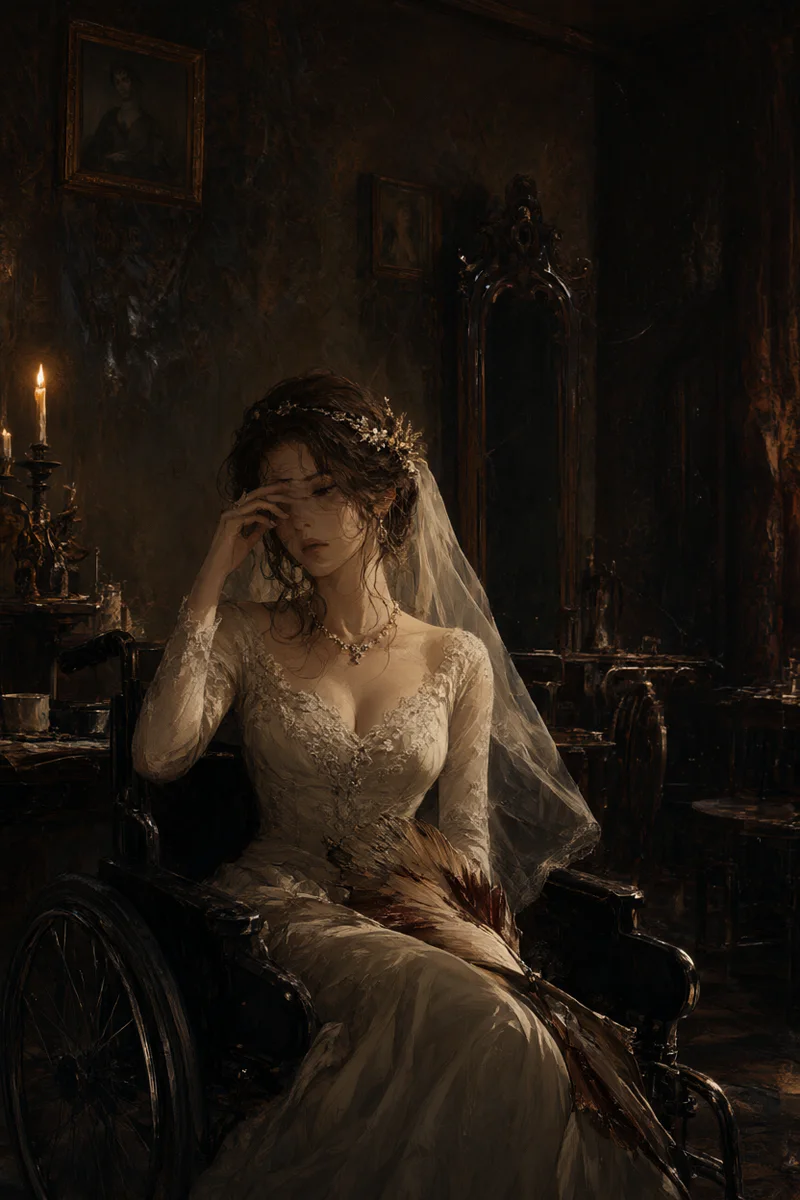
 She Saved Her Little Sister From a Fire and Ended Up in a Wheelchair
Chapter 1
The Smoke and the Shadow
The memories of the fire did not fade with time; they simply changed shape, lingering like soot settled deep in the grain of old timber. To understand the coldness in the air at St. Jude’s Episcopal Church in Charleston, South Carolina, one had to go back nineteen years, to a night when the world smelled of burning paint, melting plastic, and suffocating terror. I was ten years old when our family home caught fire in the dead of winter. My little sister, Emily, was just three.
I can still feel the intense, roaring heat of that hallway, the way the ceiling beams groaned before giving way, and the terrifying wall of black smoke that blocked the stairs. My parents had already made it outside, screaming my name and Emily’s name from the freezing lawn, panicked and helpless. But Emily was trapped in the upstairs nursery, crying out for me.
Without thinking—because a ten-year-old child does not calculate survival, she only knows love—I ran back inside. I crawled on my hands and knees through choking clouds of black poison, my skin blistering as the ambient temperature soared past anything a human body should endure. I found Emily huddled beneath a heavy velvet curtain, clutching her stuffed rabbit, coughing violently and slipping into unconsciousness.
I didn't hesitate. I pulled off my heavy winter jacket, wrapped it tightly around her face and small body, and curled entirely over her. As the ceiling began to collapse, raining burning embers down upon my back, legs, and face, I dragged us both toward the window and down the emergency ladder that a neighbor had thrown up against the side of the house.
Emily walked away from that inferno with a single, faint pink line near her right shoulder—a tiny reminder of a night that should have claimed us both. Her lungs remained clear because mine had inhaled the bulk of the superheated toxic air.
As for me? I spent the next year in a burn unit undergoing skin grafts, surgeries, and agonizing physical therapy. The doctors saved my life, but they could not restore my mobility or my previous face. The scars climbed my arms, crossed my neck and back, ran down my legs, and covered half my face in thick, tight tissue that pulled at my skin. By the time I turned twenty-nine, my legs could no longer bear my weight for long stretches, confining me to a wheelchair, while my hands lived inside thin ivory gloves designed to protect my fragile grafts from irritation.
Yet, as I sat in the second row of the church on that sunlit Saturday morning, watching the white roses sway gently in the breeze from the open oak doors, none of my physical pain hurt half as much as the look in my sister’s eyes.
Emily Whitmore was twenty-two now, radiant, wealthy, and marrying into one of Charleston’s most prominent families. Her pearl-white wedding dress fit her like a glove of seafoam and cream, sparkling under the stained-glass sunlight. Every detail of the ceremony had been curated to absolute perfection—the florist had flown in white roses from Ecuador, the string quartet played classical masterpieces with practiced precision, and the guest list was filled with local elites, socialites, and wealthy business partners.
And there I was, parked awkwardly at the edge of the second row, my wheelchair angled away from the center aisle to keep my scarred profile from drawing immediate gasps from the arriving guests. People tried not to stare, of course. Some were polite about it, offering quick, sympathetic glances before looking away. Others lingered, their eyes tracing the jagged texture of my cheek and neck with morbid fascination.
I had spent my entire adolescence hiding in the background, making myself small, ensuring that my survival never felt like a burden to my parents, Linda and Mark. They had done their best, providing medical care and paying for surgeries, but as the years went on, a quiet, unspoken resentment had settled into our household. My scars were a living, breathing monument to a tragedy they preferred to forget. To them, I was a walking reminder of a past they wanted to bury under social status, country club memberships, and charity galas.
And now, it was Emily’s big day. The day she became Mrs. Daniel Callahan.
Before the processional music reached its crescendo, Emily walked down the aisle alone for a quick final check before the official grand entrance. She was smiling brightly for the hidden wedding photographer, her veil trailing behind her like sea foam. But when she reached my row, her stride faltered.
The bright, practiced smile remained frozen on her painted lips, but her eyes—those eyes I had looked into while carrying her through the smoke—went completely cold.
She leaned down, pretending to adjust her bouquet or whisper a sweet sisterly secret, bringing her face close enough that anyone in the pews would assume she was expressing deep familial affection.
Instead, her voice was a sharp, venomous hiss.
"Go sit in the back," she whispered, her teeth clenched behind her smile.
For a heartbeat, I thought the sound of the organ had distorted her words. I stared up at her, blinking against the sudden sting in my chest.
"What?" I murmured softly.
"You heard me," she snapped under her breath, her gaze darting anxiously toward the back of the church where Daniel’s family sat. "You’re ruining the atmosphere and the perfect image of my wedding. Look at you. People are staring. Just take your chair to the very last row behind the pillars where nobody can see you."
My throat tightened, closing up as if I were back in that burning hallway. The irony hit me with crushing force: nineteen years ago, my body had acted as a human shield to save her from turning to ash. Today, my body was an inconvenience she wanted swept under the rug because it didn't match the aesthetic of her luxury wedding.
"Emily..." I started, my voice trembling.
"Don't start," she interrupted, her eyes flashing with anger. "You’re being too much, as always. Just move."
Behind her, near the altar, our mother Linda suddenly found the floral arrangements on the side altar fascinating, studying them with intense concentration. Our father, Mark, stood rigidly beside her, his jaw locked hard, staring straight ahead at the brass cross. Neither of them moved a muscle. Neither of them uttered a single word to defend their eldest daughter—the one who traded her youth, her face, and her physical health so that Emily could grow up to wear a pearl-white gown.
A heavy, suffocating silence seemed to settle over the front rows, broken only by the low, gentle murmur of the string quartet warming up near the loft. I looked from my mother’s averted eyes to my father’s stony profile, and finally back to Emily, whose foot was tapping impatiently against the marble floor.
I wanted to ask her when my scars had transformed from a badge of survival into something she needed hidden from society. I wanted to ask her when aesthetic perfection became more sacred than the sister who had crawled through hell to keep her alive.
But I didn't scream. I didn't cause a scene in front of Charleston’s high society. I simply lowered my gaze, blinking back the hot tears stinging my eyes, and reached out to place my hands on the rubber rims of my wheels.
If my own sister wanted me hidden away in the darkest corner of the church, out of sight and out of mind, I would go. I wasn't going to beg for a place beside her. I wasn't going to let her see me break.
Just as my fingers tightened around the wheels, ready to spin the chair backward down the side aisle toward the shadows behind the stone pillars, a sharp movement from the front row arrested my motion.
Margaret Callahan rose from her seat.
She was Daniel’s mother—a matriarch known throughout South Carolina for her immense wealth, her sharp tongue, and her unyielding elegance. Dressed immaculately in a floor-length gown of deep green silk that caught the stained-glass light, she didn't make a sound, didn't wave for attention, and didn't raise her voice.
She simply stood. And in that church, that was more than enough to make the world stop turning.
The organist abruptly stopped mid-note. The murmurs of the guests died out instantly.
Emily froze, her smile slipping entirely from her face as she turned around to face her future mother-in-law. Daniel, standing near the altar in his tailored tuxedo, turned around with an expression of pure confusion, looking back and forth between his mother, his bride, and me.
Margaret’s cool, piercing gaze swept slowly across the aisle. It passed over my silent parents, whose faces drained of color. It lingered for a long, heavy moment on Emily, who looked suddenly small and terrified beneath the older woman's scrutiny.
Finally, Margaret’s eyes locked onto mine. There was no pity in her expression—only a fierce, unshakeable dignity.
She turned her head back toward the bride, her chin lifted high.
Then, Margaret opened her mouth and delivered five words that froze the entire room, shattering the illusion of Emily’s perfect wedding in a single breath.
The End









