 She Paid Their $100K Mortgage for 3 Years
Chapter 7
The Open House
Two weeks later, the "For Sale" sign stood proudly on the front lawn of the Oak Park house.
The neatly painted white post and red lettering sliced through the autumn landscape like a declaration of war. Neighbors had stared in open-mouthed shock when the real estate agents rolled up in their branded SUVs. Word travels fast in upscale Chicago suburbs, and within forty-eight hours, the entire block knew that the Walsh family—the picture of suburban middle-class stability—was being ousted from their home.
I hadn't set foot inside the house since the morning I found the unopened mail on my father's desk. But on a crisp Saturday afternoon, I drove out to Oak Park to meet Mark Jenkins and oversee the preliminary open house walkthrough.
As I pulled my car to the curb, I noticed Trevor’s black BMW was missing from the driveway. Apparently, my brother had finally been forced to drive his luxury vehicle somewhere other than his bedroom window, likely crashing on a college buddy's futon in the city.
Mark was waiting on the front porch, holding a leather binder and a clipboard. He tipped his hat as I walked up the stone pathway.
"Everything's set for the 2:00 p.m. public slot," Mark said, checking his watch. "The staging company came in yesterday and cleared out most of the personalized family clutter. We've got three competing agent previews scheduled before the weekend crowd rolls in."
"Good," I replied, stepping past him through the front door.
The interior looked entirely different. The mantelpiece was bare of the cropped family photographs. The walls had been repainted in a neutral, modern off-white, erasing the dated floral wallpaper my mother had stubbornly insisted on keeping for a decade. It no longer felt like my childhood home. It felt like a pristine, high-value asset ready for market liquidity.
As Mark and I walked through the kitchen, the front door suddenly swung open.
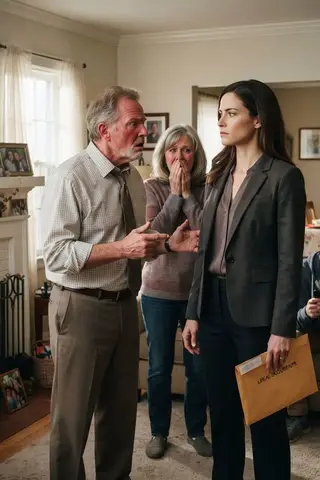
I turned around to see my father standing in the entryway. He looked haggard, his suit unpressed, carrying a cardboard box filled with loose files and old photo albums. He had apparently returned to grab the last of his personal belongings before the official eviction window closed next week.
Gerald froze when he saw me standing by the marble kitchen island. His eyes darted to Mark, then back to me. A bitter, defeated scowl twisted his features.
"Are you happy now?" Gerald muttered, his voice shaking with suppressed rage as he set the cardboard box down with a dull thud. "You're turning our lives upside down over a stupid text message. You're selling the house out from under your own flesh and blood."
I didn't flinch. I kept my expression completely neutral, the same expression I used when restructuring a failing corporate subsidiary.
"I'm not selling the house over a text message, Dad," I replied calmly, walking slowly toward the kitchen island. "I'm selling the house because I finally woke up and realized I was funding a lifestyle for people who didn't even consider me part of the family. The text message was just the notification bell."
Gerald stepped forward, his fists clenched at his sides. "We were your family! We raised you!"
"And I kept you out of foreclosure for three years," I shot back, my voice cutting through the quiet room like a scalpel. "I gave you one hundred thousand dollars of my own money, plus a down payment, plus property taxes, while you sat around pretending you were still a successful real estate broker. You didn't respect me, Dad. You respected my bank account. And now, my bank account is closed."
Gerald stared at me, his chest heaving, searching desperately for some emotional lever to pull—some piece of guilt to weaponize against me. But for the first time in his life, he found nothing. The well had run completely dry.
"You'll regret this, Audrey," he whispered, his voice cracking with bitter malice. "When you're old, and you're alone, and you don't have anyone left... you'll realize what you threw away for money."
"Money is just an asset, Dad," I replied smoothly, turning my back on him and looking out the back window toward the empty yard. "And right now, this asset is performing much better on the open market than it ever did in your hands."
Gerald let out a harsh, defeated sound, grabbed his cardboard box, and stormed out the back door, slamming it shut behind him.
Mark cleared his throat awkwardly. "Well. That could have gone worse."
"That," I said, looking around the bright, sunlit kitchen, "was the sound of closure."
The End









