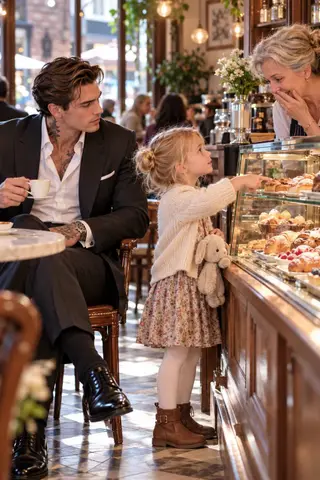
 She Offered 26 Cents for Cookie Crumbs in the North End
Chapter 1
TWENTY-SIX CENTS
Excuse me, ma'am. Could I please have the crumbs?
Mrs. Russo almost missed it. The bell over the door had rung twice already that morning, the espresso machine was hissing, and the voice came from somewhere below the register, small enough to be mistaken for the radio. She set her towel down and leaned over the pastry case.
A girl stood on the other side of the glass. Five, maybe six. A pink coat two sizes too big, the cuffs frayed where small fingers had worried the thread loose. Her hair was pulled back in a ponytail that had given up somewhere around the left ear. Her sneakers had been white once, a long time ago.
"Honey," Mrs. Russo said. "What did you say?"
The girl lifted her chin, the way a child does when she has practiced a sentence on the walk over and intends to get it right. "The crumbs. The ones at the bottom of the tray. When the cookies are gone." She swallowed. "Could I have those? I have twenty-six cents."
She opened her fist. Three pennies, a dime, two nickels, and three more pennies, pressed into her palm and warm from being held all morning.
Tuesday in late October, and the North End was quiet the way it only gets after rain. Steam curled off the espresso machine. Outside, the brick street shone. Two men in work boots argued about the Patriots at a table by the window, and nobody in the café was looking at the little girl.
Nobody except the man in the corner.
Adrian Romano sat with his back to the wall, the way his father had taught him when he was seven years old. Thirty-six, charcoal coat folded over the chair beside him, a white cup of espresso in front of him going cold. He came here because Mrs. Russo had known his father and never asked him a single question, and because for twenty minutes a morning a man in his position could sit in a room and be nobody at all.
Mrs. Russo leaned closer. "Sweetheart. Why do you want the crumbs?"
The girl's eyes flicked to the cookies and away again, as if looking too long at something you couldn't afford was bad manners. "They're for my mama. She's sick. She didn't eat yesterday." Her voice stayed steady. She had clearly thought this part through. "I thought if I brought her something sweet, maybe she'd eat today."
Mrs. Russo's mouth opened and closed. She pressed one hand flat against her chest.
From the corner, Adrian lifted two fingers off the table. Barely a gesture. Mrs. Russo had served him for twenty years; she caught it.
"You know what, sweetheart?" she said, blinking hard. "We just pulled a fresh tray out. Let me pack you a whole box. On the house."
The girl's eyes went wide, then narrow with suspicion. "But I only have twenty-six cents."
"Keep your money," Mrs. Russo said. "Breakfast is on the gentleman in the corner."
The girl turned. Slowly, the way you turn toward a kindness you have not yet decided to believe in. Adrian did not smile. He nodded once, the small nod of a man accustomed to being obeyed without a sound, and looked back down at his cup.
Mrs. Russo was already moving. Tongs clicking, wax paper rustling, warm cookies lifted from the tray and stacked into a white cardboard box. Butter and sugar and almond rose into the air and stayed there.
"Chocolate chip, or almond?" she asked.
"Both?" the girl whispered, as though both were greedy.
"Both it is." Mrs. Russo folded the flaps, tied the box with thin red string, and set it on the counter at the child's eye level. The box was almost the size of her chest.
"Now you tell your mama Mrs. Russo made those this morning, and she's to eat two before she touches anything else. Promise?"
"I promise." The girl pushed up onto her toes and reached with both hands, palms open, lifting the box the way other children lift kittens.
Her sleeve slid back.
Adrian saw the chain before he understood why his body had gone quiet. Not a bracelet. A bracelet would have been thicker, prouder, something a jeweler made. This was a child's chain, delicate, the clasp worn thin from twenty years of being taken off and put back on. And hanging from it, small enough to disappear in a palm, a six-pointed silver star, hollow at the center, with a chip missing from the lower left point.
The cup stopped halfway to his mouth.
In the silence of the café, between the hiss of the steam wand and the distant whine of a delivery truck on Salem Street, Adrian felt the blood leave his face. He didn't drop his cup. He didn't stand up. He simply sat there, staring at a little girl's wrist, while every ghost he had buried in the winter of 2001 clawed its way back through the floorboards.
"Hey," Mrs. Russo said softly, leaning over the counter as the door chimed and the girl slipped back out into the gray Boston morning. "You okay, Adrian? You look like you just saw a ghost."
Adrian stood up so fast his chair legs shrieked against the tile. He reached for his charcoal coat, his movements mechanical, precise, and terrifyingly cold.
"Keep the espresso, Maria," he said, his voice dropping into that low, flat register that made even veteran capos check their weapons. "And don't ever let anyone else look at that girl."
The End









