 She Mocked Her Niece’s Crooked Haircut Online
Chapter 2
The Trap of the Golden Child
The memory of the previous afternoon rushed back into my mind with crystal clarity. Courtney had called me around lunchtime on Friday, her voice dripping with an unnatural, sugary sweetness that should have immediately set off alarm bells in my head.
“Hey, Sarah! I’ve got a massive opening in my schedule today,” Courtney had chirped into the phone. “Why don’t you let me take June off your hands for a couple of hours? Bring her down to the salon. I’ll give her a cute little trim, make both my nieces look amazing for the weekend. It’s on me, sister discount!”
At the time, I had felt a momentary flash of warmth. Courtney was notoriously self-absorbed, rarely offering to spend quality time with June unless it served her own image on social media. But I thought to myself, Maybe she’s trying to be a better aunt. Maybe she wants to bond with June.
I had agreed immediately. June had been thrilled. She loved going into the city, loved the idea of sitting in a real salon chair like an adult, and she completely idolized her glamorous aunt Courtney, who always drove a luxury SUV and posted pictures of exotic vacations.
When I picked June up two hours later, the damage was already done. Courtney had wrapped a vibrant pink cape around June’s shoulders and was standing behind her, clapping her hands together enthusiastically.
“Look at my little fashion icon!” Courtney had declared loudly, drawing the attention of the other stylists and clients in the chic downtown salon.
At first glance, because Courtney was talking so fast and projecting so much unearned confidence, my eyes were tricked. But as June turned around to hug me, I saw it clearly. Her bangs were hacked completely crooked, slanting sharply across her forehead like a jagged staircase. One side of her layers was three inches shorter than the other, hacked away with what looked like kitchen shears rather than professional thinning scissors. It didn't look like a haircut; it looked like an accident at a DIY summer camp.
Yet, June hadn’t seen the disaster. She had looked in the full-length mirror, trusted her aunt’s enthusiastic applause, and believed every single word.
“Do you love it, sweetie?” I had asked hesitantly, kneeling down to look at my daughter.
Before June could answer, my mother—who had apparently dropped by the salon to supervise—had chimed in with effusive praise. “Oh, it’s so edgy! Very modern European runway, Courtney! You’re a genius with the scissors. June, honey, you look like a little model.”
June had beamed. Her chest puffed out with pride. She wore that lopsided, botched haircut out of the salon with her head held high, genuinely believing she was the most fashionable girl in town.
And then, less than twenty-four hours later, the very same women who had clapped in her face had published her image online as the punchline of a cruel joke. They had stripped away her dignity for a few cheap social media laughs, transforming her innocent trust into public humiliation.
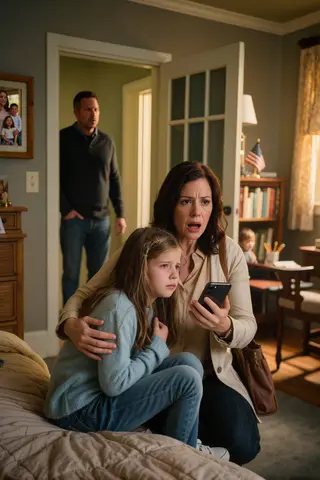
Sitting on the edge of the bed now, looking down at the poll on the phone, I felt a heavy, suffocating weight lift from my chest, replaced by something cold, sharp, and absolute. It was clarity.
June shifted against my shoulder, pulling me back from my thoughts. Her small frame trembled as she looked up at me with tear-filled, heartbroken eyes.
“They told me I looked pretty, Mom,” she whispered, her voice cracking painfully. “They smiled right at me in the mirror. They high-fived me.”
She paused, swallowing hard as a fresh tear spilled over her eyelashes and tracked down her cheek. Then she asked the single question that shattered the remaining fragments of my patience, burning away years of hesitation and forced politeness.
“Why would they say that if they thought I was ugly? Why would they laugh at me behind my back?”
I pulled her tightly against my chest, burying my face in her soft hair as I wrapped my arms around her protectively.
“You listen to me, June,” I said, my voice steady, fierce, and entirely unyielding. “You are beautiful, you are brilliant, and you are loved. What happened today has nothing to do with how you look, and everything to do with how small and cruel other people are. You never, ever have to doubt your worth because of someone else’s ugliness.”
She nodded against my shoulder, her breathing slowly beginning to regulate as the shock of the betrayal started giving way to the comfort of my embrace. But as I held her, my mind raced backward through decades of my own life.
I knew exactly why Courtney had done it. Courtney had been doing variations of this exact psychological warfare to me since we were children growing up in Ohio. Courtney was the golden child—loud, demanding, conventionally attractive, and endlessly enabled by our parents. I was the quiet, studious, sensitive middle child who was always expected to keep the peace, smooth over conflicts, and absorb the collateral damage of Courtney’s endless need for attention.
Whenever Courtney humiliated me or stole something of mine, my mother’s automatic response had always been the same script: “Oh, stop crying, Sarah. You’re just too sensitive. Courtney was only teasing.”
So, I had learned to stay quiet. I learned to swallow my anger, smile through the disrespect, and keep my head down.
Even as an adult, that dynamic had persisted, mutating into something far more financial. When our parents hit financial trouble a few years ago, who stepped up to pay their mortgage installments so they wouldn't lose their house? Me. When their utility bills piled up or they needed emergency car repairs, who wired the money without asking questions? Me.
And when Courtney decided to open her trendy downtown hair salon, who secretly paid the expensive lease deposit when the bank denied her commercial loan? Who bought her high-end styling chairs and covered her payroll during the slow winter months?
Me. I had paid nearly thirty thousand dollars out of my own savings account over the last three years to keep Courtney’s business afloat, all while telling myself that it was just what family did. I told myself that keeping the peace was worth the financial drain because June deserved to have grandparents and cousins who loved her.
But as I sat there in the dark room holding my sobbing daughter, I finally saw the undeniable, sickening truth of my existence.
I had spent years paying a heavy monthly ransom for access to people who didn’t even like us. I was funding the very lifestyle of the people who were currently sitting downstairs—or behind their screens—laughing at my nine-year-old child.
The transaction was over.
The End









