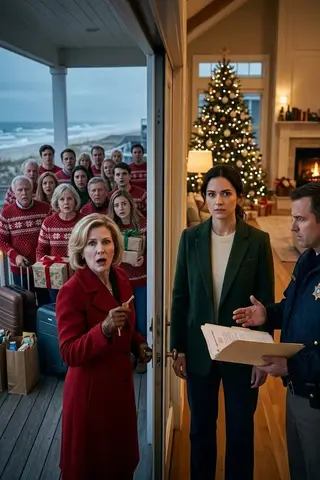
 She Lock Me Out of Christmas for 15 Years
Chapter 1
The Last Unwanted Stocking
The Raleigh apartment smelled perpetually of stale microwave popcorn and winter dampness. I sat on the edge of my sagging mattress, pulling a cheap polyester blanket tighter around my shoulders. Outside, the rain tapped a rhythmic, mocking beat against the windowpane, blurring the neon lights of the convenience store across the street. It was December 24th, exactly 11:43 PM.
My phone buzzed against the nightstand, vibrating with the exact kind of digital torture I inflicted upon myself every single year. A new notification from Instagram. I tapped it, my thumb cold and stiff.
There they were.
The glowing, filtered snapshot of the annual Outer Banks Christmas gala at Grandma Eleanor’s historic oceanfront estate. In the center of the frame stood my mother, Celeste, draped in a cream-colored cashmere wrap, holding a crystal flute of sparkling cider. To her right, my half-sister Hannah flashed a brilliant, professional-grade white smile while pouring vintage Merlot. My aunts, uncles, and cousins crowded the frame, decked out in matching crimson-and-cream holiday sweaters.
Behind them, the massive stone hearth crackled with a roaring fire, flanked by twenty-three meticulously embroidered stockings hanging in a neat, orderly row.
Twenty-three.
Not a single one bore my name. Not a single thread acknowledged my existence.
For fifteen agonizing years, this had been my December ritual. I would sit alone in my four-hundred-square-foot box, chewing on cold takeout pizza, watching my entire bloodline celebrate a holiday built on the deliberate, calculated exclusion of my very soul. They never used the word banned. They were far too sophisticated, too concerned with suburban politeness and public optics, to ever utter anything so crude.
Whenever I dared to ask why I was never invited, the phrasing was always wrapped in velvet poison.
“It’s simply not the right time for you, Ila,” my mother would sigh with practiced, martyr-like sorrow. “You’ve always been so high-strung around large family gatherings.”
Or the classic, weaponized assumption: “We assumed you had plans with your friends. You’re so busy with your little graphic design work.”
And mother’s ultimate masterpiece of psychological gaslighting: “You’re always welcome, honey. You just never come.”
As if an invisible barrier didn’t erect itself every time December rolled around—a barrier reinforced by blocked phone numbers, ignored emails, and unreturned text messages.
My father had died when I was barely three years old. He wasn’t corporate royalty or a pillar of the Outer Banks social scene; he was an impoverished, bohemian oil painter with ink under his fingernails and stardust in his eyes. He was the one dark stain on my mother’s meticulously curated pedigree—a mistake she spent the rest of her life trying to scrub away.
She remarried a wealthy corporate executive three years later, erasing my father as if he had never breathed. But she couldn't erase me. Every time she looked into my face, she saw his eyes—the exact same restless, sea-green shade that refused to conform to her rigid, elitist expectations.
According to Grandma Eleanor, who was the single beacon of truth in that family of phonics, my mother didn’t merely dislike me.
“She hates what you remind her of, sweetheart,” Eleanor had whispered to me one afternoon, squeezing my hand tightly in her weathered palm. “Your father made her feel free, and freedom terrifies women who spend their whole lives building cages.”
Eleanor was the only one who kept a secret line of communication open with me. She would call me on burner phones, slip me cash on my birthdays when she visited Raleigh in secret, and apologize with tears in her eyes for the cruelty of her own daughter.
“Hold on, Ila,” she whispered during our last phone call, just six months before her heart finally gave out. “Just hold on. One day, the tables are going to turn.”
I didn't know what she meant back then. I thought it was just the comforting platitude of a doting grandmother.
Until the phone rang three weeks after her funeral.
The End









