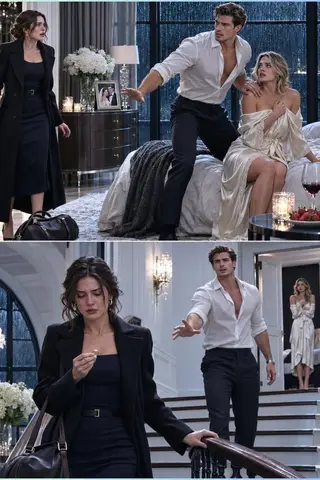
 She Left for a Weekend Conference
Chapter 1
The Nine-Mile U-Turn
The rain did not merely fall over Lake Michigan; it lashed against the reinforced glass of the master bedroom windows like a fist demanding entry. Outside, the night was a bruised purple, swallowed by fog and the relentless downpour that had already turned the interstate north of Chicago into a churning, impassable river.
Hadley Kessler stood frozen on the plush Persian rug, her fingers clamped around the worn leather handle of her overnight bag. The thud of the bag hitting the floor still seemed to echo in the cavernous silence of a house designed for a family that never quite materialized.
Seven years.
Eighty-four months of quiet compromises, unreturned text messages, and late-night conferences that somehow always required Bennett Ashford’s physical presence in the city while his wife drove two hours west to a community health seminar alone.
Sloane Merrick pulled the heavy ivory silk of Hadley’s robe tighter across her chest. Her collarbones, pale and fragile, trembled slightly. Sloane was twenty-eight, six years younger than Hadley, a junior communications director at Bennett’s foundation, and supposedly the bright, ambitious protege who was “learning how to navigate the boardrooms of Chicago philanthropy.”
Right now, sitting on the edge of a custom-built mahogany bed draped in Egyptian cotton, she looked less like a corporate prodigy and more like a thief caught with her hand inside the safe.
“Hadley,” Bennett said again. His voice had lost its initial defensive sharpness, replaced by that smooth, measured baritone he used when negotiating million-dollar grants with hospital trustees. It was the voice that had built Ashford Healthcare into a titan of Midwestern philanthropy. It was also the voice that had systematically dismantled Hadley’s trust over the past three years. “You’re soaked. Let’s go downstairs. We can talk about this like adults.”
“Adults,” Hadley repeated. The word tasted like ash.
She didn’t move. Her trench coat, drenched from the dash between her Audi and the double oak front doors, dripped a small, dark puddle onto the carpet. She couldn’t feel the cold. Her nervous system seemed to have short-circuited the moment she saw Bennett’s thumbs tracing the delicate hollows of Sloane Merrick’s neck.
“You told me you had a dinner with the city councilman at the Union League Club,” Hadley said softly. Her gaze didn’t flicker to Sloane; it locked onto Bennett’s eyes, searching for the man she had married in a limestone chapel outside Evanston when they both still drove dented Hondas and split plates of diner fries. “At six o’clock tonight. You kissed me on the cheek by the kitchen island, told me not to wait up if the weather got bad, and asked if I had enough gas in the SUV.”
Bennett didn’t flinch, but a muscle near his left jaw twitched. “The dinner wrapped up early. Councilman Vance had a family emergency. Sloane called me from her apartment—she was having a severe panic attack, Hadley. You know how fragile she’s been since her brother’s accident. She couldn’t drive. This was the closest safe place.”
“The closest safe place,” Hadley said.
She turned her head slowly, cataloging the room with the clinical detachment she usually reserved for triage reports at the county clinic.
The two crystal wineglasses—Baccarat, a wedding gift from her uncle—holding deep, ruby-red cabernet. The small silver plate holding half a dozen hand-dipped chocolate strawberries, still glistening under the amber glow of the bedside lamps. The three unscented beeswax candles, burned down at least two inches, weeping golden wax onto the mahogany nightstand.
“You must have bought the strawberries on your way home from the councilman’s dinner,” Hadley noted, her tone conversational, almost detached. “Or did you have them delivered? The delivery app doesn’t usually bring artisanal fruit to our zip code in under twenty minutes, Bennett.”
Sloane cleared her throat, her voice small and breathy. “Mr. Ashford didn’t—that is, I brought them. I was keeping them in the office mini-fridge for a donor meeting tomorrow.”
Hadley finally looked at her. Really looked at her.
“Sloane,” Hadley said, her voice dropping an octave, carrying the effortless authority that made junior medical residents stand up straight during morning rounds. “You are wearing my silk robe. The one my sister bought me in Kyoto for my thirtieth birthday. It smells like my sandalwood laundry detergent. Did you bring that in your handbag too?”
Sloane flushed bright crimson, her eyes darting toward Bennett like a trapped animal seeking an exit.
Bennett stepped forward, his massive frame deliberately shielding Sloane from Hadley’s line of sight. It was an instinctive, protective reflex—the exact reflex Hadley had begged him to show when her mother had passed away, when she had spent forty-eight hours straight managing a measles outbreak at the clinic, when she had broken her wrist slipping on the ice outside their garage and had driven herself to emergency because Bennett was “locked in a budget meeting with the state comptroller.”
“Enough, Hadley,” Bennett commanded, his voice hardening into steel. “You are projecting your own insecurities onto a compassionate, professional situation. Sloane is having a mental health crisis. I was comforting a colleague. If you choose to see something sleazy and sordid because you’re bored with your own life, that is your pathology, not mine.”
The silence that followed was absolute.
Even the rain against the glass seemed to hush, waiting for the impact.
Hadley stared at her husband of seven years. She looked at the expensive tailored shirt he had refused to take off, the silver cufflinks engraved with his grandfather’s initials, the smooth, unlined skin of a man who slept eight hours a night while his wife managed three different community health initiatives on four hours of restless sleep.
She didn’t scream. She didn’t throw the wineglasses. She didn’t lunge across the mattress to tear the silk robe from Sloane Merrick’s shaking shoulders.
Instead, a profound, chilling clarity washed over her, sweeping away the last lingering remnants of grief.
“You’re right,” Hadley said quietly.
Bennett blinked, visibly disarmed by her compliance. “What?”
“You’re right, Bennett. I am projecting.” Hadley slowly unbuttoned her sodden trench coat and let it slide off her shoulders, letting it join her overnight bag on the floor. Beneath it, she wore a simple gray cashmere sweater and dark trousers—clothes meant for a conference hotel lobby, not a dramatic confrontation. “I was projecting the delusion that you were a good man.”
She walked past him—not brushing his arm, not giving him the satisfaction of a recoil—and stepped up to the dresser.
Right beside the silver hairbrush her grandmother had given her sat their wedding photograph. In the frame, Hadley was laughing, her head thrown back, sunlight catching the simple gold pendant around her neck. Bennett was looking at her with an expression so fierce and devoted that strangers often stopped them in restaurants to ask how long they had been together.
Hadley picked up the heavy silver frame, turned it face down against the wood, and walked toward the door.
“Where are you going?” Bennett demanded, his voice cracking slightly despite his best efforts to maintain control.
Hadley paused at the threshold, her hand resting on the brass door handle. She didn’t turn around.
“To check into the Four Seasons downtown,” she said, her voice steady and clear. “Unlike Sloane, I actually know how to book my own room when I need a safe place to stay.”
Behind her, Bennett’s phone lit up the dark room with a sharp blue flare, displaying the text message none of them were supposed to see: She wasn’t supposed to be back until Sunday. Did you handle it?
The End









