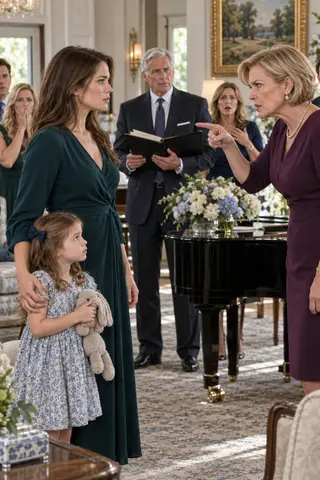
 She kicked her pregnant teen daughter out onto the street
Chapter 2
The Expulsion
The rain had been relentless that night three years ago, drumming a frantic rhythm against the glass of the kitchen window as Sharon pointed a trembling, immaculate finger toward the front door.
"You’re throwing your life away," Sharon had screamed, her voice cutting through the quiet hum of the refrigerator. "Get out."
Clara stood frozen near the kitchen island, her hand instinctively pressing against her flat stomach. She was eleven weeks pregnant, terrified, and utterly alone. The blue pregnancy test stick lay on the counter like a loaded weapon. Sharon hadn't asked who the father was. She hadn't asked if Clara was scared, or how she planned to survive, or if she needed comfort. To Sharon, life was a strict ledger of status, reputation, and control. Pregnancy out of wedlock for an eighteen-year-old girl under her roof wasn't just a personal crisis; it was a public humiliation that threatened the immaculate social standing Sharon had spent decades cultivating in the county.
"Mom, please," Clara had choked out, tears burning her throat. "Just... give me a minute to think. I don't have anywhere to go."
"You should have thought about that before you acted like a common streetwalker," Richard, Clara’s father, had barked from the doorway. He didn't look angry; he looked disgusted, like someone stepping in mud. He walked over to the front door, turned the deadbolt with a loud, heavy click, and pulled it wide open, letting the freezing autumn wind and rain sweep into the warm hallway. He held the door open, his posture rigid and uncompromising.
Clara didn't argue anymore. The coldness in her parents' eyes told her everything she needed to know. Whatever love they had for her was conditional, tethered entirely to her obedience and their image.
She walked upstairs, packed two large black trash bags with her clothes, a few cherished books, and her childhood savings jar containing three hundred and forty-two dollars. As she carried them down the stairs past her parents, neither of them moved to help. Richard merely tilted his head toward the open driveway.
When Clara stepped out into the pouring rain, Mr. Henderson, their next-door neighbor, happened to be pulling his car into his driveway. Shocked by the sight of an eighteen-year-old girl hauling trash bags in a storm, he stepped out under an umbrella, shouting, "Sharon, Richard, what on earth is going on? Let the girl inside!"
Before Clara could say a word, Sharon marched out onto the porch, stepped squarely between Clara and Mr. Henderson, and raised her voice so the entire block could hear.
"She did this to herself, Tom! She’s incorrigible! Don't encourage her rebellious filth!"
Humiliated and shivering, Clara had walked down the long asphalt driveway, her sneakers soaking up puddles with every step. Mr. Henderson looked back and forth between Sharon’s stone-cold expression and Clara’s retreating figure, muttered an oath under his breath, and went back inside his house.
No one called when Clara found a cramped, damp half-duplex two towns away.
No one called when she gave birth alone in a county hospital room, gripping the metal rails while a kind, tired nurse named Brenda held her hand and told her she was brave.
No one came for Millie’s first birthday, or her second, or her third.
Clara learned how to survive through sheer, unyielding willpower. She took a job managing inventory and keeping the books for a local grocery store owned by an elderly couple, Mrs. Gable and her husband, who treated her like family. On weekends, she sat at her small laminate kitchen table after Millie fell asleep, preparing tax returns for local blue-collar workers who couldn't afford big-firm fees. It was exhausting work, but it paid the rent, filled the refrigerator, and bought diapers.
More importantly, it gave her peace. In her small, quiet life, there was no shouting, no polished cruelty, and no conditional affection. Millie grew into a bright, curious toddler with a mop of unruly copper hair and an infectious, gap-toothed laugh. She loved collecting smooth river stones, drawing with chunky crayons, and carrying a small wooden sparrow that a strange, quiet old man had handed to her across the counter at the bakery one Tuesday afternoon.
Clara had no idea who the old man was at first. He wore a faded tweed jacket, his hands were spotted with age, and his eyes—a striking, piercing green—held a deep, sorrowful recognition every time he looked at Millie. He never stayed long, just bought a cinnamon roll, carved a small animal out of scrap wood while sitting in the corner booth, and left it on the table before walking out.
It wasn't until months later, when the old man stopped coming and the local newspaper published an obituary with a familiar, stern-looking photograph, that Clara understood.
It was her grandfather. Arthur Vance.
And according to the quiet whisperings of the town, Arthur had spent the final year of his life searching for the daughter his household had cast out into the dark.
The End









