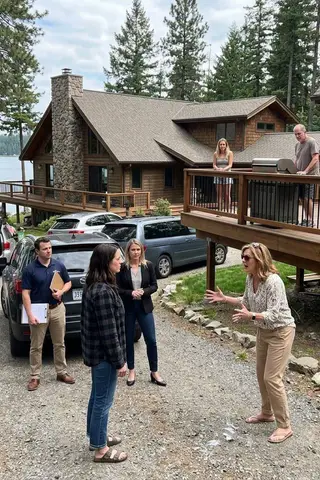
 She Inherited a Ruined Lake House, Fixed Every Inch With Her Own Money
Chapter 1
The Will, The Ruin, and The Promise
The legal scent of aged paper and bitter finality always smelled like cheap carpet cleaner. When my grandfather, Arthur Vance, passed away at the age of eighty-four, the entire family expected his modest estate—most notably the historic lake house sitting just outside Coeur d’Alene, Idaho—to be neatly carved up and divided among his children. My mother, Diane, had already mentally redecorated the master bedroom. My younger sister, Kayla, had already staked a claim on the east-facing deck for her future summer parties.
Instead, the lawyer slid a solitary, crisp envelope across his mahogany desk, bearing my name written in my grandfather’s shaky, deliberate cursive: To Claire.
When the reading of the will concluded, Diane looked like she had swallowed a live wasp. My grandfather had bypassed my mother entirely, citing a lifetime of financial irresponsibility and a distinct lack of respect for his hard work. The deed to the lake house—acres of prime waterfront timber, a rocky shoreline, and a crumbling cabin built entirely with his own calloused hands—belonged exclusively to me.
Along with the legal title, he had left a handwritten note tucked inside the folder. The ink was faded, but the words cut through the silence of the room like a razor:
“Claire, my girl. They only want the fruit, but none of the sweat. Make this place yours before someone else decides what it should be. Don't let them turn my legacy into their playground.”
At twenty-six, I was a junior architectural drafter living in a cramped, drafty one-bedroom condo in downtown Spokane, wrestling with student loans and a mountain of self-doubt. Owning a waterfront property sounded like a dream, but the reality waiting for me on the shores of Lake Coeur d’Alene was an absolute nightmare.
The weekend after the funeral, I drove up to inspect my inheritance. The reality hit me like a physical blow. The roof leaked every time the Pacific Northwest skies opened up, leaving stubborn, moldy water rings across the popcorn ceilings. The wraparound cedar deck had rotted through to the point of being dangerously spongy—you could literally push a screwdriver straight through the floorboards. Inside, the kitchen boasted peeling, avocado-green cabinets straight out of 1978, smelling faintly of decades of old grease and damp mouse nests.
Most people would have sold it as-is. Most people would have taken the easy way out and let a developer bulldoze it for scrap wood. But Arthur Vance had raised me after my father walked out, teaching me how to swing a hammer, how to mix concrete, and how to honor a promise. Standing in that rotting, freezing kitchen with the rain dripping rhythmically onto the linoleum floor, I pressed the folded note against my chest.
“I’ll make it mine, Grandpa,” I whispered to the empty room. “I swear I will.”
That vow cost me six years of my youth, every spare cent in my bank account, and eventually, the very family I thought I loved. I refinanced my condo, took on grueling weekend consulting gigs designing commercial blueprints late into the night, and poured a staggering $67,000 of my own hard-earned money into the resurrection of the cabin.
I oversaw the installation of entirely new plumbing, replacing rusted iron pipes that burst during winter freezes. I replaced every single drafty, single-pane window with double-paned glass that could withstand an Idaho blizzard. Working side-by-side with a local carpenter named Tom, I personally helped rebuild the dock from scratch, hauling heavy cedar pilings out of the icy water until my palms were torn open and wrapped in duct tape.
My masterpiece, however, was the massive stone fireplace in the living room. My grandfather had built it stone by stone in the 1960s, but shifting foundations had caused a massive crack to split the hearth right down the middle. I spent three solid weeks meticulously numbering each stone, clearing away crumbling mortar, resetting the structural support, and piecing the geological puzzle back together with my own hands.
By the time I finished, the lake house was no longer a rotting shack. It was a breathtaking, rustic sanctuary. The cedar smelled fresh and rich; the lake shimmered through crystal-clear glass; the stone hearth radiated a warm, welcoming glow on chilly autumn nights. It was my refuge, my safe haven from a demanding corporate job and a chaotic family.
Or at least, I thought it was. I had no idea that the moment the cabin transformed from an eyesore into a luxury retreat, the vultures were already circling overhead.
The End









