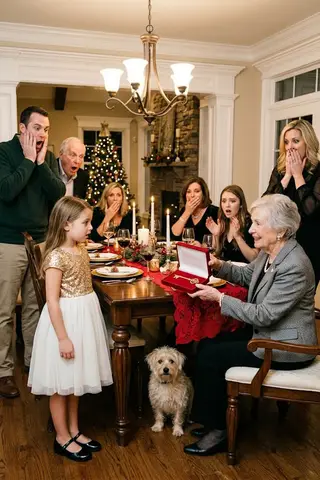
 She Handed My Seven-Year-Old Daughter a Cheap Candle Labeled 'Brandon's Girl' on Christmas Morning. Then My Husband Told Her to Open the Red Box
Chapter 1
The Weight of a Place Card
The silence in Gene’s dining room wasn’t just quiet; it was heavy, suffocating, and weaponized. Every single detail in that room had been curated to project an image of untouchable perfection, from the hand-pressed linen napkins to the antique crystal glasses that caught the pale winter sunlight filtering through the frost-rimmed windows. Gene sat at the head of the table like a queen presiding over a court of fearful subjects, her silver hair styled into an immaculate, hair-sprayed shell that hadn't moved an inch since breakfast preparation began at five o'clock that morning.
For three years, my daughter Holly had been forced to orbit this family like an unwelcome satellite. She was not Gene's biological flesh and blood—she was the child from my first marriage, a chapter of my life that Gene treated as a personal insult to her precious son, Brandon. While Brandon loved Holly with a fierce, unwavering devotion that brought tears to my eyes more often than I cared to admit, Gene viewed children like Holly as temporary inconveniences, stray elements that did not belong in the pure lineage of the family tree.
The morning sun hit the table, illuminating the polished silver place cards. I scanned down the line of glittering names. There was Aunt Beatrice, Uncle Arthur, the loud cousins from Chicago, and Brandon. And right beside Brandon, tucked neatly between a crystal water goblet and a silver fork, was a card written in Gene’s looping, elegant cursive.
It didn't say Holly.
It didn't say Granddaughter.
It simply read: Guest.
Brandon saw it at the exact same moment I did. His jaw clenched so hard I thought the bone might fracture. Beside him, Holly sat with her small hands folded tightly in her lap, wearing the gold dress we had spent hours ironing the night before. She didn't throw a tantrum. She didn't cry. She just stared at the card with a look of profound, heartbreaking resignation that a seven-year-old child should never, ever have to wear on Christmas Day.
Gene cleared her throat, a sharp, bird-like sound designed to draw every eye in the room directly to her. She raised her crystal mimosa glass, her diamond rings flashing under the chandelier. "Well, family," she announced, her voice dripping with artificial sweetness, "I am so blessed to have you all here today. We have so much to celebrate, and I am glad everyone managed to dress appropriately for the occasion."
Her eyes lingered for a fraction of a second on Holly’s gold dress, as if finding a microscopic flaw in the fabric. The subtle dig hung in the air, poisoning the scent of cinnamon rolls and pine needles. Around the table, family members murmured polite agreements, avoiding eye contact with our side of the table like cowards fleeing a crime scene. They knew how Gene operated. Cross her, and you were cut off, erased, banished from the holiday cards, the wills, and the family estate.
Brandon didn't murmur agreement. He didn't smile. Instead, he reached slowly into the deep pocket of his tailored wool trousers, his fingers brushing against something small and hard. I saw the movement from the corner of my eye and remembered the conversation we whispered in the guest room the night before. The red velvet box. The brass key.
Gene had built her entire empire on control, manipulation, and the quiet humiliation of anyone who didn't fit her narrow definition of perfection. She believed her wealth and her name made her invincible. She believed she could treat a seven-year-old child like an unwanted intruder in her home without consequences.
She had no idea that the foundation of her entire life was built on glass, and Brandon was holding the hammer.
The End









