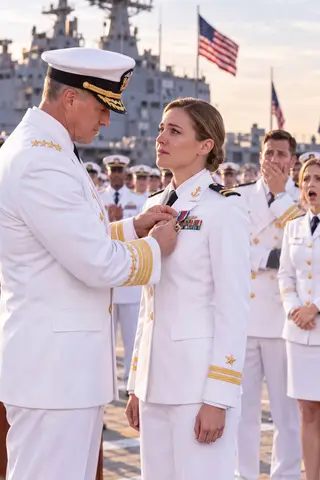
 She Got Demoted For Saving A Stranded Family
Chapter 3
The Bureaucratic Trench
Two weeks in the basement-level logistics bullpen felt like two years in a Siberian labor camp. While the rest of the Atlantic Fleet prepared for upcoming joint-force naval exercises in the Atlantic, my world was reduced to endless rows of serial numbers, pallet counts, and requisition forms.
"Check the inventory code on pallet 44-B," a tired logistics specialist named Petty Officer Davis muttered, sliding a thick binder across my desk. "The supply depot in Portsmouth claims they’re missing twenty cases of hydraulic fluid."
"It’s not missing," I replied without looking up from my screen, my fingers flying across the keyboard. "It was rerouted to Dry Dock 4 last Tuesday under authorization manifest #889-Delta. Tell Portsmouth to check their own receiving dock logs."
Davis sighed, rubbing his tired eyes. "Man, I don't know how you're surviving down here, Lieutenant. Ever since the Captain chewed you out at that morning briefing, the whole base has been whispering."
I paused my typing. "What whispering?"
"Oh, you know how Miller and his circle are," Davis leaned in slightly, lowering his voice. "They’ve been spreading it around that you cracked under pressure during the storm, that you're losing your edge, and that Briggs is looking for an excuse to push you out of the logistics division entirely."
A cold spike of anger hit my chest, but I kept my face neutral. "Let them talk. Gossip doesn't move cargo."
"True, but it hurts your career track," Davis warned sympathetically. "Promotion review board is coming up next month. With a formal reprimand from Briggs stamped permanently in your file, your chances at lieutenant commander are practically zero."
I knew he was right. In the Navy, a black mark from a commanding officer—especially one centered around insubordination and protocol violation—was an anchor tied directly around your ankles. It didn't matter that the rule I broke saved a family from freezing to death on a desolate highway. In the eyes of the career bureaucrats, a rule broken was a character flaw.
Later that afternoon, the tension in the bullpen escalated further when Captain Briggs himself walked down the aisle between our desks. The room went dead silent. Every officer straightened up instantly, eyes locked forward.
Briggs stopped right beside my partition. He didn't look at my screen; he looked down at me with an expression of cold, calculated disappointment.
"Hayes," he said loudly enough for everyone within thirty feet to hear. "I trust the inventory audit is keeping you out of trouble? Remind yourself that military efficiency is built on compliance, not compassion. A soldier who cannot follow small orders cannot be trusted with important ones."
I stood up slowly, coming to attention. "My reports are up to date, Captain. Every pallet is accounted for."
"Good," Briggs sneered slightly, adjusting his cover. "Because the Atlantic Fleet operates on precision, not charity work. Try to remember that before you decide to play neighborhood hero again."
He turned and walked away, his polished shoes clicking sharply against the floor.
Across the aisle, Miller gave me another exaggerated look of pity, shaking his head as if watching a tragedy unfold.
I swallowed the bitter pill of humiliation, keeping my emotions locked down tight behind a stoic facade. I had lived by the Navy’s code my entire adult life. I respected the uniform, the tradition, and the chain of command. But standing there under the harsh lights of the base headquarters, watching men like Briggs weaponize bureaucracy while ordinary people froze on dark highways, something inside me shifted.
I wasn't broken. I was just trapped in a system that valued paperwork more than people.
And little did Captain Briggs know, the consequences of his public humiliation were about to catch up with him in a way no spreadsheet could ever predict.
The End









