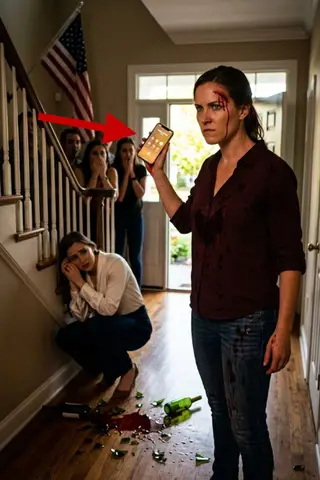
 She drugged my 2-year-old at her cousin's birthday party just because she was "difficult"
Chapter 1
The Weight of Five Lost Years
The June heat hung thick over Maple Drive, smelling of sweet buttercream frosting, warm sunscreen, damp grass, and cheap Pinot Grigio going sour in the afternoon sun. Pink plastic streamers snapped sharply against the white patio railing whenever a stray breeze rolled through the yard, and a small, tinny Bluetooth speaker on the folding food table looped a cheerful children's birthday song that felt entirely too bright for the hollow, fractured reality of the family I had been born into.
From the curb, my sister Natalie’s house looked like an advertisement for suburban perfection. Matching pastel balloons were tightly bound to the mailbox, a row of flawless cupcakes sat under a mesh dome, and a crisp American flag fluttered near the porch. A heavy family SUV sat parked crookedly across the driveway because someone had arrived late and refused to walk an extra fifty feet.
My family had always been exceptionally skilled at decorating around cruelty. They could drape smiling faces, expensive clothes, and polite manners over malice so seamlessly that outsiders would never suspect a thing.
My daughter, Rosie, was two years old. On that Saturday afternoon, she wore a bright yellow sundress with matching white sandals, her tiny sticky hand wrapped tightly around my index finger. Rosie was naturally shy—oversensitive to loud noises, uncomfortable around strangers, and deeply anxious around adults who smiled too hard and spoke in booming, performative voices. To everyone else in my family, she was labeled "difficult." To me, she was my entire world, the hard-won light at the end of a very long, dark tunnel.
Five years of agonizing losses had preceded Rosie’s birth. Five years of endless blood tests, expensive fertility clinic bills, crinkled paper coffee cups in sterile waiting rooms, and trembling in public bathroom stalls before wiping my face clean, walking back onto the office floor, and pretending like my heart wasn't breaking into pieces. When she finally arrived, kicking and screaming into the delivery room, I made a fierce, unshakeable vow to myself: I would never let anyone make her feel like she was too much, too loud, or too burdensome.
Yet, Natalie and my mother had spent her entire short life proving my promise was going to be an uphill battle.
Natalie’s daughter, Autumn, was turning six that Saturday. Throughout the afternoon, my mother had been floating from group to group, telling guests and neighbors how effortlessly "easy" Autumn had always been. Easy to feed. Easy to dress. Easy to show off to the neighbors. Every single time Rosie reached out for me, whimpering at the overwhelming noise of the yard, my mother would let out an exaggerated, public sigh, as if maternal tenderness was the highest form of bad manners.
At precisely 2:17 p.m., my mother leaned in close to me. Her face remained locked in a wide, pleasant smile meant for the surrounding guests, but her voice dropped into an arctic chill meant exclusively for my ears.
"Go get Autumn’s birthday gift out of your trunk before everyone starts gathering for the presents," she commanded.
"I’ll take Rosie with me," I said immediately, starting to stand up from the lawn chair.
My mother’s eyes sharpened into tiny, venomous slits. "Stop acting so neurotic. Natalie will watch her for five minutes. You’re making a scene and embarrassing yourself."
That was the primary psychological trick of my family. They never called neglect by its actual name. They reframed every heartless action as me being overly dramatic, unhinged, or hysterical.
Across the grass, Natalie sat comfortably in a white lawn chair, one ankle crossed lazily over her knee, holding a half-empty glass of Pinot Grigio. She lifted her free hand in a dismissive, lazy wave. "Go ahead. I’ve got her."
I hesitated, a cold knot tightening in my stomach. I crouched down in front of Rosie, gently brushing damp blonde curls away from her hot forehead. "Mommy’s just going to the car and I'll be right back, okay, sweetheart?"
Her tiny bottom lip trembled, but she nodded bravely because she trusted me implicitly. That realization hit me with a fresh wave of guilt even then. I had taught my daughter that Mommy always came back—and in that single moment, I let go of her small, trusting hand.
The End









