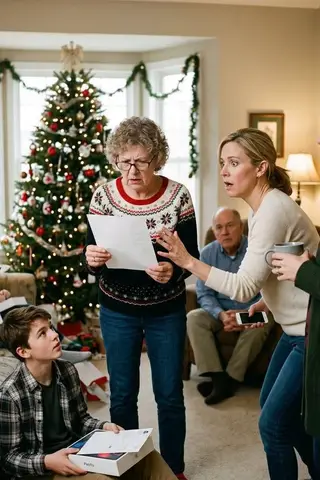
 She Demanded 'Equal Rights' For Her Kids, But Aunt’s Christmas Revenge Left The Whole Family Speechless!
Chapter 1
The Rule of Imbalance
The autumn wind whipped through the oak trees lining our suburban neighborhood, rattling the windowpanes of my kitchen as I stood sorting through a mountain of Tuesday mail. It was an ordinary evening until my phone lit up with my mother’s caller ID flashing aggressively against the screen. I wiped my hands on a dish towel and slid my thumb across the glass, expecting a routine check-in about Sunday dinner or whether I had signed Mason up for his fall soccer league.
Instead, Mom bypassed the pleasantries entirely. Her voice had that tight, brittle quality she only used when she was delivering news she desperately wished she didn't have to carry.
"Olivia, we need to talk about the tablets," she said, her tone clipped and guarded.
I paused, an envelope half-torn in my hand. "What about them, Mom? The ones I bought the kids last week?"
There was a heavy sigh on the other end of the line, the sound of a woman bracing herself for an unnecessary battlefield. "Brooke says her kids feel left out."
A cold spike of irritation flared behind my ribs. Brooke, my younger sister, lived less than ten minutes away in a sprawling, perpetually chaotic house filled with four demanding children and an endless list of financial emergencies. My own household consisted of three children: Mason, Lily, and Grace. A few weeks prior, after a particularly grueling quarter at work, I had used my bonus to buy each of my three kids an iPad. They weren't frivolous status symbols or digital trophies; they were practical tools. Mason needed his digital drawing tablet for his advanced school architecture modules. Lily had just started editing short documentary videos for an after-school media class, and Grace had been squinting at my ancient, dying tablet that barely held a charge long enough to complete her online homework modules.
"They’re my kids’ tablets, Mom," I said, keeping my voice level through sheer willpower. "I bought them with my own money, earned from working sixty hours a week."
"I know, I know," Mom replied, her voice softening into a conciliatory murmur. "You work hard, Olivia, we all know that. But Brooke thinks it creates an imbalance. You have three children, she has four. When you buy expensive electronics for yours and not hers, it sets a bad precedent in the family. It makes her kids feel like second-class citizens."
That word—imbalance—echoed in the quiet of my kitchen, bouncing off the granite countertops and stinging my ears. An imbalance. The irony was so thick it felt physical, choking the air right out of my lungs.
For the past seven years, since Brooke’s husband transitioned through a series of unstable jobs and failed business ventures, my family had been the unofficial safety net for their household. Nobody called it an imbalance when I quietly paid for Ethan’s high school laptop because his parents couldn't scrape together the funds before the semester started. Nobody called it an imbalance when I secretly covered the registration fees and club jerseys for Chloe’s summer volleyball league so she wouldn't have to sit on the bench while her friends played. And nobody ever raised an eyebrow when family vacations or holiday dinners ran hundreds of dollars over budget, and I was the one who quietly stayed behind to settle the bill with my credit card while everyone else packed into their cars and drove home.
I had never asked for a medal. I had never kept a running tally. I had simply helped because they were family, and because I was in a position to do so. But now that my own children—who quietly excelled in school and rarely asked for anything extravagant—finally received something nice through my own labor, apparently the family needed a strict legislative policy.
"So what are you suggesting, Mom?" I asked, staring hard at a junk mail flyer for local carpet cleaning.
Mom cleared her throat, a sure sign of discomfort. "Brooke and I talked about it. We think it’s best to keep things uniform. Either every grandchild gets one, or nobody does. A family rule. That way, nobody feels excluded or resentful."
I glanced across the room. Grace was sitting quietly at the kitchen island, her new iPad propped neatly beside her notebook, her fingers moving steadily across her homework assignment. She looked so peaceful, so content, entirely unaware that her grandmother and aunt were currently conspiring to strip her of the first major gift she had ever truly called her own.
"So you want my kids to return theirs?" I asked, testing the weight of the words.
"I just want everything to feel fair," Mom pleaded, her voice dripping with artificial harmony. "Just bring them back to my house this Saturday. We’ll handle it together."
I could have spent the next hour dismantling her logic, screaming about hypocrisy, and reading out a list of every single financial bailout I had extended to Brooke over the last decade. I could have torn down the fragile illusion of fairness that my mother so desperately clung to. But anger, I realized in that exact moment, was a waste of breath.
"Okay," I said softly.
Mom paused, clearly shocked by how easily I had surrendered. "Okay? Just like that?"
"I heard you, Mom. I’ll see you Saturday."
I hung up the phone without another word. My youngest son, Mason, looked up from his homework, sensing the shift in the atmosphere.
"Who was that, Mom?" he asked, his young eyes narrowing with suspicion.
"Nobody, sweetie," I said, walking over and placing a gentle hand on his shoulder. "Just Grandma talking about family rules. Come on, let's finish up your math. We have an errand to run this weekend."
The End









