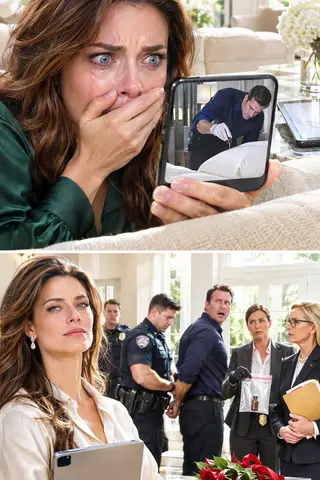
 She Came Home Sick and Hid Behind the Sofa
Chapter 3
The Secret Ledger
The digital clock on my bedside table glowed a stark 2:14 AM in piercing neon red.
I lay wide awake in the center of our king-sized bed, staring up at the ceiling fan lazily spinning overhead. My head was clear, my body strong, and every single sense was heightened to a razor-sharp edge. The poisoned pillow was gone, replaced by a clean, pristine case swapped out by the police forensics unit, but the psychological weight of what had happened in this exact room hung heavily in the air.
Daniel was three states away, sleeping in a luxury hotel paid for by embezzled real estate funds, dreaming of a life where I was buried six feet under and his bank accounts were millions of dollars richer.
Not on my watch.
Quietly, without making a sound, I slipped out from under the duvet, pulled on a dark silk robe, and crept down the stairs. The house was pitch black, save for the faint green glow of the smoke detectors and the digital display on the microwave.
I didn't head for the living room. Instead, I walked past the kitchen, down the short hallway leading to the back of the house, and stopped in front of Daniel’s private home office.
The door was locked. Daniel always kept it locked when he traveled, claiming he kept sensitive real estate deeds and client financial disclosures inside.
He thought he was being secure. He forgot who he married.
From the pocket of my robe, I pulled out a small leather pouch I had retrieved from my desk drawer upstairs—a professional lock-pick set I had confiscated from an insolvent corporate client three years ago during an asset seizure.
I knelt on the plush carpet outside his office door, inserting a slim tension wrench into the bottom of the keyway and sliding a fine rake pick into the top pins. My fingers moved with practiced, mechanical precision. Years of breaking down complex offshore accounts had taught me one thing: locks, passwords, and vaults are all just puzzles built by human minds. And human minds are inherently flawed.
Click.
The internal tumblers gave way with a soft, satisfying snap.
I gently turned the brass doorknob, pushed the door open just enough to slip inside, and pulled it shut behind me, clicking the latch softly into place.
I switched on my phone flashlight, shielding the beam with my hand so it only illuminated a small circle on the floor.
Daniel’s home office was immaculate. A massive mahogany desk dominated the center of the room, flanked by floor-to-ceiling bookshelves lined with leather-bound volumes on property law and urban development. A high-end iMac sat in the center of the desk, its screen dark and sleeping.
I walked straight to the computer. Daniel had left it locked, requiring a password. But Daniel, like ninety percent of arrogant executives, was a creature of lazy habits.
I reached down and plugged my encrypted USB drive—pre-loaded with a brute-force keystroke injector provided by one of our firm’s top cybersecurity specialists—into the side USB port of the iMac.
Blink. Blink. Green.
The script bypassed the login screen in less than four seconds.
The desktop wallpaper flashed onto the monitor: a high-resolution photograph of Daniel and Vanessa standing side-by-side at a charity gala last year, both of them smiling into the camera with an intimacy that went far beyond business partners.
"There you are," I whispered, pulling up a rolling leather chair and sitting down.
I didn't bother looking at his regular documents. I opened the hidden encrypted partition folders tucked deep within the system directory—folders labeled with random administrative strings like sys_cache_backup_99.
Inside was a digital Pandora’s box.
There were financial records detailing massive, systematic embezzlement from Daniel’s real estate firm—skimming funds from investor escrow accounts to fund speculative land buys in Florida. But beneath the corporate fraud files lay something infinitely darker: a dedicated folder titled “Estate Transition.”
I opened it.
Inside were scanned PDF copies of forged life insurance policies naming Daniel as the sole 100% primary beneficiary, totaling over four million dollars. There were medical records—stolen from my own primary care physician’s portal through a compromised login—detailing my routine blood work, noting my susceptibility to chronic migraines and mild anemia.
And then, I found the file that made my blood run cold.
A document titled “Toxicology & Metabolism Study - Compound Alpha-7.”
It was a scientific white paper on a rare, odorless, tasteless botanical alkaloid derived from a South American plant. The paper detailed its exact pharmacological profile: when administered in micro-doses over a period of two weeks, it mimics the exact physiological symptoms of severe chronic fatigue, neurological migraines, and gastrointestinal failure. It causes progressive dizziness, nausea, and cognitive slowing, eventually leading to cardiac arrest that mimics natural causes or accidental poisoning.
And right beneath the PDF was an invoice from an illicit dark-web chemical supplier based in Zurich, showing a purchase order for five vials of Compound Alpha-7 shipped directly to a P.O. box registered under one of Daniel’s shell corporations in downtown Boston.
I stared at the invoice, my chest tightening with a mix of fury and vindication.
He hadn't just improvised. He had planned my murder for over six months, importing lethal compounds across international borders, setting up fake insurance riders, and coordinating every detail with Vanessa Sterling to ensure my death looked like a tragic, natural medical event.
With shaking hands, I plugged my high-speed flash drive into the iMac and initiated a full, mirrored download of the entire hidden partition. Every ledger, every PDF, every dark-web invoice, every incriminating email chain between Daniel and Vanessa copied over in a matter of seconds.
I ejected the drive, slipped it into my pocket, and stood up from the desk.
As I turned to leave the office, something caught my eye on the corner of a side table—a small, silver-framed photograph of Daniel and me on our wedding day twelve years ago in Newport, Rhode Island. In the picture, Daniel was laughing, his arm wrapped tightly around my waist, his eyes shining with what I had believed then was unconditional love.
I walked over, picked up the frame, and stared at the glass reflecting my own cold, resolute face in the dark room.
Then, I set the frame face-down on the table.
"You picked the wrong auditor, Daniel," I whispered into the empty room.
The End









