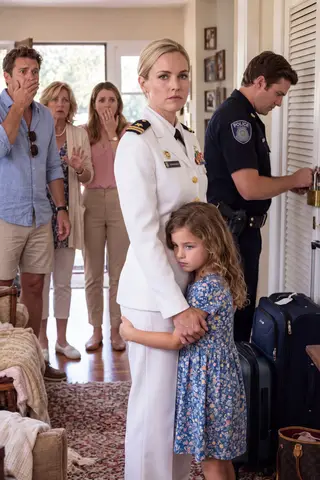
 She Came Home Early from a Work Trip and Found Her 9-Year-Old Scrubbing the Floor Alone
Chapter 2
The Price of Silence
To understand how my life had devolved into this grotesque domestic nightmare, you had to look at the ledger. Literally.
When Brendan and I married four years ago, he came packaged with a crumbling historical home in an upscale neighborhood, an 11-year-old daughter from a failed first marriage, and a mountain of financial debt that would have given a corporate restructuring team nightmares. Brendan fancied himself an artistic entrepreneur, which in practical terms meant he spent his days tinkering with vintage audio equipment in our basement workshop, making zero income, while sinking whatever spare cash he could find into speculative crypto schemes.
His parents, Arthur and Eleanor, weren't doing any better. They had retired on a pension that had long since been eaten away by inflation, and their sprawling suburban home was currently drowning under the crushing weight of a second mortgage they had taken out to bail out my stepson’s previous failed business ventures. When their credit scores cratered and foreclosure notices started arriving in their mailbox like clockwork, Brendan suggested a "family synergy" model.
Translation: Move Arthur and Eleanor into our guest wing, consolidate our households, and let me handle the heavy lifting.
At first, I agreed because I believed in partnership. I was earning a high six-figure salary as a senior acquisitions director for a major logistics firm. I had the financial muscle. When Brendan’s parents moved in, bringing their old-world traditionalism and sharp-tongued opinions with them, I told myself their presence would be good for Evelyn. I thought having grandparents around would enrich her childhood, giving her a sense of deep, generational roots.
Instead, it created a caste system.
In the beginning, the hierarchy was subtle, masked as generational wisdom or harmless family quirks. Amanda, being Brendan’s flesh and blood, was treated like royalty. She was witty, loud, and confident—traits that Eleanor praised as "spirited leadership." When Amanda broke curfew or left her damp towels on the Persian rug in the hallway, Eleanor would laugh it off, calling her a "free spirit."
Evelyn, on the other hand, was my daughter from a previous relationship—a relationship that had ended amicably when her biological father passed away from a sudden aneurysm when she was three. Evelyn was quiet, artistic, deeply empathetic, and prone to introversion. In Eleanor’s rigid, old-school universe, Evelyn’s introversion was interpreted as defectiveness.
“She’s far too sensitive,” Eleanor would announce across the dinner table, stabbing a roast potato with her silver fork as if puncturing an enemy. “You coddle her too much, Claire. A child needs calluses on her soul if she’s going to survive this world.”
Those subtle slights quickly mutated into structural oppression.
Three months ago, Amanda complained that her bedroom upstairs was too drafty during winter storms—even though winter was months away. Without consulting me, Brendan and his parents orchestrated a bedroom shuffle. They moved Evelyn out of the bright, spacious corner bedroom she had decorated with star decals and fairy lights, and shoved her into the tiny, windowless converted linen closet next to the laundry room.
“Amanda needs better sleep for her competitive cheerleading squad,” Brendan had reasoned over coffee, his eyes avoiding mine. “Evelyn won’t care. She’s adaptable.”
At family dinners, Amanda sat at the right hand of Arthur, served first with the prime cuts of meat. Evelyn was assigned the rickety folding chair at the end of the table, constantly corrected on her posture, her table manners, and the volume of her voice. Too loud. Too messy. Too demanding.
Every time I tried to push back, every time I threatened to pack up and set boundaries, Brendan deployed his ultimate emotional shield.
“My mom is just old school,” he would say, placing a heavy, placating hand on my arm. “She means well, Claire. She’s just trying to help shape Evelyn into a strong young woman. You’re overreacting. You always bring your corporate boardroom energy into our family home.”
And every month, without fail, my corporate paycheck kept the lights on.
My salary covered the mortgage on the house where my daughter was being treated like a scullery maid. My salary paid for the groceries that Eleanor cooked into feasts for Amanda and Brendan while Evelyn was fed leftovers at the counter. My salary paid the insurance premiums, the utilities, the gas for the luxury SUV that Arthur used to drive Amanda to her amusement park outings while leaving my nine-year-old behind with a bucket of soapy water.
I looked down at Evelyn, who was now wiping a stray tear from her cheek with the back of her soapy hand, leaving a white streak of foam across her nose. The fog of rationalization that had blinded me for two years burned away in a single, searing second.
I wasn't a partner in a loving blended family. I was the financial sponsor of a cult that worshipped Brendan’s bloodline while treating my child like an indentured servant.
“Go pack your favorite things,” I said, my voice steady, cold, and absolute.
Evelyn stopped scrubbing. Her eyes widened in genuine terror, darting toward the hallway as if expecting Eleanor’s shadow to appear in the doorway.
“Are they going to be mad?” she whispered, her voice trembling.
“Probably,” I said, rising smoothly to my feet.
“Are we in trouble?”
“No, sweetheart,” I said, offering her a calm, reassuring smile that reached my eyes for the first time in months. “We’re not in trouble. We’re leaving.”
She stared at me for a beat, processing the impossibility of the command. Then, a spark of pure, desperate hope ignited in her dark eyes. She dropped the sponge into the dirty water, stood up, and bolted up the stairs toward her tiny linen-closet bedroom as fast as her legs could carry her.
I followed her at a measured pace. I didn't waste time packing lightly. I grabbed her suitcase—the hard-shelled pink one her grandmother had gifted her last Christmas before the favoritism turned toxic—and started tossing in everything that mattered. Clothes, school transcripts, birth certificates, vaccination records, her emergency inhaler, and her favorite worn-out pony blanket that still smelled faintly of lavender baby wash.
When the bags were zipped, I walked into the master bedroom. Brendan’s side of the closet was neat, lined with expensive loafers I had bought him for our anniversary. On his dresser sat a framed photo of us from our wedding day, smiling under a white archway.
I didn't take my wedding ring off just yet. That required legal paperwork. But I did take something much more valuable: my dignity.
I grabbed a thick marker and a piece of heavy cardstock from the home office desk. I scrawled a single note in block letters and left it right in the center of the kitchen island, where Eleanor was sure to see it first thing when they returned from their roller coaster paradise:
You left a nine-year-old child home alone as punishment while you took your ‘real granddaughter’ out for fun. My daughter will never spend another night in this house. Do not look for us.
We loaded our bags into my sedan, backed out of the gravel driveway, and drove away without looking in the rearview mirror once.
The End









