 She Called Her Sister a Disgrace at Grandpa’s Funeral
Chapter 7
The Final Roll Call
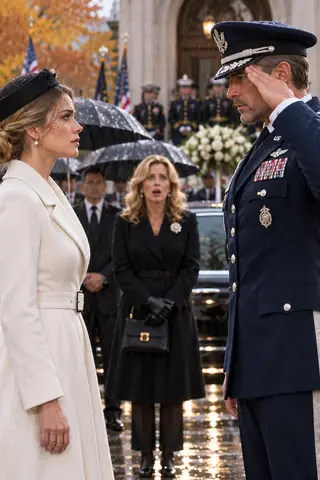
The chapel doors swung open wide as the senior military chaplain entered, flanked by six crisp members of the ceremonial honor guard carrying white gloves and gleaming rifles. The time for private grief and family reckonings had come to an end; the official military memorial service was about to commence with full honors, befitting a retired four-star general who had shaped the modern defense architecture of the United States. General Marcus Vance stepped back, snapping another crisp salute in my direction before moving down the aisle to take his designated seat in the front row reserved for the highest echelons of government and military leadership. As the general moved past my family, my father and uncle instinctively stood at rigid attention, their bodies stiffening out of sudden, overwhelming intimidation. They finally understood the sheer magnitude of the world I inhabited, a world where orders were law and respect was earned through blood, sweat, and absolute discretion.
Rebecca slowly retreated to the back row, sliding into a wooden pew next to my mother, who had remained disturbingly silent throughout the entire morning. My mother looked at me with wide, tear-filled eyes, her hands trembling in her lap as the reality of my five-year absence settled over her like lead. She had lost a daughter to a shadow war, believing her to be a failure, only to discover she was a decorated commander honored by the nation’s highest leadership. I walked slowly down the center aisle, my footsteps echoing softly against the stone floor. As I approached the front row, I didn't take a seat among the civilian family members. Instead, I stopped directly beside General Marcus Vance and turned to face the assembly of mourners, politicians, and foreign attachés who filled the chapel to capacity. The chaplain stepped up to the podium, opening the leather-bound service book, and began the solemn liturgy of final farewell.
“We gather today,” the chaplain’s rich voice resonated through the vaulted ceiling, “to honor the life, the service, and the enduring legacy of General Edward Whitmore. A servant of the Republic, a leader of men, and a pillar of strength.” Every word of the service washed over me like a cleansing tide. I closed my eyes for a fraction of a second, remembering the old man sitting on his porch, teaching me how to cast a fishing line, telling me that respect isn't given—it is survived and claimed. When the time came for the final roll call—the traditional military tribute where a fallen soldier’s name is called out across the ranks—the senior honor guard sergeant stepped forward, his voice ringing out with crystal clarity through the vaulted chapel. “General Edward Whitmore.” Silence. “General Edward Whitmore.” Silence. “General Edward Whitmore.” A solitary bugler stationed near the rear entrance raised his gleaming brass instrument, and the haunting, mournful notes of Taps began to drift through the chapel air. The notes climbed upward, sharp and clear, vibrating against the stained glass before fading slowly into the steady patter of rain outside.
Tears finally spilled over my eyelashes, hot and unheeded, tracing paths down my cheeks. Not tears of weakness, but tears of absolute closure. I had come home an outcast, branded a disgrace by the very people who shared my blood. And I was leaving the chapel as a Commander, having claimed my respect not through words or arguments, but through the enduring strength of an unbroken oath.
The End









