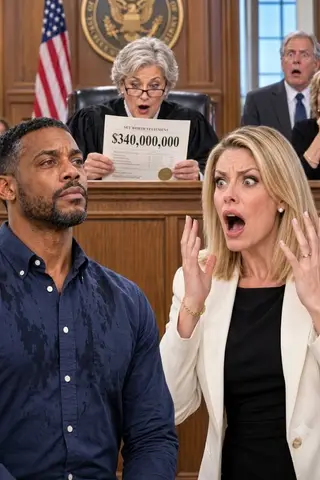
 She Called Her Black Husband 'Worthless' in Court
Chapter 3
The Golden Cage
To understand why the Prescott family viewed Hudson Irwin with such visceral, unadulterated contempt, one had to understand the gilded cage they had built around themselves in the humid, moneyed foothills of Savannah. The Prescott name was synonymous with steel, rubber, and asphalt. For three generations, Prescott Motors had controlled regional distribution contracts across four Southern states, turning grease and gears into generational wealth that bought country club memberships, political influence, and absolute social immunity.
When Shelby Prescott first met Hudson at a charity gala nine years ago, she had viewed him as a fascinating, exotic novelty—a brilliant, quiet statistician working behind the scenes at a regional logistics firm, possessing an encyclopedic mind for market trends but zero social clout. At the time, Shelby was rebelling against her father's iron-fisted control. Marrying an ordinary, hardworking Black man from a modest background was, in her twisted worldview, the ultimate act of modern independence. She fancied herself a progressive benefactor lifting a worthy subject into her elite stratosphere.
But the fairy tale eroded the moment the marriage certificate was signed.
The reality of living under the Prescott microscope quickly turned toxic. Warren Prescott viewed Hudson not as a son-in-law, but as an employee who had managed to secure a permanent equity stake in the family bloodline without paying dues. Every holiday dinner at the Prescott estate turned into an interrogation disguised as casual conversation. Warren would casually drop corporate valuation figures across the dining table, watching to see if Hudson understood the complex maneuvers of hostile takeovers, treating him like a slow student in an advanced seminar.
Shelby, conditioned by her mother’s relentless elitism, soon turned on her husband with the same cruelty. When Hudson refused to quit his job to become a full-time accessory for her social club galas, she called him ungrateful. When he chose to drive his reliable, aging Honda Civic instead of leasing a flashy European sports car on her father’s dime, she mocked his lack of ambition. In Shelby's eyes, a man who did not flaunt his wealth was a man who possessed none. She spent years chipping away at his self-esteem, convinced that without her family’s financial safety net, Hudson would literally starve in the streets.
What Shelby and her father never bothered to notice, however, was the quiet, methodical precision with which Hudson lived his life. While Warren Prescott leveraged millions in high-interest commercial loans to fund their sprawling lifestyle, and while Craig Belmont billed exorbitant retainers to keep the family out of regulatory scandals, Hudson studied the foundational mechanics of the very industry that fed them. He didn't need to flash a gold Rolex to know what time it was. He spent his evenings reading corporate filings, tracking municipal zoning laws, and quietly acquiring distressed assets in sectors the Prescott empire was systematically ignoring.
Sitting in the courtroom gallery now, Diane Prescott whispered something sharply into Warren’s ear, pointing a manicured nail at Hudson's frayed shirt cuffs. Warren chuckled softly, shaking his head. They were entirely trapped in their own arrogance, blinded by the belief that money could only be accumulated through loud, ostentatious displays of power. They had no inkling that the modest, quiet man sitting across the aisle had spent the last seven years quietly buying up the underlying debt of their primary automotive suppliers. The golden cage they had built wasn't a fortress protecting them from the world; it was a self-locking vault, and Hudson held the only master key.
The End









