 She Called Boston’s Most Feared Underworld Boss From Her Sister’s Wedding
Chapter 1
The Call in the Dark
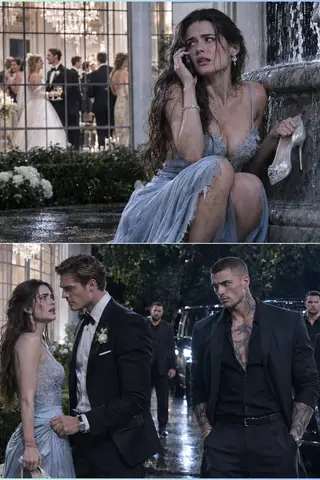
The cold Boston air tasted of salt and impending rain as Evelyn Mercer pressed the cell phone to her ear, her barefoot heel digging into the damp grass behind the marble fountain of Ashford House. Inside the glowing ballroom, the string quartet played a lively waltz, two hundred high-society guests clinked champagne flutes beneath blinding crystal chandeliers, and her younger sister, Vanessa, twirled effortlessly in the arms of a groom who still looked at her with unconditional adoration.
Evelyn, however, was running for her life. Or, at the very least, running for whatever fragile fragment of her soul still remained after three years of a living nightmare.
Her pale blue silk gown was torn at the hem, frayed from where she had frantically sprinted across the gravel path after slipping away from the reception. Her breathing came in short, jagged gasps, sending small puffs of white vapor into the evening chill. Every few seconds, her head whipped back toward the terrace doors, terrified that Grant—her husband, her warden, her polished and perfect tormentor—would emerge from the shadows.
Her fingers trembled so violently she nearly dropped the device into the dark water of the fountain. The phone number glowing on the screen had been saved quietly, almost superstitiously, for eleven agonizing months. She had never expected to dial it. She had promised herself she was strong enough, that she could handle the quiet degradation behind closed doors, the digital monitoring, the subtle isolation from her friends, and the crushing erosion of her career as an independent architectural designer.
Then she had overheard Grant talking on the terrace twenty minutes ago.
“She found the credit accounts,” Grant had chuckled to his business partner, his voice dripping with casual cruelty.
“And?” his partner had asked.
“And she’ll sign whatever I put in front of her tonight once we get home. She always does. Break her spirit a little more, and she won’t even look for a lawyer. All her assets are legally transferred under my corporate shield anyway.”
That was the moment the illusion shattered entirely. There was no partnership. There was only a cage.
On the second ring, a low, gravelly voice answered.
“Moretti.”
Evelyn opened her mouth, but her throat constricted. No sound came out. The air felt thick, heavy with the weight of her desperation.
On the other end, the line shifted. The silence grew heavier, charged with quiet intensity.
“Who is this?” Vincent Moretti demanded, his tone dropping an octave, razor-sharp and instantly alert.
“My name is Evelyn Mercer.”
A pause hung over the line, long enough for a distant wave to crash against the distant Weston shoreline. Then his voice softened, carrying a strange, haunting familiarity that nearly unraveled her completely.
“Evelyn Hart.”
Her maiden name. He remembered. The fact that the most feared man in Boston remembered a random architect he had met for twenty minutes nearly broke her last line of defense.
“We met at the Harbor Children’s Benefit last winter,” she choked out, fighting back a sob.
“I remember you,” Vincent replied instantly.
Evelyn pressed a trembling hand against her mouth, trying to muffle the hitch in her breath. Behind the ballroom glass, a burst of laughter erupted as someone toasted the newlyweds.
“I need help,” she whispered, the words tasting like ash.
Vincent did not ask why. He did not waste time demanding context or judging her vulnerability. His voice was an unyielding anchor in the storm.
“Tell me where you are.”
“Ashford House. In Weston. My sister’s wedding.”
“Are you alone?”
“Yes.”
“Are you hurt?”
Evelyn instinctively looked down at her wrist, where dark red bruises wrapped around her skin like a bracelet—the souvenir of Grant’s grip earlier that afternoon when she had tried to speak to an old college friend.
“No,” she lied.
Vincent seemed to hear the lie echoing through the digital connection. “Is the person you’re afraid of there?”
Evelyn shut her eyes, tears spilling over her lashes and tracking hot paths down her chilled cheeks.
“Yes.”
“Who?”
“My husband.”
The word felt toxic on her tongue. For three years, she had forced herself to say it with a bright, proud smile in front of company. My husband sent these flowers. My husband planned the trip. My husband handles the money. My husband thinks Vanessa is a bad influence. My husband doesn’t like me working late. My husband says opening my own design studio would be irresponsible right now.
My husband. My husband. My husband. Until there was nothing left of Evelyn.
Her voice collapsed into a ragged plea. “Please don’t make me go back.”
Vincent’s answer came without a single fraction of hesitation.
“I won’t.”
Her knees buckled, and she nearly sank into the wet mud.
“Listen carefully,” Vincent commanded, his tone hardening into iron. “I need you to stay where other people can see you. Do not go somewhere private with him. Do not confront him unless you have witnesses. I’m leaving now.”
Evelyn wiped her cheeks with the back of her torn sleeve. “You’re coming?”
“Yes.”
“Why?”
Vincent was quiet for half a second. When he spoke, there was a strange, grim finality in his words.
“Because you called.”
Then the line went dead.
Eleven months earlier, Evelyn had met Vincent Moretti under entirely different circumstances. It had been at a charity fundraiser hosted in a cramped, brick-walled seafood restaurant near Boston Harbor. Back then, she had still secretly accepted freelance branding projects behind Grant’s back, stealing hours at night while he traveled for corporate acquisitions.
The charity organizers had hired her to design menus, table placements, and program signage. Because one of the event coordinators had suddenly fallen ill with the flu, Evelyn had stayed late to help clear the tables and pack up the remaining marketing collateral.
Vincent Moretti had been seated entirely alone at a corner booth near the kitchen service doors.
Everyone in Boston knew who he was, even if the city's glossy magazines rarely printed his photograph. Officially, Vincent owned a massive logistics empire spanning commercial freight companies, upscale waterfront restaurants, several commercial real estate holdings, and an elite private security firm that guarded corporate executives and politicians alike.
Unofficially, people lowered their voices to a nervous whisper whenever his name drifted into conversation. He belonged to an older, darker underworld of Boston—a network of unwritten loyalties, cold debts, and absolute power that respectable society pretended not to notice until they found themselves drowning and needed an anchor.
That evening, however, Evelyn had watched him intervene in a quiet dispute that had nothing to do with high finance or organized crime.
A nervous young delivery driver—a kid who couldn’t have been older than twenty-two—was cornered near the loading dock by the restaurant’s frantic general manager. A high-end wooden crate of imported Italian wine had arrived shattered, and the manager was screaming at the boy, demanding he pay four thousand dollars out of pocket to cover the loss.
The kid was crying, stammering that four thousand dollars was more than he earned in three months, and that he would lose his job and his apartment.
Vincent had walked out from his corner booth without raising his voice, without flexing his reputation, and without a single aggressive gesture. He simply asked to examine the shipping ledger and the transit insurance paperwork.
Within three minutes, Vincent pointed out a specific clause in the digital manifest proving that the distributor’s master policy had already fully insured the cargo against transit damage.
The manager’s face drained of color.
Vincent handed the clipboard back to the trembling kid. Then he looked the manager dead in the eye. “Then why in God’s name are you trying to shake down a kid making nineteen dollars an hour to pay for a corporate write-off?”
No one dared to answer. Vincent didn't threaten the manager; he simply paid for the boy's dinner, tipped the kitchen staff five hundred dollars, and walked back to his table.
Evelyn had watched from the service station, spellbound. Not because Vincent frightened her, but because the most terrifying man in the room was the only human being who had bothered to protect someone weaker.
As Vincent prepared to leave, he noticed Evelyn standing by the supply boxes. He had paused, his dark eyes analyzing her with unsettling precision.
“You were the first person who walked over to try and help him,” Vincent noted quietly.
“It didn’t cost me anything,” Evelyn had replied.
“Most decent things don’t,” he said.
Then, slipping his hand into his tailored wool coat, he pulled out a thick, matte-white business card. There was no company logo, no title, and no address. Just a single name embossed in black ink, and a ten-digit direct phone number.
“If you ever need someone to listen before they decide what you deserve,” Vincent told her softly, “call.”
She had slipped the card into the secret coin pocket of her leather wallet, convincing herself she would never, ever need it.
Now, standing behind the marble fountain with her heart hammering against her ribs, she waited for that impossible promise to materialize out of the Boston night.
“Evelyn.”
Her blood instantly turned to ice water.
Grant stood ten feet away on the gravel path.
His tuxedo jacket was casually unbuttoned. To any casual wedding guest gazing out from the illuminated terrace, Grant Mercer looked like the epitome of a devoted husband tenderly searching for his runaway bride. Tall, clean-cut, wearing an expensive Patek Philippe watch, and carrying himself with immaculate posture.
The man who remembered every anniversary. The man who had publicly gifted Evelyn’s sister and new brother-in-law a six-thousand-dollar honeymoon package that very morning. The man who smiled radiantly beside her in every single professional photograph displayed across the reception hall.
Only Evelyn knew the truth. Only Evelyn noticed the slight, rhythmic twitch of the muscle in his left jaw.
“What are you doing out here in the cold?” Grant asked, his voice smooth, carrying that warm, honeyed cadence he reserved for public consumption.
“I needed air,” she said, her voice shaking despite her best efforts.
“Without your shoes?” Grant took two steps closer, his gaze dropping to her bare feet against the wet grass, then flicking up to her torn hemline. “Who were you talking to?”
“No one.”
Grant’s facial expression underwent a microscopic shift.
That was how it always began. Never a shout in public. Never a clumsy punch where witnesses could see. Just a sudden, chilling rearrangement of his features—the private, predatory version of him bleeding through the immaculate public facade.
“Give me your phone, Evelyn.”
Her fingers tightened around the device in her palm.
“No.”
Grant froze, staring at her as if she had spoken in an alien language.
“What did you say?”
For three years, Evelyn had engineered her entire existence around preventing moments exactly like this. If Grant demanded her phone, she handed it over without hesitation. If he disliked a friend, she stopped returning their calls. If he decided her cocktail dress drew too much attention from male colleagues, she went upstairs and changed into something conservative. If he accused her of embarrassing him at a charity gala, she apologized profusely before even asking what she had supposedly done wrong.
She had traded her autonomy, her voice, and her architectural dreams for a false sense of security, believing that if she made herself small enough, compliant enough, and obedient enough, the monster inside her house would stay asleep.
Peace had become just another word for total surrender.
But as she stared at the man who had plotted to steal her life, her assets, and her sanity behind her back, something inside her snapped. The fear didn't vanish—it transmuted into cold, burning fury.
Before Grant could take another step forward to rip the phone from her hand, the heavy iron gates of Ashford House swung open.
A pair of matte-black, armored Maybach sedans rolled silently up the winding gravel drive, their high-beam headlights cutting through the darkness and pinning Grant in a blinding, inescapable glare.
The End









