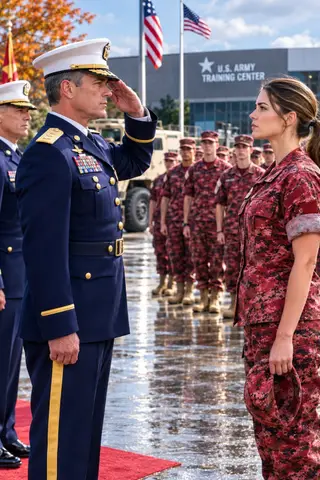
 She Bought Dinner For A Stranger With A Declined Card
Chapter 1
The Rain and the Registry
The rain in Norfolk didn't just fall; it pounded against the asphalt with a relentless fury, turning the perimeter roads of the base into shimmering mirrors of neon light from the nearby storefronts. It was the kind of evening that stripped away whatever energy you had left after a twelve-hour shift. I was Corporal Jenna Reynolds, and by the time I clocked out, my bones felt heavy, my boots were damp despite the best leather waterproofing, and my mind was buzzing with an endless loop of administrative checklists, inspection protocols, and logistical nightmares.
Heading straight home to an empty apartment and a pile of unwashed PT gear didn't appeal to me. Instead, I turned my Honda civic toward a small, family-owned diner tucked away off Route 58—a greasy spoon with fading booths, a flickering neon sign that buzzed like an angry hornet, and a lingering scent of fried bacon and black coffee that somehow felt like home.
The diner was nearly empty at this hour. A lone waitress named Brenda, whose name tag was perpetually crooked, wiped down the laminate counter with a damp rag while country music played softly from a radio behind the partition. I slid into a corner booth near the window, shivering slightly as the damp chill of the evening clung to my civilian jacket. I ordered a black coffee and a plate of scrambled eggs with hash browns, letting the warmth of the mug seep into my fingers.
I was halfway through my coffee, staring blankly at the rain streaking down the glass, when the quiet atmosphere was broken by a low, frustrated murmur from the front register.
I glanced up.
Standing by the cash register was an elderly man. He wore a faded, rain-spotted green jacket and a worn canvas baseball cap bearing the embroidered emblem of a Vietnam veteran. His posture was stiff—not with the casual slouch of a civilian senior citizen, but with that subtle, unmistakable straightness in the spine that hinted at years of military discipline, even if time had bowed his shoulders slightly.
He was holding a worn leather credit card, looking down at the card terminal with a frown of deep concentration. The teenage cashier tapped the screen again, her expression shifting from polite boredom to awkward discomfort.
"I'm sorry, sir," the girl said, her voice dropping a fraction of an octave. "It's declining again. Do you have another card?"
The elderly man didn't answer immediately. He slowly pulled out a thin, frayed leather wallet. Inside were a few well-worn family photos, a faded military ID or membership card, and a handful of crumpled dollar bills. He pulled them out, smoothing the paper bills against the wooden counter with a trembling thumb, counting them slowly under his breath. One ten, two fives, three singles. Twenty-three dollars.
The total on the register screen glowed brightly: thirty-eight dollars and fifty cents.
He was short. And worse, he knew it.
I watched the subtle shift in his jaw muscles. There was no anger in his face, only a profound, heavy dignity that made the silence in the diner feel ten times heavier. In a place like this, financial embarrassment is a public spectacle. Brenda stopped wiping the counter. The cook paused behind the order window. Nobody laughed, nobody made a snide comment, and nobody rushed forward to help, paralyzed by that universal awkwardness that strikes when someone else is caught vulnerable.
My mind didn't do a careful cost-benefit analysis. It didn't calculate my own bank balance or weigh the consequences. It just flashed back to something my grandfather—a Korea vet—used to say: A soldier’s uniform doesn’t come off just because you’re out of it, and neither does your duty to watch your flank.
I slid out of the booth, my boots clicking softly against the linoleum, and walked up beside him.
"Add it to my bill," I said, laying my debit card flat on the counter next to his crumpled bills.
The End









