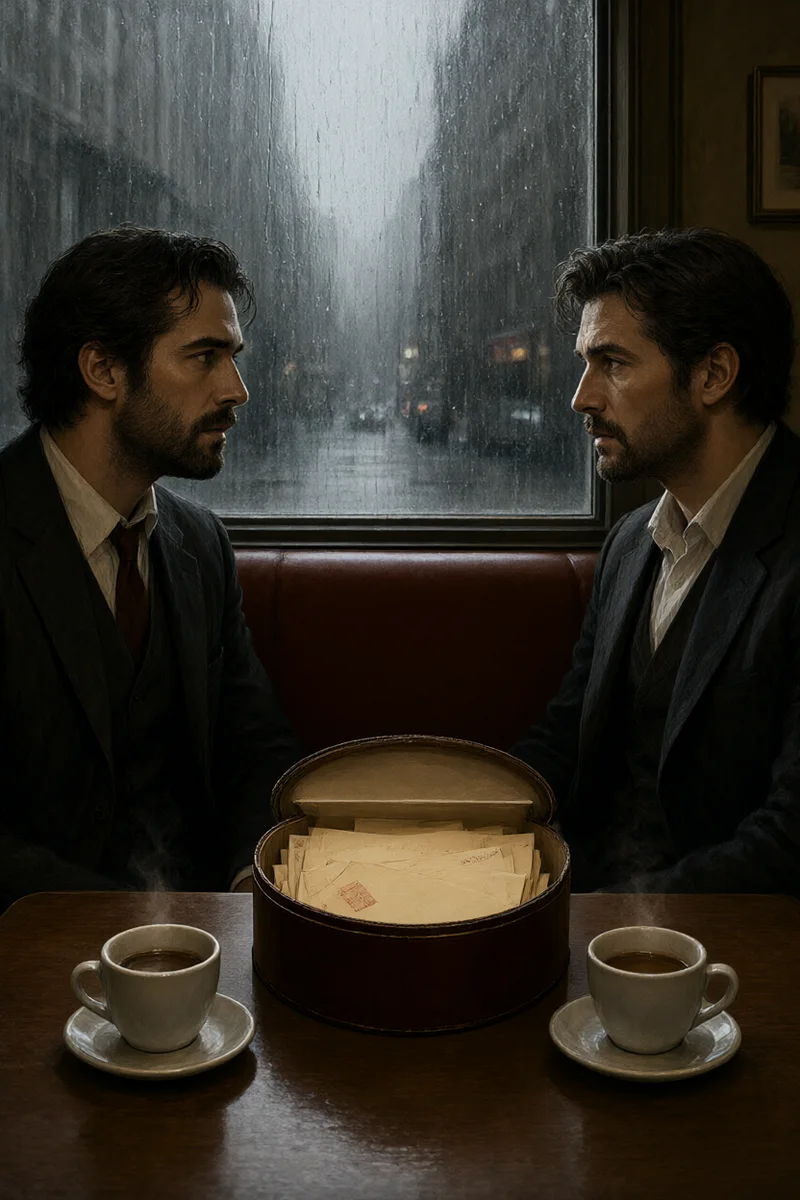
 Same Mother, Same Father
Chapter 3
Box 212
Ezra's mother had run the flower shop on Tanner Street for twenty-six years, and on Monday evenings after close she did the books at the workbench in the back, under a hanging fern that had been there longer than Ezra had been alive.
He came in through the back door at six-fifteen. She looked up from the ledger and smiled, and then she saw the hatbox in his hands, and the smile stayed on her face a beat too long, like a light left on in an empty room.
“Oh,” Magda said. “Oh, Ezra.”
He set the box on the workbench between a bucket of eucalyptus and a roll of green wire. “He's got Dad's ears.”
His mother put down her pen. She was fifty-four, small, with reading glasses on a beaded chain and soil permanently under two of her fingernails. She took off the glasses and folded them.
“Have you told Talia?”
“Not yet. I wanted to hear it from you first.”
Then she told him, in the flat, organized way she told customers what a wedding would cost.
She had been eighteen. Reuben was nineteen. Freshmen at the state college forty miles away, both of them on scholarships. When she found out she was pregnant, in the summer of 1990, her own mother had cried for a week and Reuben's father had said, in his calm way, that he would not help with a single dollar if they ruined their lives.
“Your father wanted to keep him,” Magda said. “I want you to know that. He wanted to quit school and get a job at the tire plant. I was the one who couldn't. I couldn't see how. I was so scared all the time, Ezra. I signed first and then I watched your father sign, and he did it because I asked him to.”
“And then?”
“And then he fell apart. He stopped going to class. He stopped eating. He drove his car into the culvert on Route 7 one night that spring, and he always said it was ice, and there wasn't any ice.” She looked at the fern. “He got better. Slowly. And when he asked me to marry him, he made me promise one thing. That we would never look back. Never try to find out. He said it was the only way he could live.”
“And you broke it.”
“The first March. On the baby's birthday.” She said it without apology. “I wrote to the agency. They said they'd forward one letter, once. June wrote back to me herself, with her address. I rented the box at the post office that same week. I've had it thirty-four years.”
Her hands went into the pocket of her apron and came out with a small brass key on a ribbon. She put it on the bench beside the hatbox.
“June died in April,” Magda said. “I knew something was wrong when there wasn't a letter in March. Then her sister sent a card. I went to the post office and read it in the car and I came back here and made sixty boutonnières for the Kessler wedding. I've been mourning a woman I never met for six months, and there was no one in the world I could tell.”
Ezra opened his mouth. Behind them, the bell over the shop's front door jingled.
They both turned. Reuben Mandel was standing in the doorway with his car keys in his hand, the way he did every Monday when he came to drive her home. His eyes went from his wife to his son to the bench.
He walked over. He didn't look at Ezra. He looked down at the open hatbox, at the cream and blue envelopes, at the top letter lying unfolded, and he put one finger on it, very lightly.
“You wrote those,” he said. “To June.”
The End









