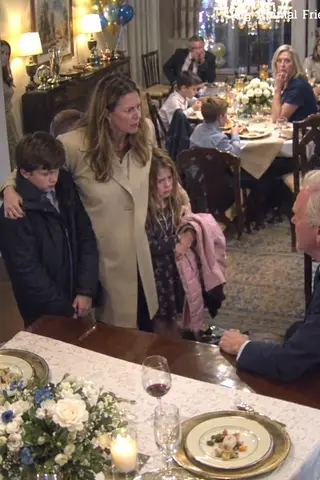
 Relegated to a side table at her father's birthday party, a single mother resolutely walked away
Chapter 49
The Eleanor Miller Foundation
The autumn following Arthur’s passing brought a profound, dignified stillness to our lives. In accordance with his final revised testament, the Elm Street estate in Philadelphia—which the restitution trust had reacquired and cleared of all predatory liens—was not converted into luxury condominiums or sold to real estate developers.
Instead, on a crisp morning in late October, Vanessa and I stood before the iron gates of the estate, surrounded by dozens of community leaders, apprentice drivers, and scholarship recipients.
The old brass plaque that had read Sterling Manor had been removed. In its place hung a hand-carved slate monument bearing a simple inscription: The Eleanor Miller Institute for Workplace Democracy and Cooperative Enterprise.
The mansion had been completely renovated into a state-of-the-art residential learning center, providing free technical training, logistics software engineering classes, and cooperative business incubation for children of working-class families across the region.
Vanessa, who had completed her supervised parole and received a full executive pardon from the governor in recognition of her extraordinary cooperation in dismantling the Vanguard network, stepped up to the podium as the Institute’s inaugural Director of Governance and Restitution.
She looked radiant, wearing a simple tailored forest-green suit, her eyes reflecting the quiet, unshakeable confidence of a woman who had walked through the valley of humiliation and found her true calling on the other side.
"For generations," Vanessa spoke to the gathered crowd, "this house was a monument to exclusion. Its doors were locked to the people who generated the wealth that paid for its stone pillars. Today, we open these gates permanently. Here, we will teach the next generation of American business leaders that an enterprise is not a weapon to enrich a few at the expense of the many. An enterprise is a shared covenant, where every worker has a voice, every child has an opportunity, and every table is built wide enough to welcome everyone."
The applause that followed was not the polite, performative clapping of corporate galas; it was the joyful, roaring approval of people who knew they were witnessing the permanent redemption of a broken lineage.
After the ceremony, Vanessa and I walked through the sunlit rose gardens our mother had planted decades ago. The bushes, newly pruned and tended, were blooming with late-season white roses, their sweet, delicate fragrance filling the autumn air.
"Do you think Dad would be angry that we turned his ballroom into a computer lab?" Vanessa asked with a wry, affectionate smile.
"I think Dad is finally resting, Van," I answered, putting my arm through hers. "Because for the first time in eighty years, nobody with the name Sterling is running away from the truth."
The End









