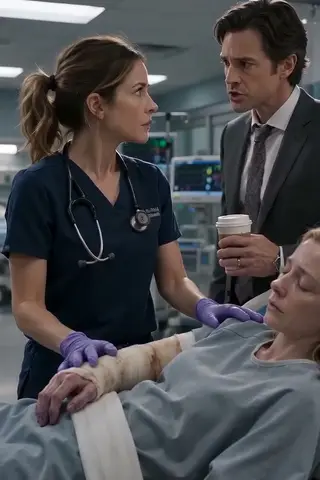
 Purple Fingers, a 104-Degree Fever, and a Husband Who Refused to Let the Doctor Cut the Cast Open
Chapter 1
The Scent of Rot in Trauma Room Two
The odor hit my senses long before the squeaking wheels of the stretcher crossed the threshold of the emergency bay. It was a suffocating, sickly sweet stench that cut straight through the crisp, bleach-scrubbed air of County General Hospital, carrying a metallic undertone of corruption that immediately made the veteran triage nurses turn their heads in disgust. I’m Dr. Sarah Jenkins, and after eight grueling years holding the line in emergency medicine, I have learned a fundamental, unwritten law of trauma care: the most dangerous threats rarely arrive with the theatrical noise of flashing lights and screaming sirens. Sometimes, they slip through the double doors in near silence, shepherded by a calm, smiling companion who insists that everything is completely under control.
“Thirty-two-year-old female, brought in by private vehicle,” Marcus, one of our sharpest charge nurses, muttered as he jogged alongside the rolling gurney, his clipboard pressed tightly to his chest. “Vitals are tanking fast. Temperature is sitting at 103.8, heart rate is racing at 142 beats per minute, and her blood pressure is dropping into the danger zone. She’s lethargic, barely responsive to verbal stimuli, and completely out of it.”
Marcus paused, casting a wary, sideways glance toward Trauma Room 2 where the gurney was being locked into place. “Her husband is driving this whole circus. He keeps telling everyone in the hallway that she just has a bad case of the seasonal flu. But Sarah, you need to look at her arm right now. Something is deeply, catastrophically wrong.”
I stepped into the blinding fluorescent glare of Trauma Room 2, my mind instantly shifting into high-gear clinical mode. Emily Harris lay on the medical gurney, looking frighteningly small and impossibly frail. Her lips were cracked, bleeding, and parched, her cheeks sunken into a greyish pallor that signaled her body was losing a war it no longer had the strength to fight. But it was her right arm that immediately drew my focus like a magnet. Encased from her knuckles to well above her elbow was a thick, orthopedic fiberglass cast. It was old, dingy, stained with dark brownish rings of dried fluid, and bulging unnaturally at the forearm, pressing brutally against skin that had swollen far past its normal boundaries.
Her fingers protruding from the end of the cast were a terrifying, deep shade of purple. The tips were already turning an ashen, mottled blue. I stepped forward, sliding my gloved fingers against her index finger, pressing down to test for capillary refill. The color stayed dark, refusing to return. The blood circulation had been completely choked off weeks ago.
“How long has she been wearing this cast?” I demanded, turning my gaze from the dying limb to the corner of the trauma bay.
A man was standing near the sink, casually holding a hot cup of specialty coffee from a nearby café. Daniel Harris looked completely out of place in a chaotic emergency department. He wore an immaculate designer wool jacket, his dark hair was styled with precision, and his Italian leather shoes didn't have a single speck of dust on them. He possessed the relaxed, unbothered demeanor of a man waiting for a routine dental cleaning, not a husband watching his wife slip toward multi-organ failure.
“About a month, give or take,” Daniel replied smoothly, taking a slow, unhurried sip of his coffee. “Emily has always been terribly clumsy. She took a nasty spill down our front staircase a few weeks back. Fractured her radius pretty cleanly.” He offered a light, dismissive chuckle, shaking his head. “She woke up running a fever this morning. I told her it’s just some nasty stomach bug going around the neighborhood.”
I stared at him, my instincts screaming that every single word coming out of his mouth was a calculated lie. I turned back to Emily, lifting her burning, unresponsive hand. “Mr. Harris, your wife is in septic shock,” I said, my voice rising with professional authority. “Her body is drowning in a catastrophic infection. I need to take shears to this cast right now. If we don’t relieve the pressure and clear whatever is festering underneath, she is going to lose her entire arm—and if this systemic infection reaches her heart, she will die.”
I expected him to drop his coffee. I expected him to panic, to rush to her bedside, to beg me to save her. Instead, Daniel’s relaxed expression vanished in a single heartbeat, replaced by a cold, rigid mask of absolute defiance.
“No,” Daniel said sharply, his voice dropping an octave into a tone of chilling finality. “Her private orthopedic surgeon explicitly said that cast is not to be touched for another two weeks. Just pump her full of broad-spectrum IV antibiotics, write us a prescription for home care, and we’ll be discharging ourselves in an hour.”
There was zero panic in his voice now. Only control. And as I looked into his cold, calculating eyes, a horrifying realization washed over me: whatever was trapped beneath that rotting fiberglass cast, Daniel Harris wasn't trying to protect his wife’s broken bone. He was terrified that I was about to uncover the evidence of a crime.
The End









