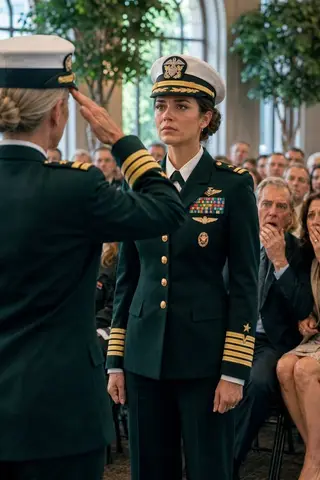
 Parents Called Her Promotion "Pathetic," But Rear Admiral's Four Words Left 200 Guests and Her Family in Absolute Shock!
Chapter 1
The Kitchen Sink Verdict
The water from the kitchen faucet in Dayton, Ohio, ran cold, but the air in the room felt suffocatingly hot. Howard Whitaker sat in his brown leather recliner, the television murmuring a low, droning baseball game that he wasn’t really watching, though he used it as a shield against any conversation that required genuine effort. Beverly Whitaker stood at the sink, her hands rhythmically sliding a paring knife around a crisp, green Granny Smith apple. The peel fell away in one long, unbroken ribbon, curling into the stainless-steel basin like a sleeping snake.
Lieutenant Commander Nora Whitaker stood three feet away, clutching the strap of her garment bag. Inside was her service dress uniform—crisp white wool and polyester, adorned with ribbons earned through years of classified, grueling labor in windowless rooms. Her cap sat neatly on top of her small suitcase by the screen door. Three days. Just three days until the ceremony at Naval Station Norfolk. A ceremony she had delayed mentioning until the absolute last minute, hoping that giving them time to process would strip away any excuse.
"We are not driving nine hours just to clap for your pathetic little ceremony," Beverly had said, her voice entirely flat, devoid of anger or malice, which somehow made it infinitely worse. It was delivered with the casual dismissal one might use when deciding not to buy a dented can of peaches at the grocery store.
From the living room, Howard offered a dry, dismissive snort. It wasn’t a roar of rage. It was a chuckle, small and dismissive, vibrating softly from his chest. "Nine hours in a sedan for an office party? Be real, Bev. Nobody's got time for that."
Nora felt a strange, cold numbness wash over her. She had spent the last seven years analyzing complex threat vectors, tracking anomalies in global data streams, and managing operatives whose very lives depended on her precision. She knew how to build a case, how to calculate risks, and how to weather high-stress crises without blinking. Yet, standing in her parents' suburban kitchen, she felt precisely like the nine-year-old girl who had won the district science fair only to find her parents' seats empty in the school auditorium because her father wanted to catch the start of a local stock car race.
"It’s not an office party, Mom," Nora said, her voice remaining carefully level, trained by years of military protocol to suppress emotion in the face of insubordination. "It's a promotion ceremony. It's a milestone."
Beverly dropped the apple core into the garbage disposal, wiped her hands on a floral dish towel, and finally turned around. Her eyes were hard, gray, and entirely unbothered. "An office is an office, Nora. You type on a computer, you look at maps, you drink terrible coffee. You aren't out there fighting wars. You want a parade? Go find someone who actually fired a weapon."
Howard laughed again, louder this time, adding a supporting grunt from the recliner. "Tell her, Bev. If she wants a medal, she should've joined the infantry instead of hiding behind a desk in Virginia."
Nora didn't argue. She didn't raise her voice, and she didn't slam the door when she left three minutes later. She simply walked out to her car, tossed her garment bag into the backseat, and drove away. As the Dayton suburbs faded in her rearview mirror, a cold, hard knot formed in her stomach. She told herself she didn't care. She told herself she was a grown woman, a senior officer in the United States Navy, and that she didn't need validation from people who viewed her life's work as a clerical job.
Yet, as she drove through the night toward Norfolk, the phantom weight of those two empty seats began to press down on her shoulders, heavy and inevitable. She had checked the box on the RSVP form weeks ago, allocating two seats in the center section for her parents. She had imagined, foolishly, that maybe this time they would surprise her. Maybe this time they would look at her uniform and feel a flicker of pride.
By the time she reached her apartment in Virginia, she knew the truth. Some people are simply incapable of showing up for anyone other than themselves. And three days from now, she would walk into a hall of two hundred strangers, entirely alone.
The End









