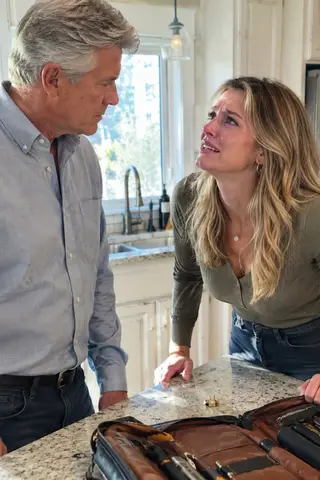
 Parents Abandoned Me at an Airport at 16 with a One-Way Ticket
Chapter 2
Forging a Life in County Clare
At seventeen, I learned to drive a sputtering, vintage tractor across rolling green hills that seemed to stretch endlessly toward the Atlantic. At eighteen, I learned how to stitch a sheep's torn flank during a bitter spring lambing season, my hands steady despite the blood and the driving rain. While my sister Vanessa was likely attending country club parties and shopping with our mother's credit cards in Ohio, I was finishing school with marks good enough to impress the strict local nuns, then training rigorously as a nurse.
County Clare was a tight-knit, unforgiving community that didn't easily accept outsiders, but it respected hard work above all else. By the time I was twenty-three, I was a qualified district nurse, driving my beat-up hatchback down narrow, winding back roads to dress wounds, check on elderly neighbors, and sit quietly with people who were terrified of dying alone in the dark. The valley slowly began to know me, not as the Yank who was dropped off by strangers, but as someone they could rely on when things got dark and desperate.
Tom Gerie, an eighty-six-year-old farmer who was as stubborn as a rusted barbed-wire fence, took a liking to me. He called me “the Yank who shows up,” and in the rugged vernacular of County Clare, that was the highest form of affection and acceptance I could ever hope to receive.
Meanwhile, Hollyfield farm began undergoing a slow, quiet transformation. A major wind energy company came surveying the high ridge behind our pasture, looking to lease land for towering turbines. A few months later, the county council rezoned the lower forty acres for commercial and residential development as tourism expanded along the Wild Atlantic Way. Land that had nearly buried Norah in debt, forcing her to skip meals and patch her boots with duct tape, suddenly skyrocketed in value overnight.
Norah watched the astronomical valuations rise on official government letters without ever becoming impressed or blinded by the staggering numbers.
“It's land,” she told me one evening while mending a feed sack by the hearth. “It was dirt when it was worthless, and it's dirt now. Don't let a price tag make you forget what it takes to grow things in it.”
Then she looked up, fixing those sharp green eyes on me. “Don't let the number turn your head, Gabrielle. People will look at green pastures and see only greenbacks. Be smarter than them.”
By the time I reached twenty-seven, the final comprehensive valuation for Hollyfield came in from the estate planning office. I sat at the weathered kitchen table, staring at the official appraisal document, and read the final figure twice just to make sure I wasn't hallucinating.
Twenty-three million euro.
It was an incomprehensible sum for a farm where the roof still leaked in heavy storms. Norah barely looked up from her tea, taking a slow, measured sip.
“When I'm gone,” she predicted with chilling accuracy, “this place will draw people the way fresh blood draws hungry flies. They'll crawl out of the woodwork.”
She was entirely right. But neither of us understood just how violently right she was until her health finally began to fail.
The End









