 Pitch 31
Chapter 2
The Ceasefire
The card stayed under his wiper all the next day, curling in the damp, and Ines served for eleven hours with her back to it.
On day three she ran both steamers and the fryer through the lunch rush, because the queue was past the ice-cream kiosk and she was not a woman who under-steamed. The pedestal clunked. Her lights went out. So did his.
She waited for the gloating. Instead he came around the back with a key, reset the breaker, and walked down her line carrying a foil pan. “Burnt ends while the lady's steam comes back. No charge. She'll tell you they're too heavy.”
“They are too heavy,” Ines said through the window.
“Noted,” he said, and gave the last one to a child.
On day four he ran out of buns at one o'clock. She heard the phone call through two layers of sheet metal. The bakery wanted cash at the door from now on, and the driver had left with the order still on the van.
She had a tub of scallion flatbread dough she had meant for her own lunch. It took her a minute to decide and twenty to griddle forty rounds. She opened his back door without knocking and set the tray on his counter.
“What's that?”
“Bread. It has met a vegetable. Don't make a speech.”
He folded sliced brisket into the first one and handed it out of his window. The customer got four steps down the quay, turned around, and bought two more.
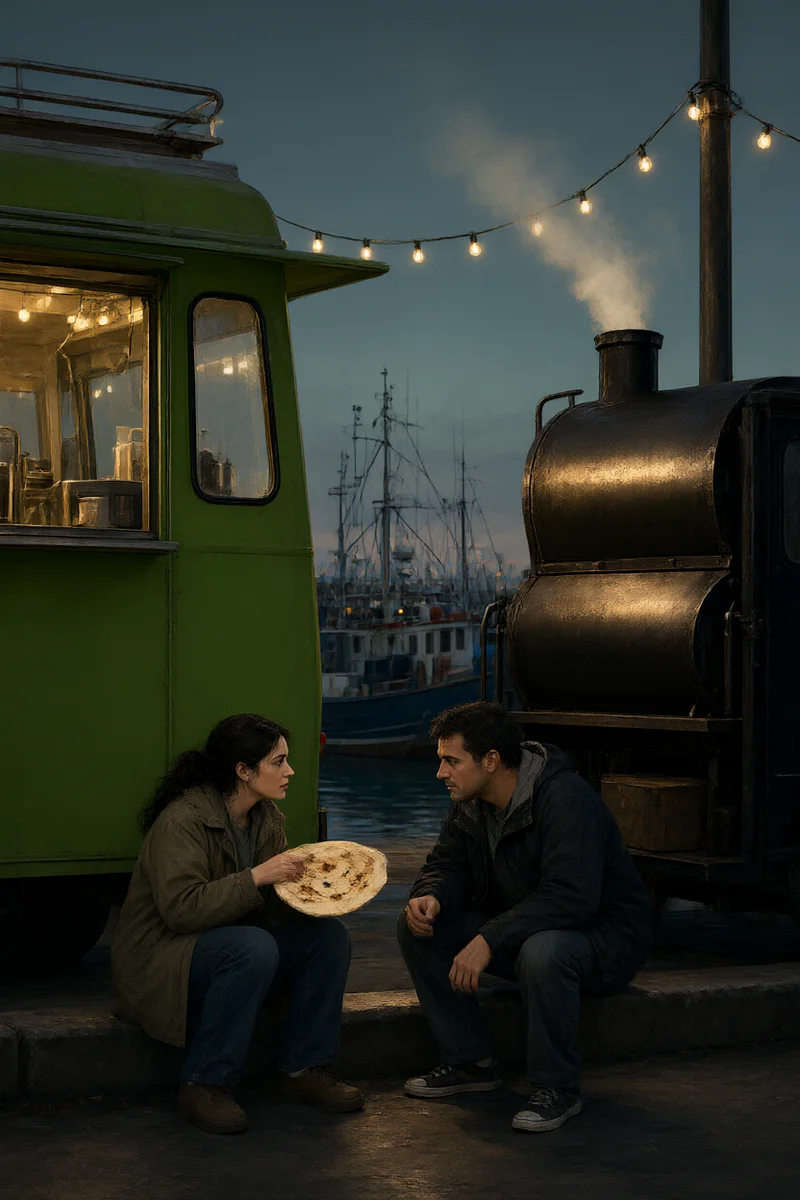
At closing they sat on her back step with the last flatbread torn in half between them. She added a spoon of her pickled chili and a thread of black vinegar. He chewed for a long time, looking at the water.
“That's annoying,” he said. She said she knew. “We should sell it. Call it the Truce.”
“The Ceasefire. A truce means I trust you.”
They settled on eleven dollars and an even split, and shook on it. His hand was rough and very warm. She let go first.
“The card,” she said. “I can read upside down.”
He didn't pretend not to follow. “Nine thousand two hundred, in their office by nine on the morning of the twentieth. The flatbed's booked for ten.” He rubbed the scar on his wrist with his thumb. “The smoker's mine. I paid off the smoker. It's the truck underneath it they want.”
“How much have you got?”
“Not nine thousand two hundred.” He stood and gathered up the foil. “Night, Okafor.”
She was locking her back door when her phone buzzed. It was Lyle, at Tri-County Truck and Trailer, the broker she had rung in June about a cheap second van.
“Good news on that unit,” the message said. “Comes free the morning of the 20th. Black step van, rear smoker porch, lender very motivated. Your $1,500 hold keeps you first in line.”
The End









