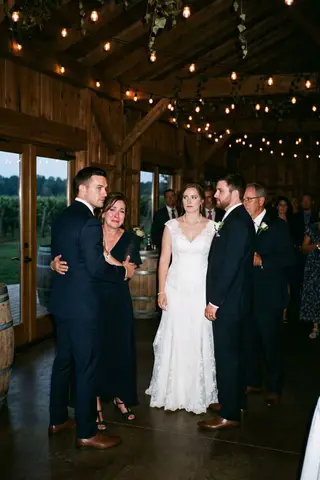
 My Stepmother's Husband Forced Me to Walk Down the Aisle Alone at My Own Wedding
Chapter 3
The Vineyard Pavilion
The morning of the wedding arrived with a crisp, clear autumn sky that painted the rolling hills of the Hudson Valley in shades of amber and gold. The venue was a rustic family-owned vineyard, surrounded by acres of grapevines heavy with purple fruit that caught the early morning dew like scattered diamonds.
Inside the bridal suite, the air smelled of eucalyptus, hairspray, and roasted coffee beans. My bridesmaids—my two best friends from college and my cousin Sarah—were bustling around, laughing and adjusting their sage-green dresses in front of the full-length mirror. But the loudest presence in the room wasn't any of them; it was my aunt Martha, my father’s younger sister, who swept into the room like a localized weather system carrying an enormous garment bag and an expression of fierce, unadulterated determination.
"Move aside, girls, let me look at my masterpiece," Aunt Martha announced, her silver earrings jangling as she marched straight toward me. She didn't waste time on small talk. She unzipped the garment bag to reveal a veil edged in delicate, hand-stitched lace that had belonged to my paternal grandmother.
Without asking, she stepped up behind me, draped the lace over my dark hair, and gently fastened the vintage pearl necklace around my throat. The cool weight of the pearls settled against my collarbone with a familiar, comforting chill.
"Your father would have given anything to be in this room today," Aunt Martha murmured softly, her reflection locking eyes with mine in the mirror. Her voice hitched slightly, but she swallowed the emotion down, replacing it with the stubborn grit that ran through the entire paternal side of our family. "He would have looked at you right now and said you’re the spitting image of his mother—strong-willed, beautiful, and entirely unimpressed by anyone’s bullshit."
A wet, shaky laugh escaped my lips, and I reached up to touch the pearls. "Thanks, Aunt Martha. I needed to hear that."
She turned me around by the shoulders, her sharp eyes scanning every detail of my lace-trimmed gown. "Your mother called me this morning," she dropped casually, her jaw tightening. "Tries to explain why she and Roland are sitting in the second row instead of walking you. Sounded like a robot reading a script about 'blended family harmony.' I told her straight up: 'Claire, you’re making a mistake you’ll spend the rest of your life regretting.' Do you know what she said?"
"She hung up," I guessed.
"Roland took the phone out of her hand and told me I was being 'unconstructive,'" Martha spat, rolling her eyes so hard I thought they might get stuck. "The man is a parasite in a tailored suit. But listen to me, Clara—don't you let them steal one second of your joy today. You walk down that aisle with your head held so high your neck aches. You belong to us. You belong to yourself."
When the heavy wooden doors of the vineyard pavilion swung open and the first notes of the acoustic guitar began to drift across the lawn, my heart performed a heavy, rhythmic thud against my ribs.
I stood at the threshold alone, exactly as my mother and Roland had planned. For a brief, stinging second, the empty space to my right felt glaringly obvious—a physical manifestation of every abandonment I had suffered since I was twelve years old. But then I remembered Aunt Martha’s words. I remembered the weight of my grandmother’s pearls.
I took a breath, squared my shoulders, and stepped forward.
The walk down the long wooden pathway felt like walking through a gallery of my own history. On my left, rows of guests sat smiling, whispering, and holding up phones. In the second row, sitting rigidly beside a beaming Marin, sat my mother. She was wearing a taupe dress that Roland had undoubtedly chosen for her—something muted, neutral, and designed to blend into the wallpaper. She stared straight ahead at the floral arch, refusing to turn her head, though I could see the frantic trembling of her hands resting in her lap. Next to her, Roland wore a placid, diplomatic smile, looking like a benevolent patron observing a charity event he had personally funded.
I didn't look at them. I kept my eyes fixed entirely on the end of the aisle, where Elias stood waiting.
He wasn't wearing a tuxedo; he wore a well-fitted navy suit with an open-collared white shirt, his broad shoulders squared and his gaze locked onto mine with an intensity that made the rest of the world vanish into a blur of green vines and golden sunlight. As I drew closer, I saw the slight, proud curve of his lips, the absolute certainty in his stance. He didn't pity me for walking alone; he respected me for it.
When I finally reached the wooden platform and placed my hand in his, the electric warmth of his palm washed away the chill of the empty space behind me.
The ceremony was short, emotional, and entirely ours. When the officiant pronounced us husband and wife and Elias leaned down to kiss me, the applause that erupted from the crowd wasn't polite country-club clapping—it was a roaring, thunderous cheer from people who genuinely loved us, led by Aunt Martha, who was openly wiping her eyes with a lace handkerchief, and Elias’s father, who pumped his fist in the air with uncontainable joy.
We had survived the walk. But as the guests began migrating toward the open-air pavilion for the reception, I knew the real battle hadn't even started yet. Roland and my mother were still in the room. And they were about to find out what happens when you mistake a woman’s independence for weakness.
The End









