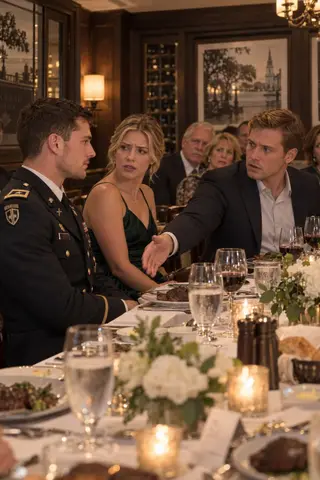
 My Sister Mocked My Military Service at Her Engagement Dinner
Chapter 5
What Silence Cost
The drive from the steakhouse back to my small, single-story house in Richmond Hill was forty minutes of empty blacktop.
The hum of the tires against the highway was the only sound in the world. I drove with the windows cracked, letting the humid Southern breeze wash over me, trying to strip away the suffocating tension of the evening.
When I reached my house, I unlocked the front door, walked into the dark living room, and didn't bother turning on the lights. I stood in front of the mirror in the hallway and began unclipping the medals, one by one.
The Combat Medical Badge.
The Bronze Star with Valor.
The Purple Heart.
People who don't wear uniforms think these medals represent glory. They think they represent moments where a man felt tall, powerful, and triumphant.
They don't know that every piece of stamped metal in that velvet-lined box in my closet tasted like copper and ashes.
The Combat Medical Badge didn't remind me of being a hero. It reminded me of a dusty wadi outside Sangin in 2017. It reminded me of Specialist Miller—no relation, just a nineteen-year-old kid from Ohio—screaming for his mother while I used both hands to compress his severed femoral artery, the blood so slick between my fingers that I could barely maintain a grip on the tourniquet windlass.
The Bronze Star with Valor didn't remind me of courage. It reminded me of dragging our team leader, Captain Vance, thirty meters through an open courtyard while Russian-made heavy machine guns tore the adobe walls apart around us, the concussive shockwaves rattling my teeth inside my skull until I couldn't tell if the ringing in my ears was gunfire or my own ruptured eardrums.
And the Purple Heart? That was just a jagged piece of shrapnel that tore through my right shoulder and lodged two millimeters from my subclavian artery. It was three months of physical therapy learning how to lift my arm high enough to brush my teeth again.
How do you bring that to a dinner table where people are arguing over whether the wedding napkins should be ivory or eggshell?
How do you sit with parents who panicked when you scraped your knee in Little League and explain to them that their son has patched gunshot wounds with chest seals while kneeling in pools of stagnant irrigation water?
You don't. You protect them. You let them believe you work in an office. You let your sister make her jokes about ibuprofen and gate duty, because if she’s making jokes, it means she’s innocent. It means the world she lives in is safe, sanitized, and unbroken.
I hung my dress uniform jacket in the closet and pulled on an old gray PT shirt and gym shorts.
My phone buzzed on the nightstand.
It was a text from my father:
“I’m sorry, Chris. I don't know what else to say. Your mother hasn't stopped crying. I feel like I haven't known my own son for ten years. Can I come see you tomorrow? At your house?”
I stared at the glowing screen for a long time. For ten years, I had maintained the perimeter. I had kept my family firmly outside the wire, believing that keeping them in the dark was an act of love.
Perhaps Liam was right. Perhaps silence wasn't just protection.
Perhaps it was also a wall I had built because I was too tired to help them climb over it.
I typed back: “Come over at ten, Dad. I’ll make coffee.”
The End









