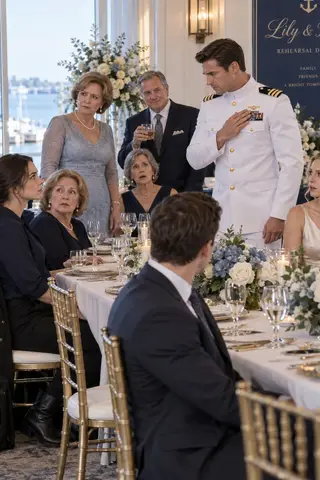
 My Mother Hid Me at the Back of My Sister’s Wedding
Chapter 24
Iron on Capitol Hill
The hearing chamber of Room 214 was bathed in the harsh, sterile glow of recessed overhead lights.
A high, curved mahogany dais dominated the front of the room, behind which sat seven members of the congressional subcommittee, flanked by aides and military liaisons. At the center of the high table sat Deputy Undersecretary Marcus Caldwell, a smooth, silver-haired politician with cold, calculating eyes and an expensive bespoke suit that looked out of place among the uniforms in the room.
I sat alone at the witness table in the center of the vast chamber, my hands resting flat on the polished wood, my spine perfectly straight. Behind me in the spectator gallery sat Vice Admiral Vance, Ryan, and Lily.
Caldwell leaned forward into his microphone, his voice dripping with condescending formality.
“Rear Admiral Hayes,” Caldwell began, shuffling a stack of classified operational logs. “The records from your deployment in the Denmark Strait show that at 0300 on October fifteenth, you personally ordered your strike fighters to bypass the multi-billion-dollar automated Aegis combat network and engage on manual tactical radio frequencies. Furthermore, you ordered four helicopters into sixty-five-knot Arctic squalls outside standard operational envelopes to recover foreign civilian crewmen.”
Caldwell looked over his gold-rimmed glasses, his mouth curving into a tight, accusatory smirk.
“You risked a hundred-billion-dollar strike group, four thousand American sailors, and an escalation of international hostilities to play the hero, Admiral. Did you think your recent promotion granted you unilateral authority to rewrite defense doctrine and gamble with taxpayer assets?”
The room fell dead silent. A junior congressman on Caldwell’s left nodded along, preparing to pile on.
I adjusted the witness microphone. I didn't look at the aides. I didn't look at the gallery. I locked my eyes directly onto Caldwell, holding his gaze with the unwavering, lethal intensity of an officer who had survived twenty years of combat flight decks.
“Undersecretary Caldwell,” I began, my voice ringing through the cavernous chamber with the crisp authority of a firing squad. “At 0258 on that morning, the automated radar software installed aboard our cruisers—software designed, built, and maintained by Titan Aerospace Systems—suffered a catastrophic phased-array cascade failure under baseline hostile jamming.”
Caldwell’s smirk vanished. His fingers twitched against his paperwork.
“That failure was not weather-related,” I continued calmly, sliding a thick, red-stamped technical report from my leather portfolio. “It was the result of defective semiconductor relays that your civilian procurement office approved over the explicit objections of the Naval Sea Systems Command testing board three years ago. When the jamming hit, that multi-billion-dollar system went completely blind in less than forty seconds.”
Whispers immediately broke out along the congressional staff benches.
“Had I relied on your automated system,” I spoke with absolute, crushing precision, “two hostile strike aircraft would have closed to within forty miles of an American aircraft carrier undetected. I bypassed the defective equipment using basic naval air tactics. My pilots pushed the adversary back across the international corridor without firing a single shot, without losing an aircraft, and without yielding an inch of American sovereign capability.”
Caldwell’s face flushed a mottled, furious red. “Admiral, you are out of line—”
“I am not finished, Mr. Secretary,” I commanded, my voice dropping into a register that made the entire committee freeze. “As for the forty-two mariners on the Nordic Sun: they are human beings who were drowning in freezing water under the watch of the United States Navy. If you believe that saving human lives within the capabilities of our crews constitutes operational misconduct, then you are welcome to submit a formal letter of reprimand to the President. But you will do so knowing that every sailor, pilot, and commander in the Atlantic fleet will read the transcript of this hearing tonight.”
Down at the end of the dais, the senior ranking member of the Armed Services Committee—a decorated Marine Corps veteran from Texas—slowly closed his notebook.
“Undersecretary Caldwell,” the Marine veteran barked into his microphone, “this hearing is adjourned. Admiral Hayes, on behalf of this Congress, thank you for your service, your competence, and your leadership. Dismissed.”
The End









