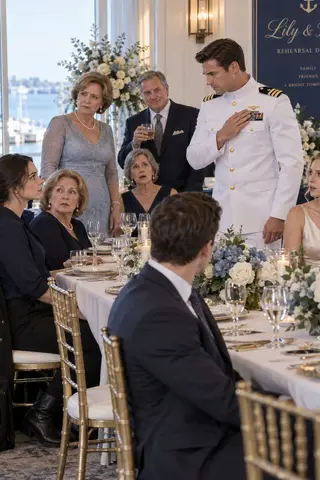
 My Mother Banished Me To The "Loser Table" At My Sister's Wedding
Chapter 17
The Command Briefing
The secure conference room on the third floor of Fleet Forces Command in Norfolk smelled of industrial floor wax, hot electronics, and the dark, bitter coffee favored by carrier air wing commanders.
Behind the soundproofed security doors, twenty senior officers and technical directors sat around an oval mahogany table equipped with encrypted digital displays. Flanking the head of the table were the four-star commander of Fleet Forces and the civilian Deputy Undersecretary of the Navy.
Sitting at the center of the operational briefing console was Rear Admiral Nora Hayes.
My service dress blue uniform was sharp, the single silver star on each shoulder board gleaming beneath the fluorescent lighting. Across my chest, the four rows of ribbons were perfectly aligned, anchored by the gold wings of a naval aviator. In front of me lay the master tactical deployment plan for Carrier Strike Group Twelve—an operational package encompassing eight thousand sailors, sixty-five combat aircraft, and three guided-missile cruisers scheduled for deployment to the North Atlantic.
"Admiral Hayes," the Undersecretary said, adjusting his spectacles as he glanced at the flight-deck readiness projections on his screen. "We’ve reviewed the carrier air wing’s sortie generation rate during the recent North Sea combat exercises. Your team cut the turnaround time between catapult launches by fourteen percent. That’s the highest sustained sortie rate an air wing has logged since the 2003 fleet surge."
"The credit belongs to the deck crew and the squadron commanders, Mr. Secretary," I replied, my voice calm, direct, and completely devoid of false modesty. "We adjusted the maintenance cycles and integrated the avionics troubleshooting directly onto the hangar deck rather than routing components back to the supply depot. When you give seasoned master chiefs the authority to make tactical maintenance decisions, the flight line moves."
Beside me, Admiral Thomas Walker nodded with quiet satisfaction, leaning back in his leather chair with his hands folded over his gold-braided cuffs. "She’s right, Arthur. Nora doesn't manage from thirty thousand feet. She knows the deck because she bled on it."
At the far corner of the briefing room sat three civilian defense contractors and a corporate liaison from a major regional infrastructure consortium. Among them was Marcus Vance, a polished, silver-tongued corporate lobbyist who had spent the last five years cozying up to Alan Brooks’s circle at the Commonwealth Club in Richmond.
Vance had spent the first half of the meeting fidgeting with a gold pen, his eyes darting toward me with a mixture of nervous apprehension and calculated obsequiousness. He knew precisely who I was. More importantly, he knew that his firm’s multi-million-dollar bid to construct the new advanced aviation training complex at Oceana required the operational endorsement of my office.
As the formal briefing concluded and the Undersecretary stepped out for an executive call, Vance seized his opening. He gathered his leather folder, hurried around the table, and positioned himself directly in front of my chair, flashing the broad, practiced smile of a man who believed every door had a price tag.
"Admiral Hayes," Vance began, his voice dripping with smooth, corporate deference as he offered a manicured hand. "A truly magnificent presentation. The consortium has been watching your career with immense admiration. In fact, prior to his recent... personal leave, your stepfather Alan spoke very highly of your strategic vision. We had actually discussed creating a private advisory board for the Oceana infrastructure project, and we felt strongly that someone with your distinguished pedigree—"
I didn't take his hand. I didn't even blink.
The temperature in the briefing room plummeted instantly. Two captains standing near the map display halted their conversation, their eyes locking onto the lobbyist with the unmistakable, predatory stillness of officers watching an enemy aircraft cross the line of engagement.
"Mr. Vance," I said, my voice quiet, flat, and slicing through the room like a chilled razor blade. "Alan Brooks is not my father. He has no authority over my career, no insight into my strategic vision, and no connection to this command."
Vance’s smile faltered, a bead of sweat breaking across his hairline. "Of course, Admiral, I only meant—"
"Furthermore," I continued, closing my briefing folder with a single, crisp snap that echoed through the vault, "your consortium’s proposal for the Oceana hangar project was reviewed by my engineering staff at 0800 this morning. It relies on subcontracted materials that fall twelve percent below naval structural safety requirements, while padding your corporate administrative fee by three million dollars."
Vance turned the color of damp chalk. "Admiral, those were preliminary estimates, easily renegotiated—"
"The bid is rejected, Mr. Vance," I said, rising smoothly to my feet. "The United States Navy does not build hangars out of cheap materials to line the pockets of country-club syndicates. And we do not award defense contracts based on who you drank bourbon with at the yacht club. Master Chief, please escort Mr. Vance to the security checkpoint."
"Aye, aye, Admiral," the master chief petty officer barked from the doorway, stepping forward with an unyielding, granite expression.
Vance opened his mouth, but the absolute, cold authority radiating from my desk choked the words in his throat. He clutched his folder to his chest, bowed his head in mortified defeat, and hurried through the heavy steel doors.
Admiral Walker chuckled softly from behind his coffee mug. "Lethal as ever, Nora. You took his wings off without even lighting the afterburners."
I smiled faintly, picking up my service cap from the table. "Just clearing the airspace, sir. Some people spend their whole lives looking for an angle because they never learned how to do the work."
The End









