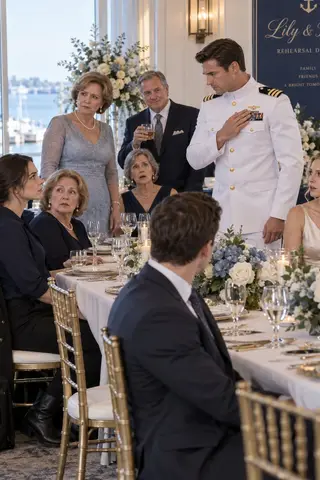
 My Mom Put Me at the "Loser Table" at My Sister’s Wedding Rehearsal
Chapter 29
The Glass Pavilion
Six months after the winter storm, the summer sun broke over Elliott Bay with radiant warmth, painting the Seattle skyline in brilliant strokes of gold and azure. Along the historic waterfront, thousands of citizens, university faculty, naval officers, and civic leaders had gathered for the formal grand opening of the David Hayes Memorial Center for Maritime Preservation.
The completed building was an architectural masterpiece. Constructed with soaring timber arches reclaimed from historic shipyards, anchored by deep-water concrete caissons, and enclosed by sweeping curtain walls of ultra-clear structural glass, the pavilion appeared to rise directly out of the Pacific tide like a magnificent vessel setting sail toward the horizon.
Inside the grand exhibition hall, sunlight poured over restored historic lifeboats, interactive marine science laboratories, and a bronze memorial wall honoring fallen coastal service members.
Lily Walker stood at the top of the central amphitheater staircase, wearing an immaculate linen navy suit, her face glowing with genuine happiness. Beside her was Ryan, who had received the Navy Commendation Medal for his heroic seamanship during the winter ferry rescue, his posture upright and proud. Surrounding them were hundreds of architecture students and community members who had come to celebrate Lily’s graduation and the completion of her visionary design.
"Thank you, everyone," Lily’s voice echoed smoothly across the vaulted cedar ceiling as she addressed the crowd. "When my father was lost at sea nineteen years ago, I believed that duty was something that took people away from us. I believed that honor was a cold, lonely thing that demanded silence and sacrifice while the rest of the world looked away."
She paused, turning her gaze toward the front row.
Sitting in the place of highest honor, flanked by city mayors and university regents, was Rear Admiral Nora Hayes. She wore her crisp summer white uniform, the four rows of combat ribbons and her aviator wings gleaming beneath the soaring glass ceiling.
"I know now that true honor does not abandon us," Lily said, her voice rich with profound emotion. "True honor is the invisible foundation that holds up our homes, our communities, and our lives. My sister, Admiral Nora Hayes, carried the weight of our family’s security in the dark so that I could one day stand in the light and build something that would last. This center does not belong to the wealthy, the entitled, or the vain. It belongs to the brave men and women who keep watch over our shores, and to the generations who will learn to love this sea."
The applause that followed rolled through the glass pavilion like thunder. City officials presented Lily with the Northwest Architectural Achievement Medal, while maritime scholars lined up to shake her hand.
Outside the grand glass entrance, across the busy four-lane coastal boulevard, an elderly woman in a faded polyester trench coat stood near a municipal bus shelter. It was Diane. She held a plastic grocery sack in one hand, her face lined with deep, bitter exhaustion as she squinted across the traffic toward the gleaming pavilion.
Through the transparent glass walls, Diane could clearly see Lily laughing warmly as Ryan embraced her, surrounded by mayors, admirals, and distinguished scholars who hung on her every word. She saw Nora standing beside them, radiant, commanding, and revered as a national hero.
Diane took a trembling step toward the crosswalk, clutching her coat collar, an old, pathetic urge rising within her to cross the street, demand recognition, and claim her share of the glory.
But as the pedestrian signal changed, Diane looked down at her scuffed shoes, then back at the brilliant, impenetrable fortress of honor her daughters had built without her. She realized, with a final, crushing finality, that there was no table reserved for her in that room. There were no false words that could open those doors.
A city bus pulled up to the curb with a hiss of air brakes, blocking her view. Diane turned around, climbed the metal steps into the dim interior of the bus, and vanished into the gray sprawl of the city suburbs.
The End









