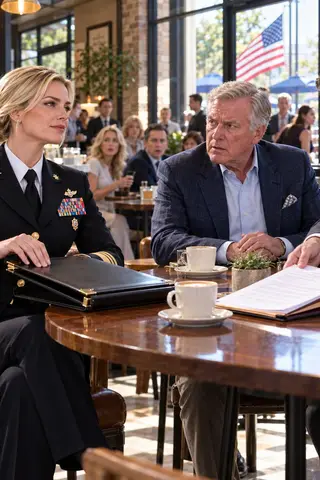
 My Millionaire Parents Skipped My Military Promotion For A BBQ, But 4 Years Later Dad Begged Me To Sign Away My $650K Inheritance
Chapter 4
What Hiram Left Behind
The silence that followed our exit from the country club lasted exactly thirty-six hours before the counter-attack arrived.
My phone did not ring. Instead, my commanding officer at the regional legal service office called me into his office at zero eight hundred on Thursday morning.
Captain Thomas Miller was an old-school naval officer who had served two tours in the Persian Gulf before attending law school. He sat behind an immaculate oak desk, looking down at a formal complaint letter stamped with overnight courier delivery markings.
"Take a seat, Commander," Miller said, gesturing to the leather chair across from him.
I sat down, spine straight, cover resting in my lap. "Yes, sir."
"I received an official complaint this morning from a prominent commercial developer in Savannah," Miller began, leaning back. "One Royce Sinclair. He alleges that an active-duty Navy JAG officer attended a private civilian political and business reception in full military dress uniform for the explicit purpose of intimidating a private citizen in a civil property dispute."
I took a slow breath. "Sir, I attended a public reception at a commercial venue to deliver legal notice in a matter regarding my grandfather's estate, in which the trustee has committed extensive fiduciary violations."
"Did you wear your Service Dress Blues?"
"I did, sir."
Miller sighed, rubbing the bridge of his nose. "Laura, you know the regulations as well as I do. Department of Defense Directive 1334.1. Wearing the uniform to private business functions or civil confrontations creates the appearance of military endorsement or coercion."
"The venue was open to ticket holders, sir, and I entered with an invitation purchased through the municipal association. But I accept responsibility for the appearance."
Miller looked at me for a long moment. Then, to my surprise, he pushed the letter into his desk drawer and slammed it shut.
"Your father called my direct line three times this morning before seven o'clock," Miller said dryly. "He demanded you be subjected to immediate non-judicial punishment. He threatened to contact the Secretary of the Navy. He spoke to me as if I were a junior sub-contractor who had failed to pour his concrete on schedule."
"I apologize that you had to endure that, Captain."
"Don't apologize," Miller said, a slight smirk touching his lips. "I spent twenty minutes listening to that blowhard scream about his political connections before I looked up his name in the state court registry. I see what he’s doing. He’s trying to use your military career as leverage to force you into a settlement."
"He thinks the threat of an administrative reprimand will make me sign."
"Well, he picked the wrong commanding officer," Miller said flatly. "You get an informal counseling note on your service file regarding uniform wear at private civilian disputes. It goes nowhere. It affects nothing. But you get Marcus Sterling to tear that man's books apart, Commander. Do you understand me?"
"Aye, aye, sir."
When I left the base that afternoon, I drove straight to Grandfather Hiram’s old property out on the marsh.
The parcel on Highway 17 wasn't just commercial land. Tucked behind the scrub pines and overgrown sweetgum trees sat Hiram’s original wooden workshop. The roof had begun to sag under the weight of pine straw, but the heavy padlock on the door was still intact. I had kept the brass key on my military dog-tag chain since the day he passed away.
Jack met me there with a heavy flashlight and a crowbar, just in case the hinges had rusted shut. With a sharp groan of weathered iron, the workshop door swung inward.
The air inside smelled of cedar shavings, WD-40, and old engine oil—the exact scent of my childhood summers. Hiram had built skiffs in this shop. He had taught me how to splice three-strand nylon rope, how to sharpen a chisel, and how to look a dishonest man in the eyes without flinching.
"Over here," Jack called out, shining his beam toward the corner of the workshop.
Behind an old work bench piled with rusted winches sat a green steel filing cabinet. It was covered in layers of dust and cobwebs, but Hiram had spray-painted his initials across the top drawer: H.S. - 1982.
I pulled out the brass key's smaller twin from my ring and inserted it into the cabinet lock. It turned with a dry click.
Inside the bottom drawer were six thick leather-bound ledgers. Hiram had kept his own accounting long before Royce ever established Sinclair Horizon Properties. And wedged between the third and fourth ledgers was an unsealed manila envelope labeled in Hiram’s shaky, deliberate handwriting:
To Laura – When Royce Thinks He’s Won.
My hands shook as I pulled out three folded pages dated barely two months before Hiram’s death.
It was a holographic codicil, witnessed and notarized by a retired county probate judge who had been Hiram’s fishing partner for forty years. Hiram knew his son. He knew Royce’s vanity, his recklessness, and his bottomless appetite for status.
“If my son Royce attempts to alter the equal division of my properties between my grandchildren Laura and Brielle,” the document read, “or if he encumbers the core assets for his private commercial ventures, the testamentary trust shall immediately terminate, and full executory authority shall transfer exclusively to Laura Sinclair Terrell.”
I sat down on an overturned wooden crate in the center of the dusty shop and wept. Grandfather Hiram had never abandoned me. He had simply left me the coordinates for the battlefield.
The End









