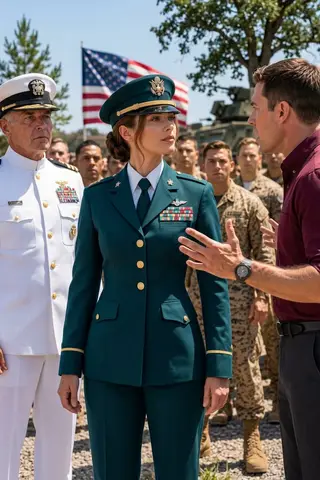
 My Marine Brother Ripped My Visitor Badge to Humiliate Me
Chapter 9
The Brotherhood’s Debt
Twenty minutes later, Gunnery Sergeant Reed stepped into the tent. He looked at my father and nodded respectfully, but his eyes were focused on me.
"Ma'am," Reed said. "If you have a moment. There are a few people who drove down from Oceanside when they heard."
I stood up, smoothed down my blazer, and walked out of the tent into the bright California sun.
Standing in a semi-circle near the static display of an armored recovery vehicle were five men. None of them were in uniform. They were older, in their late thirties and early forties, wearing civilian clothes—jeans, t-shirts, ballcaps. One of them leaned heavily on an aluminum cane. Another had prosthetic scarring visible along his neck. A third wore dark sunglasses, his posture rigid and calm.
Beside them stood Kowalski and three other Marines from Tyler’s company.
When I approached, the five men in civilian clothes stopped talking. They looked at me with an intensity that made the surrounding air feel thick with reverence.
"Ellie," Reed said softly, stepping between us. "This is Miller. He was the point man. That's Jackson with the cane; he took the shrapnel to his hip. That's Doc Alvarez; he was keeping our radioman alive with one hand and firing his sidearm with the other."
The man named Miller, a lean guy with salt-and-pepper hair, took off his ballcap. His eyes were clear, steady, and brimmed with emotion.
"We waited seven years to meet the voice on the other side of that radio," Miller said, his voice remarkably soft. "They told us your unit didn't exist. They told us your call sign was classified under a special access program and we’d never get a name."
"Protocol is strict, Miller," I said, my voice warm. "You know how it is."
"Yes, Ma'am," Miller nodded. He reached into his pocket and pulled out a worn, tarnished brass compass. It had been scratched and dented by combat, its glass face cracked down the middle.
"Jackson was carrying this when we got hit," Miller said. "We made a pact in the hospital at Landstuhl that whoever kept that compass would give it to the woman who pulled us out of the valley."
Jackson stepped forward, leaning on his cane, and took the compass from Miller. He held it out to me with both hands, his knuckles white with effort.
"We have eleven kids between the five of us, Ma'am," Jackson said, his voice trembling slightly. "None of them would be here today if you hadn't stayed on that radio. None of us would have seen another sunrise. Please... take it."
I looked at the scarred compass, feeling the immense weight of what it represented. In the intelligence community, we worked behind digital screens and satellite maps, detached from the physical reality of the lives we handled. But here, standing on this tarmac, the consequence of my service was staring back at me with names, heartbeats, and families.
I reached out and took the compass, closing my fingers around the warm, dented brass.
"Thank you," I whispered. "It was an honor to bring you home."
Behind us, standing near the edge of the crowd, Tyler watched in silence. His hands were unclenched. His eyes were wide with a profound, quiet humility. He was finally beginning to understand what true service meant.
The End









