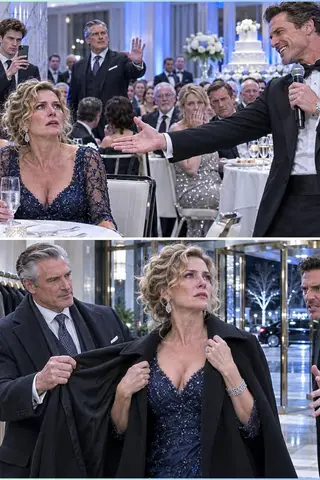
 My Husband Auctioned Me For $500 At His Company Gala
Chapter 1
The Five-Hundred-Dollar Punchline
The ballroom of the Hawthorne Grand was bathed in the kind of sterile, blue-tinted uplighting that made everyone look like they were auditioning for a low-budget sci-fi film. White tablecloths stretched across forty round tables, and the air smelled heavily of expensive perfume, stale champagne, and the lingering dread of corporate politics. It was Northline Components’ fifteenth-anniversary gala, a night designed to celebrate loyalty, longevity, and the relentless pursuit of quarterly growth.
My husband, Derek Monroe, loved nights like this.
For nineteen years, Derek had climbed the corporate ladder at Northline, clawing his way from a mid-level regional sales rep to a regional sales manager who considered himself the uncrowned king of the Midwest division. He was a man who thrived on ambient noise, clinking glasses, and the sound of his own voice echoing off high ceilings. He could charm a client into a multi-million-dollar contract while completely forgetting his wedding anniversary, a scheduling conflict he managed to solve year after year by simply letting me plan a dinner we both pretended to enjoy.
I sat at Table Twelve, staring down at my half-eaten prime rib. A single red juice stain from a rogue cherry tomato had bled into the white mashed potatoes on my plate, forming a small, jagged pool. For some absurd reason, my mind latched onto that tomato. I found myself thinking that someone really ought to clean it up before the waiter came back to clear the courses.
Around me, the room hummed with laughter. The main course had been cleared, and the bar was doing brisk business. People were loosening their ties, kicking off their shoes beneath the tables, and leaning in close to share office gossip that would inevitably fuel Monday morning watercooler chats.
Then came the moment that sliced through the ambient noise like a jagged blade.
Derek had walked up to the mahogany podium where the corporate awards usually lived. He had tapped the wireless microphone—tap, tap, tap—sending a harsh, metallic screech through the speakers that forced two hundred people to turn their attention toward the stage. He had a glass of scotch in one hand, his tie slightly loosened at the collar, and that brilliant, flashing sales-rep grin plastered across his face.
I didn’t think much of it at first. Derek loved the spotlight. He was probably going to make a joke about the company CEO, Grant Holloway, or tell a rambling story about their last golf trip in Scottsdale.
Instead, he scanned the room, his eyes sweeping lazily over the tables until they landed squarely on Table Twelve. On me.
“Before we cut the sheet cake,” Derek announced into the microphone, his voice booming with casual arrogance, “I want to offer a special liquidation sale to anyone in this room.”
A few chuckles rippled through the audience. People liked Derek. He was the life of the party, the guy who bought the first round and told the best jokes.
Derek raised his free hand, gesturing broadly in my direction as if he were unveiling a slightly used appliance on a late-night infomercial.
“Five hundred dollars,” Derek announced. “That’s what I’ll pay any man in this room willing to take my wife off my hands.”
The ballroom erupted.
At first, it was the polite, nervous laughter of people who weren't quite sure if they had heard the punchline correctly. But as Derek’s smile widened, feeding off the attention, the laughter swelled. Glasses clinked. People leaned across tables to look at me.
Not everyone laughed.
That distinction would matter to me later, etched into my memory like acid. But at the exact second those words left his mouth, all I could hear was the collective roar of amusement.
“Come on, Claire,” Derek called out, his arm still stretched toward me like a game-show host showcasing a kitchen refrigerator. “Stand up so they can see what they’re getting.”
My body turned to ice. My fingers locked around my water glass so tightly my knuckles turned translucent.
Across the room, a woman named Natalie Pierce covered her mouth with one hand, nearly spitting her Chardonnay across her napkin. Two weeks earlier, I had spent three hours helping Natalie track down a rare, vintage brooch for her mother’s seventieth birthday. Now, she leaned over to the man sitting beside her, whispered something behind her palm, and let out a sharp, breathless giggle.
Derek loved the reaction. He leaned closer into the mic, his chest puffing out under his tailored charcoal suit.
“Low mileage,” he continued, milking the crowd like a seasoned stand-up comic. “Good cook. Quiet most of the time. Comes with her own handbag.”
More laughter. Waves of it washing over Table Twelve.
“And trust me,” Derek added, winking at the front row, “the handbag is worth more than anything inside it.”
My stomach heaved. The warmth of the ballroom suddenly felt suffocating, sucking every oxygen molecule out of the air. I couldn’t breathe. I couldn’t look up. I stared down at my plate, watching the red tomato juice slowly spread across the white porcelain, wishing the earth would open up and swallow the entire table—linen, silverware, and me.
Then, out of the corner of my eye, movement caught my attention.
Near one of the massive decorative columns at the edge of the ballroom stood our twenty-seven-year-old son, Owen. He was home for the weekend, having driven down from Chicago where he worked in junior data analytics. Owen was leaning casually against the marble pillar, his smartphone held up at chest height.
He was recording.
My heart seized. A cold, sharp pain pierced my chest. I stared at him, willing him with every fiber of my being to lower the device, to look at his mother with horror, to realize what his father was doing to me.
Owen caught my gaze across the crowded room.
For one breathless second, I thought he would drop his hand. I thought he would see the absolute devastation written across my face and put the phone away.
Instead, he adjusted the angle of the screen, his thumb tapping the record button to ensure a better frame.
Something inside me didn’t break. It went dead silent. A profound, terrifying stillness settled over my mind, clearing away thirty-one years of Stockholm syndrome in a single, freezing second.
Derek kept talking, completely oblivious to the tectonic shift happening inside his wife’s soul.
“Who wants a wife like this? Five hundred bucks. I’ll pay you. Just don’t return her after thirty days.”
Someone near the back shouted, “Does she come with instructions?”
Derek laughed, throwing his head back. “Oh, plenty! Mostly complaints about the thermostat and my golf schedule!”
That was when a chair scraped loudly against the polished parquet floor.
The laughter died down, thinning out as people turned to see who had interrupted the show.
Standing near the back of the room, tall and imposing, was Grant Holloway.
President of Northline Components. Derek’s boss.
Grant was in his early fifties, broad-shouldered, with silver threading through his temples and the permanently exhausted expression of a man who carried the financial well-being of five hundred families on his shoulders. He didn’t wear a tuxedo like the other executives; his charcoal suit was immaculate, tailored, and entirely understated.
He raised one hand.
The room went instantly, suffocatingly silent. You could hear the distant hum of the industrial air conditioning units and the faint clink of silverware three tables away.
Derek blinked under the stage lights, his smile faltering for a fraction of a second before he recovered it.
“Whoa,” Derek chuckled nervously into the mic. “Big spender in the back row. Grant, are you placing a bid?”
Grant didn’t smile. Not even a twitch at the corner of his mouth.
“I’ll give you the five hundred, Derek,” Grant said. His voice wasn’t loud, but it carried effortlessly across the cavernous room without the aid of a microphone.
A collective ripple of nervous tension moved through the audience. People exchanged bewildered glances. Was the CEO actually playing along? Was this part of some corporate roast they hadn’t been briefed on?
Derek laughed uncertainly, shifting his weight from one foot to the other. “For Claire?” he asked, pointing his scotch glass at me.
“No,” Grant said.
The single word fell like an iron weight on the hardwood floor.
“I’ll give you five hundred dollars,” Grant continued, stepping out from the shadows of the back row into the pool of warm overhead light, “if you put down the microphone right now and let your wife leave this room with her dignity intact.”
Nobody laughed. You could have heard a pin drop on a velvet rug.
Derek’s face underwent a subtle, terrifying transformation. The smile remained plastered across his lips, but all the warmth, all the charm, completely drained from his eyes. It was a look I knew intimately—the look of a man who had just realized he had miscalculated his audience and was desperately trying to salvage his ego.
“Come on, Grant,” Derek forced out, his voice pitching slightly higher than normal. “It’s a joke. Everyone knows it’s a joke.”
“It stopped being funny a long time ago, Derek,” Grant replied, his tone chillingly even.
I pushed my chair back. The legs groaned against the floor. My knees felt weak, shaking so violently I wasn’t sure they would support my weight.
Derek snapped his head toward me, panic finally breaking through his arrogant facade. “Claire, sit down.”
I stood up.
That single movement shocked the room more than anything Grant Holloway had said. For thirty-one years, Claire Monroe had been the invisible anchor of Northline’s social ecosystem—the woman who smiled politely at terrible jokes, sent thank-you notes for awkward hostess gifts, and absorbed every public slight with quiet, dignified grace.
I reached down, picked up my black leather handbag from the back of the chair, and looped the strap over my arm.
Derek took a step forward from the stage, his expression hardening. “Claire, what are you doing? Sit down.”
“I agree,” I said clearly.
The microphone caught the tremor in my voice, amplifying it across the room.
Derek blinked, completely disoriented. “What?”
“I agree to leave.”
The ballroom became a vacuum. You could have heard a snowflake hit the windowpane outside.
Derek stepped off the small wooden stage, closing the distance between us down the center aisle. “Claire, don’t be ridiculous. I was just warming up the crowd.”
“You asked who wanted me gone,” I replied, looking straight into his eyes for the first time all evening.
“That isn’t what I meant, and you know it.”
“It’s exactly what you said, Derek.”
“I was joking!”
“Then,” I said, my voice dropping into a register so cold it surprised even me, “you should have told a better joke.”
I turned my back on my husband of three decades and began walking toward the grand double doors at the back of the ballroom.
Every single head turned to watch me go. Two hundred pairs of eyes burned into my spine. When I passed Table Four, I caught a glimpse of Natalie Pierce staring at her water glass, her face flushed red with shame.
When I reached the decorative pillar where my son was standing, I stopped.
Owen was still holding his phone, though the screen was now pointed toward the floor.
“Mom,” he murmured, stepping into my path. “Dad was just messing around. You’re making a huge deal out of nothing.”
I looked up at my twenty-seven-year-old son, a young man I had raised, protected, and coddled for nearly three decades, and I saw something that shattered my heart far more than Derek’s public auction.
Confusion. Not cruelty. Not malice. Just absolute, profound bewilderment.
Owen genuinely did not understand why I wasn’t laughing. He didn’t understand why a public humiliation warranted a walkout. And in that instantaneous flash of clarity, I realized the terrifying truth: I had taught him this. I had spent his entire life modeling compliance, teaching him by silent example that his father’s cruelty was just “how Dad is,” and that a wife’s primary job was to smooth the tablecloth, swallow her pride, and make everyone else comfortable again.
“I know you think that, Owen,” I said quietly, reaching out to gently touch his shoulder—the same shoulder I used to hold when he scraped his knees as a little boy.
Then, I walked past him, pushed open the heavy mahogany doors, and stepped out into the lobby.
Behind me, the silence of the ballroom broke open into a chaotic wall of whispers.
The End









