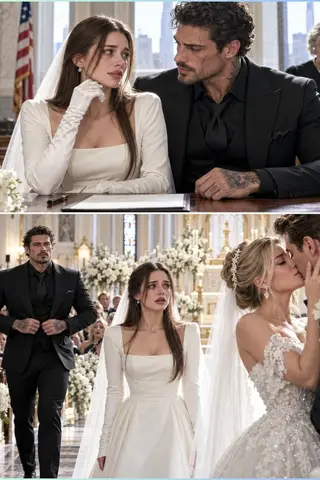
 My Fiancé Kissed My Sister at the Altar, Unaware the Mafia Boss He Feared Was Sitting in the Last Row
Chapter 2
The Shadows of Manhattan
The Pierre Hotel rose above Fifth Avenue like a limestone fortress, its copper mansard roof cutting into the gray Manhattan mist. At precisely ten minutes to ten on Wednesday morning, I stepped into the brass-trimmed elevator, clutching a weathered leather portfolio under my arm. Inside were the genuine documents: the hand-annotated trust agreements my mother had entrusted to her private corporate attorney, Mr. Harold Vance, days before she entered hospice. My father had spent a decade showing me forged summary letters, convinced the real ledgers had been burned in the estate warehouse fire eight years ago.
The elevator opened directly into the private foyer of the top-floor penthouse. Two men in charcoal suits, broad-shouldered with earpieces tucked discreetly behind their ears, stepped forward. Neither spoke. One held out a hand for my handbag while the other ran a handheld wand over my coat with practiced efficiency. Finding nothing more lethal than a silver fountain pen, the taller man gestured toward a set of double walnut doors.
"Mr. Moretti is in the library."
The library was cavernous, smelling of aged cedar, expensive tobacco, and rain drifting through a cracked terrace window overlooking Central Park. Roman Moretti was standing behind an enormous mahogany desk, reading through a stack of legal briefs.
Seeing him in person was far more jarring than reading about him in the financial pages. The tabloids called him a ruthless syndicate boss who had clawed his way to the top of New York's underworld through violence and fear; Wall Street called him an untouchable private equity magnate who liquidated bad debtors without pity. He was thirty-seven, tall and broad-shouldered, with sharp, aristocratic cheekbones, dark hair graying faintly at the temples, and eyes the color of winter frost. A thin, jagged scar ran from the edge of his left eyebrow down to the top of his ear—the only visible souvenir of the war that had claimed his older brother five years ago.
He didn't look up immediately. He signed a document, capped his pen, and then raised his gaze to meet mine.
"You don't look like a woman whose wedding is three days away," Roman said, leaning back in his leather chair.
"And you don't look like a man who needs a society bride to secure a shipping dock," I countered, walking across the room and placing the leather portfolio directly on his desk.
Roman looked at the portfolio, then at me. "Your father offered me Vivian because he believed she was malleable. He assumed that after six months of marriage, he could use her tears to negotiate extensions on his debt."
"Vivian would have folded within forty-eight hours," I said coldly. "She doesn't understand shipping routes, municipal zoning, or commercial debt covenants. She only understands how to look helpless so men will do her bidding. I, on the other hand, spent four years working as my mother’s junior analyst before my father exiled me to client relations."
Roman unbuckled the leather strap and opened the folder. He flipped through the yellowed pages, his sharp eyes scanning the notary seals, the corporate bylaws, and the explicit clause my mother had drafted: In the event of a fraudulent conveyance by the trustee, the voting rights to the harbor terminals revert entirely and immediately to Arya Hart upon presentation of this instrument to the municipal registrar.
A slow, razor-thin smile touched the corner of Roman’s mouth. "Edward Hart has been running his business on borrowed time for ten years."
"Twelve," I corrected him. "He used Hartwell capital to finance his mistress’s lifestyle in the Hamptons and Damian Lockwood’s initial private equity funds. When Damian realized my father was sinking, he didn't run. He made a deal. He promised to keep my father afloat in exchange for my shares once we married. And to ensure my father complied, Damian took Vivian as his personal insurance policy."
Roman closed the portfolio with a soft thud. He stood up, towering over me, radiating a quiet, suffocating gravity that made the spacious room feel suddenly very small. He walked around the desk until he was standing barely two feet away.
"You're remarkably calm for someone who just discovered her life was an orchestrated fraud," he observed.
"I spent yesterday crying," I replied, meeting his gaze without flinching. "I don't intend to waste tomorrow on tears."
"And Damian Lockwood?" Roman asked, his voice softening by a fraction, though the chill remained underneath. "He’s an ambitious boy with a high-priced wardrobe. Do you still love him?"
"I loved the man I pulled out of a burning car on an Albany turnpike six years ago," I said, my voice steady and unwavering. "That man died the day he decided my mother's life work was a prize to be stolen with my sister. Today, Damian Lockwood is simply an obstruction."
Roman studied my face for several long moments. There was no pity in his expression—only a deep, dangerous recognition. Men like Roman Moretti recognized cold fury when they saw it, because they had built empires upon it.
"My attorneys have drawn up the prenuptial covenant," Roman said, turning toward the window. "We marry at the Manhattan municipal court on Saturday morning at eight o’clock. Quietly. Two witnesses, sealed records until Monday morning. You will wear my ring under whatever gown you choose for your church. At eleven o'clock, you will arrive at St. Catherine’s Chapel."
"And you?"
"I will be sitting in the back pew," Roman said, turning back to me, his silver eyes flashing with dark amusement. "I enjoy high-society weddings, Arya. Especially the ones where the groom forgets who truly owns the room."
The End









