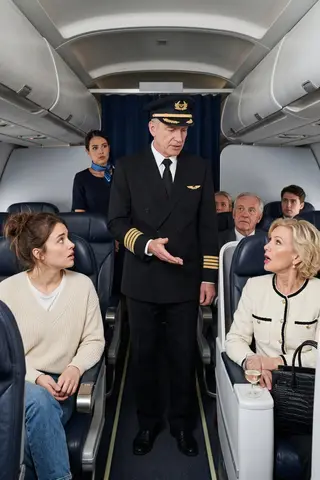
 My Evil Stepmother Put Me in Seat 31B to Humiliate Me
Chapter 2
The Fall and the Foundation
The view from Seat 1A was different than it had been two hours ago, not because the clouds looked any softer, but because the silence surrounding me was earned through blood, sweat, and absolute discretion. As the Boeing 777 finally roared down the JFK runway and lifted smoothly into the gray winter sky, I took out my leather-bound notebook and let my thoughts drift back to the beginning of this war.
Two years ago, my mother, Eleanor Bennett, died in a sterile hospital room while my father was four thousand miles away in Saint-Tropez, closing an offshore real estate venture alongside his then-mistress, Patricia.
My mother had built Richard Bennett from the ground up. In their twenties, she was the brilliant contract attorney who drafted his company charters; she was the one who mortgaged her family’s legacy farm to fund his first venture capital fund. But Richard had a weakness common among self-made men: he loved the illusion of royalty. And when my mother grew ill, her quiet, understated grace became an inconvenience to him.
Enter Patricia Vance-Holloway—a social climber with two failed high-society marriages, an insatiable appetite for designer goods, and a son, Mason, whose primary skill was failing out of prestigious business schools. Patricia didn’t build anything. She harvested.
Within three months of my mother’s passing, Patricia had moved into our family estate in Greenwich, Connecticut. Within six months, her portrait hung where my mother’s oil painting used to be.
I will never forget the day Patricia summoned me into the conservatory.
She was draped in ivory silk, flipping through architectural magazines. “Nora, dear,” she had purred without looking up. “Mason needs the carriage house for his creative studio. Your childhood things are being boxed up today. Also, Richard agreed that keeping your mother’s charitable foundation open is simply a tax redundancy. We’re rolling those assets into Mason’s luxury lifestyle brand.”
I turned to my father, who was standing by the French doors, pretending to read the financial section of the morning paper.
“Dad?” I had asked, my voice shaking with grief and disbelief. “You’re giving away Mom’s foundation? The one she used to fund pediatric clinics?”
Richard cleared his throat, unable to meet my gaze. “Nora, Mason has modern ideas. We have to adapt. Besides, your mother was always too conservative with our portfolio. Patricia understands branding.”
That was the exact moment something hard and unbreakable crystallized inside my chest. Grief is an ocean that can either drown you or carry your ship forward. I chose the latter.
“I understand,” I told them quietly that afternoon.
The next morning, I packed two suitcases. I relinquished my claim to my bedroom in the family home. I put my luxury Tribeca condo on the market and sold it within seventy-two hours at a slight discount for liquid cash. The social circuit erupted in vicious whispers. Patricia made sure of it. At every charity luncheon, she sighed theatrically, telling my mother’s old friends that poor Nora had suffered an emotional breakdown, made reckless investments, and was now burning through her inheritance.
When I stopped attending the seasonal polo matches and the Hamptons fundraisers, Patricia declared me a failure. When I bought an old, unrenovated warehouse in Long Island City and spent twenty-hour days hunched over dual monitors surrounded by corporate restructuring lawyers, she told my father I was living like a derelict.
What Patricia didn't know—what no one outside of four top-tier Wall Street attorneys knew—was that Bennett Aero Holdings wasn’t my father’s company. It was founded by my maternal grandfather in the late 1960s as a regional freight line before morphing into a massive aviation infrastructure trust.
My father had sat on the board for twenty years solely through my mother’s proxy shares. When she died, those shares didn't pass to Richard. They passed into an irrevocable spendthrift trust under my exclusive name, locked behind a performance covenant: if I could privately raise two hundred million dollars to absorb the airline’s legacy pension obligations during its post-pandemic restructuring, total voting control would transfer from the board to me.
For twenty-four agonizing months, I didn't buy clothes. I didn't go on vacations. I partnered with sovereign wealth syndicates, brokered wet-lease aircraft deals in Singapore, and restructured the debt until every creditor signed off on my leadership.
I let them believe I was broken. I let them treat me like an embarrassment. Because a predator who thinks you are harmless never looks over their shoulder.
The flight attendant arrived at my seat, placing a chilled glass of sparkling water on my console.
“Ms. Bennett,” she whispered reverently. “The passenger in seat 2B—your father—has asked twice if he can speak with you.”
I looked out the window at the endless white blanket of clouds below.
“Tell him,” I replied softly, “that I am currently occupied reviewing the airline's executive board roster. He will have to wait until we land.”
The End









