 My Daughter-in-Law Moved Her Parents Into My Home
Chapter 9
The Truth Heals
The six months that followed were a whirlwind of legal restructuring, financial untangling, and deep, quiet healing.
Kendall’s high-priced defense attorney attempted every legal maneuver in the book to suppress the evidence found in Douglas’s cardboard box, but Arthur Vance’s legal filings were impregnable. Faced with overwhelming documentary proof of wire fraud, bank forgery, and tax evasion, Kendall accepted a plea bargain.
She pleaded guilty to two counts of felony bank fraud and one count of identity theft. In exchange for avoiding a lengthy state prison sentence, she was sentenced to five years of supervised probation, required to pay full restitution to Beaufort County Bank, and surrendered all claims to Carter’s assets, his father’s estate, and the Daniel Island property.
Douglas Miller was extradited back to Georgia to face criminal contempt and fraud charges, ultimately receiving an eight-year sentence in state custody. Rita, penniless and stripped of her social pretensions, moved to a subsidized senior living community outside Augusta, entirely cut off from the Charleston family she had tried to exploit.
Most importantly, the family court awarded Carter sole legal and physical custody of Harper and Miles. Kendall was granted limited, supervised virtual visitation twice a month, contingent upon completing intensive psychological counseling and remaining current on her criminal probation.
The foreclosure on the Daniel Island house was finalized, but Carter didn't mourn it.
With Arthur’s help, Carter liquidated his remaining commercial warehouse interest, paid off the forged bank lien at a negotiated settlement discount, and walked away with clean credit and his self-respect fully intact.
He didn't look for a new suburban tract house.
Instead, he purchased a charming historic carriage house three blocks down from Tradd Street, on Church Street, within easy walking distance of my front porch.
During those six months, the grand old house at 44 Tradd Street came alive in ways Warren and I could have only dreamed of.
The four empty bedrooms on the second floor were no longer empty.
One became Harper’s art studio, where the walls were covered in her watercolor paintings of the Charleston harbor, bright pink sunbursts, and drawings of our golden retriever puppy, Barnaby, whom Carter had adopted for the children.
The second bedroom became Miles’s dinosaur kingdom. The polished heart-pine floors Warren had sanded by hand were now home to sprawling Lego castles, wooden train tracks, and miniature prehistoric jungles set among velvet cushions.
The third bedroom became Carter’s home study, where he rebuilt his private wealth management practice on a foundation of absolute transparency and peace of mind.
And the fourth bedroom—the corner suite that Kendall had so arrogantly tried to seize for her parents—became the family library and music room, where an upright piano sat against the wall, filling the high ceilings with Harper’s stumbling, joyful renditions of nursery rhymes.
One Friday afternoon in April, when the sweet jasmine was blooming thick along the piazza railings and the scent of magnolias hung sweet in the warm salt air, Carter and I sat on the porch swing.
Harper and Miles were in the garden below, chasing fireflies in the twilight, their laughter ringing like silver bells against the historic brick walls.
Carter looked at me, a glass of iced tea resting on his knee. He looked ten years younger. The hollow, haunted tension that had gripped his face for a decade had vanished, replaced by the calm, steady strength of a man who knew who he was.
“You saved my life, Mom,” Carter said softly.
I smiled, reaching over to take his hand. “You saved your own life, Carter. You just needed to remember whose son you were.”
“I used to think keeping the peace meant giving people whatever they demanded,” he admitted, watching Harper catch a firefly in her cupped palms and gently release it into the azalea bushes. “I thought if I gave Kendall enough money, enough status, enough control, she’d finally be happy, and our family would be safe. I didn't see that some people don't want peace—they just want power.”
“Peace without boundaries isn't peace, Carter,” I told him. “It’s surrender. Your father spent his entire life building things that would endure: this house, our family, our name. You don't protect an enduring legacy by letting parasites chew through the foundation.”
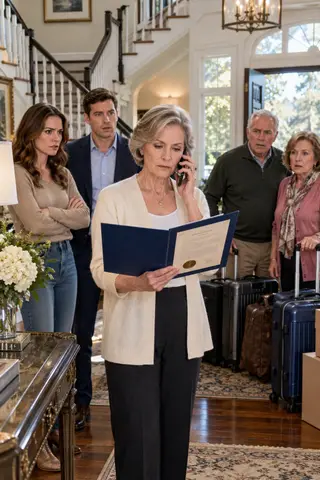
Carter smiled, squeezing my fingers. “Dad would be proud of you. You stood on that threshold with that blue folder like a general defending a fortress.”
“I wasn't defending a fortress,” I said, looking out over the garden. “I was defending a home. There’s a difference.”
The End









