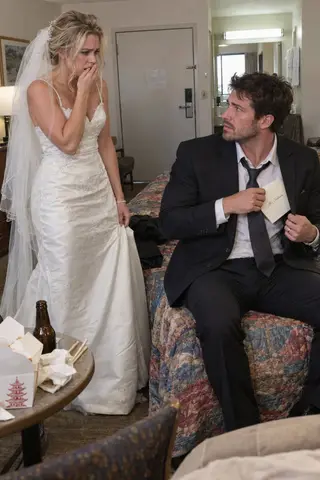
 My Billionaire Dad Offered My Mechanic Husband $500,000 to Walk Away on Our Wedding Night
Chapter 1
The Weight of a Dandelion
The afternoon sun beat down through the high wire-mesh windows of room 204, casting long, dusty rectangles across the linoleum floor. In high school, you don’t think about class rosters as instruments of destiny; you think about them as arbitrary torture devised by administrators who enjoy separating you from your friends. When Mr. Hanley, our chemistry teacher with ink-stained fingers and chronic sleep deprivation, pointed toward the empty lab stool next to me and told Leo Martinez to sit there, my world changed by pure, unapologetic coincidence.
My last name was Sterling. His was Martinez. Alphabetical seating.
By the end of that first class, I knew he was funny. Not in the loud, obnoxious way the varsity football players tried to command attention, but in a dry, observational way that made me snort into my safety goggles. By the end of the semester, I knew he was smarter than he let people think. He didn't just memorize the periodic table; he understood how things bonded, how elements reacted under pressure, and how to fix things that looked entirely broken. By graduation, I knew I loved him with a quiet, terrifying certainty that completely defied the blueprint my parents had meticulously drawn for my life.
Our worlds were not just different; they existed on entirely separate planets.
My parents lived behind wrought-iron security gates in Oakridge, an exclusive enclave where the houses looked like European estates and the lawns were manicured by invisible crews. My father, Richard Sterling, was a titan of commercial real estate development. If a skyscraper went up downtown, his signature was usually on the financing. My mother, Elaine, spent her days chairing charity galas, serving on museum boards, and mastering the unspoken social hierarchies of the country club. I grew up surrounded by imported marble, private tutors, ski trips to Aspen, and expectations so heavy they felt like lead weights sewn into the lining of my clothes.
Leo grew up across town in a cramped, two-bedroom apartment that always smelled faintly of cinnamon and laundry detergent. His mother, Rosa, was a force of nature who worked double shifts—mornings at a medical clinic and evenings cleaning rooms at a corporate hotel. Leo started working when he was fourteen. He didn’t have the luxury of summer camps or unpaid internships. He stocked grocery shelves, mowed overgrown lawns, and eventually found his way to Miller’s Auto Repair, a greasy, sun-baked garage where old man Miller taught him how to listen to an engine before ever picking up a wrench.
My parents noticed those differences immediately. They tolerated Leo during high school because teenagers are fleeting, and they assumed a mechanic’s apprentice was nothing more than a youthful rebellion—a phase I would outgrow the moment I stepped foot on a college campus.
They were wrong.
As the years stretched on, Leo didn't fade away. He became more anchored in my life, and I in his. I watched the way he treated people. He remembered the name of the woman who served us fries at the diner. He carried heavy bags of groceries upstairs for his mother without ever being asked or thanked. He never laughed when someone stumbled over an answer in class. And every single morning before first period, without fail, he would be standing by my locker holding three or four wildflowers he’d plucked from the overgrown patches along his walk to school.
Some were vibrant and fresh. Some were basically weeds. Once, he handed me a drooping dandelion and said, straight-faced, "This one looked confident."
I pressed that dandelion inside the pages of my college chemistry textbook, where it remained long after the binding cracked.
When I was twenty-two, Leo became concerning to my parents. When I was twenty-six and he finally asked me to marry him with a ring he’d saved up for six months to buy—a delicate silver band with a tiny, imperfect sapphire—he became completely unacceptable.
My father didn’t yell when I broke the news. Yelling would have implied a loss of control, and Richard Sterling never lost control. Instead, he leaned back in his custom Italian leather desk chair, steepled his fingers, and asked, "You’re serious?"
"Yes, Dad."
"About marrying a grease-monkey?"
"His name is Leo. And yes."
My mother sat on the edge of the velvet sofa, her posture rigid, staring down at her manicured hands as if she were inspecting them for flaws.
My father explained, with the calm, chilling logic of a corporate merger, that they had always expected me to move through a specific world. They expected a partner whose family background matched our tax bracket, whose father’s name belonged on country club plaques, and whose hands had never been stained by industrial solvent.
"You think he’s beneath us," I said, my voice shaking with a mix of fear and adrenaline.
"No one is using that word," my mother murmured, her voice tight. "We are simply realists, Victoria. Love is a luxury. Stability is a necessity. You have no idea what it means to live without a safety net."
The ultimatum arrived two weeks later, delivered like a legal summons. If I married Leo, I would be entirely on my own. My trust fund distributions would be legally frozen. The family emergency credit cards would be blocked. They wouldn't pay for a wedding, they wouldn't help with a down payment on a home, and, as my father coldly added, if I chose to publicly humiliate our family by going through with it, I should not expect them to save a seat for me at any future family gathering.
That evening, when I slid into the passenger seat of Leo’s battered truck, he instantly knew something was wrong. The truck gave its familiar, wheezing cough as he turned the ignition, a sound that suddenly felt symbolic of the chasm between our lives.
"What happened?" he asked, turning to me with dark, perceptive eyes.
I told him everything. Every cold word, every condition, every door slamming shut.
Leo sat quietly for a long time, gripping the steering wheel so hard his knuckles turned white. Then he looked at me and said, "You don’t have to prove anything by marrying me, Tori. If you walk away from all that, life is going to look radically different."
"I know."
"No, I mean actually different," he insisted, his voice heavy. "I don’t have a backup fund. My brakes squeak when I turn left, and my savings account has a decimal point that makes me nervous. I can give you a good life, but I can't give you the one you grew up with."
I looked at him—at the smudge of grease on his jawline, the steady kindness in his gaze, and the man who had loved me through every awkward phase of my youth.
"I’m not marrying a lifestyle," I whispered, reaching out to press my palm against his cheek. "I’m marrying you."
The End









