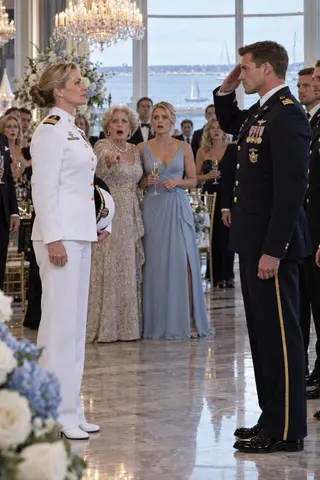
 Mother Publicly Shames Her Navy Veteran Daughter As A "Failure"
Chapter 5
The Command Center at Dawn
Twelve hours later, the artificial lighting of the Pacific Fleet Readiness Command Center in Hawaii hummed with relentless energy. Giant digital wall-maps cast a pale blue glow over dozens of officers and analysts moving rapidly between workstations.
I stood before the primary tactical display, my dress-white uniform jacket removed, my sleeves rolled up slightly as I stared at the blinking red vector lines tracking the hijacked container ship in the Philippine Sea.
"Status report, Captain Sloan," I commanded without turning around.
Meredith stepped up beside me, holding a encrypted tablet. "USS John Paul Jones has closed the distance to forty miles, ma'am. The P-8 Poseidon is currently circling overhead, feeding real-time thermal imagery to our secure feeds. The militia boarders have retreated to the ship's superstructure, holding twenty-two civilian crew members hostage on the bridge."
"Have they made any demands?"
"Radio silence so far. They’re waiting to see how the regional naval command responds."
I studied the telemetry. This wasn't a random act of piracy; it was a calculated probe by regional actors testing our response time during a leadership transition window. If we hesitated, or if our response was sluggish, it would signal weakness across the entire Indo-Pacific theater, inviting further aggression.
"We don't have time to wait for diplomatic clearance through normal channels," I said calmly. "Prepare a precision boarding protocol using the John Paul Jones’s embedded SEAL platoon."
Meredith blinked, looking up from her tablet. "Ma'am? Authorizing a live tactical boarding without waiting for State Department sign-off carries significant political risk if things go sideways."
"The risk of inaction is greater," I replied, my voice steady and absolute. "If we let hostile actors seize commercial vessels with impunity, our deterrence crumbles. Give the green light to the tactical team. I’ll take full operational responsibility."
Before Meredith could reply, the secure red telephone on my console buzzed sharply.
"That will be the Secretary of Defense," Meredith murmured.
I picked up the receiver. "Bellamy."
"Admiral," the Secretary's voice came through, heavy with the gravity of the crisis. "I’m looking at the live feed from the Philippine Sea. Your chief of staff tells me you’re preparing a tactical boarding protocol."
"Yes, Mr. Secretary," I said smoothly. "The militia is stalling for time to tow the vessel into contested territorial waters. If we wait for formal diplomatic consensus, the hostages will be moved ashore, and our operational leverage evaporates."
"The President is concerned about escalation, Katherine."
"With respect, Mr. Secretary, hesitation is escalation in this theater," I countered, every word measured and precise. "If we strike fast, cleanly, and with overwhelming force, we send an unambiguous message. I have full confidence in the tactical unit on the ground—they are the best the Navy has to offer."
There was a tense silence on the line for three long seconds.
"Do it, Admiral," the Secretary said finally. "And God speed."
"Understood. Bellamy out."
I hung up the phone and turned to face the entire operations floor. Every pair of eyes in the room locked onto me, waiting for the command.
"Captain Sloan," I said clearly. "Execute Protocol Viper. Give the order to the John Paul Jones."
"Executing Protocol Viper," Meredith replied, her fingers flying across her console. "Orders transmitted. Boarding in progress."
For the next twenty-two minutes, the command center was dead silent except for the low hum of servers and the quiet relay of telemetry data from the P-8 overhead. We watched the thermal icons move across the digital deck plans of the container ship—smooth, synchronized, professional.
"Hostiles neutralized," Meredith announced sharply, her voice ringing out across the room. "All twenty-two civilian crew members secured with zero casualties. The vessel is back under friendly control."
A collective exhale swept through the command floor. Several officers smiled and nodded in quiet relief.
I let out a slow breath, feeling the familiar, grounding weight of responsibility settle back into place. This was my life. This was the world where decisions mattered, where actions had immediate, profound consequences, and where incompetence was never tolerated—unlike the petty, trivial dramas playing out thousands of miles away in a Virginia yacht club.
The End









