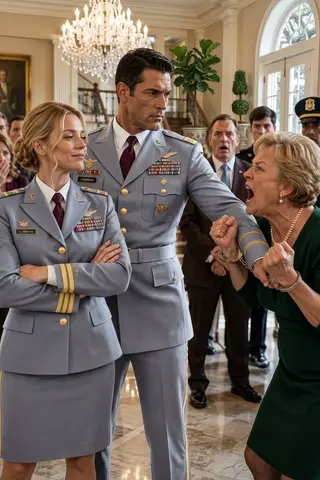
 Mother Destroys Army Major Daughter's Uniform Before Wedding Day
Chapter 100
The Midnight Tremor
By late evening, truss assemblies beta and gamma had been locked into place with millimeter precision. The entire deep-sea installation was secure, the acoustic vault resting safely upon the new cantilevered bridge.
The emergency was over. The official signing ceremony with the Department of Defense was scheduled for noon the following day at Fort Monroe.
At eleven o'clock that night, Wyatt and I suited up in heavy field jumpsuits for one final physical inspection of the internal maintenance shaft. The shaft was an eighty-foot vertical steel tube that descended from the platform's submerged pontoon down into the auxiliary pump vault, fifteen feet above the ocean waterline.
"Just a final check on the hydraulic line pressures, Dad," Wyatt said, fastening his safety harness. "Then we catch the midnight transport back to the mainland. Harper said she saved us half a pan of Martha's peach cobbler."
"I'd cross two oceans for Martha's cobbler," I smiled, clipping my carabiner to the safety cable.
We descended the steel rung ladder into the hum of the auxiliary chamber. The air was cool and smelled of fresh marine paint. Wyatt knelt beside the high-pressure manifold, checking the digital pressure gauges with his inspection flashlight.
"Manifold one is steady at four thousand PSI," Wyatt reported, logging the numbers on his tablet. "Manifold two... zero variance."
Suddenly, without a second of warning, the entire ocean beneath us seemed to convulse.
A violent, sickening jolt slammed the platform sideways with terrifying force. The steel deck beneath our feet kicked upward, throwing me hard against the bulkhead. My safety tether snapped with an explosive crack.
Above us, deep within the ocean floor, an unmapped seismic fault—triggered by decades of subterranean hollows left by Arthur's old dredging—ruptured.
The primary sea-chest valve fifty feet below sheared cleanly off its mountings.
A deafening roar of rushing, high-pressure Atlantic seawater filled the maintenance shaft. Within seconds, a freezing torrent of black ocean water exploded through the floor grates, rising around our knees, then our waists, with terrifying, unstoppable speed.
Above us, the automated emergency protocols triggered.
With a thunderous, mechanical crash, the heavy watertight steel hatch at the top of the escape shaft slammed shut, sealing us in the dark.
The emergency red warning strobes flickered to life, bathing the rising water in a crimson, flashing glare. The radio on my chest crackled wildly with static and panicked screams from the surface control room:
*"Mayday! Mayday! Platform structural rupture! Auxiliary vault flooding! Harrison! Wyatt! Can you hear me? The upper hatches are jammed from the seismic shift! We can't blow the ballast—"*
The radio died in a hiss of saltwater.
The freezing ocean was at our chests. The air in the sealed chamber was compressing rapidly, popping our eardrums. Wyatt grabbed my arm, his boots slipping against the submerged deck plates as the water surged toward our chins.
"Dad!" Wyatt yelled over the thunder of the rushing sea, his flashlight beam cutting through the churning black tide. "The hatch won't budge from the surface! The manual release is under the floor plate—beneath ten feet of water!"
I looked at my son in the flashing crimson light, feeling the ice-cold Atlantic pressing against my ribs, the titanium in my spine straining against the crushing weight of the rising abyss.
The End









