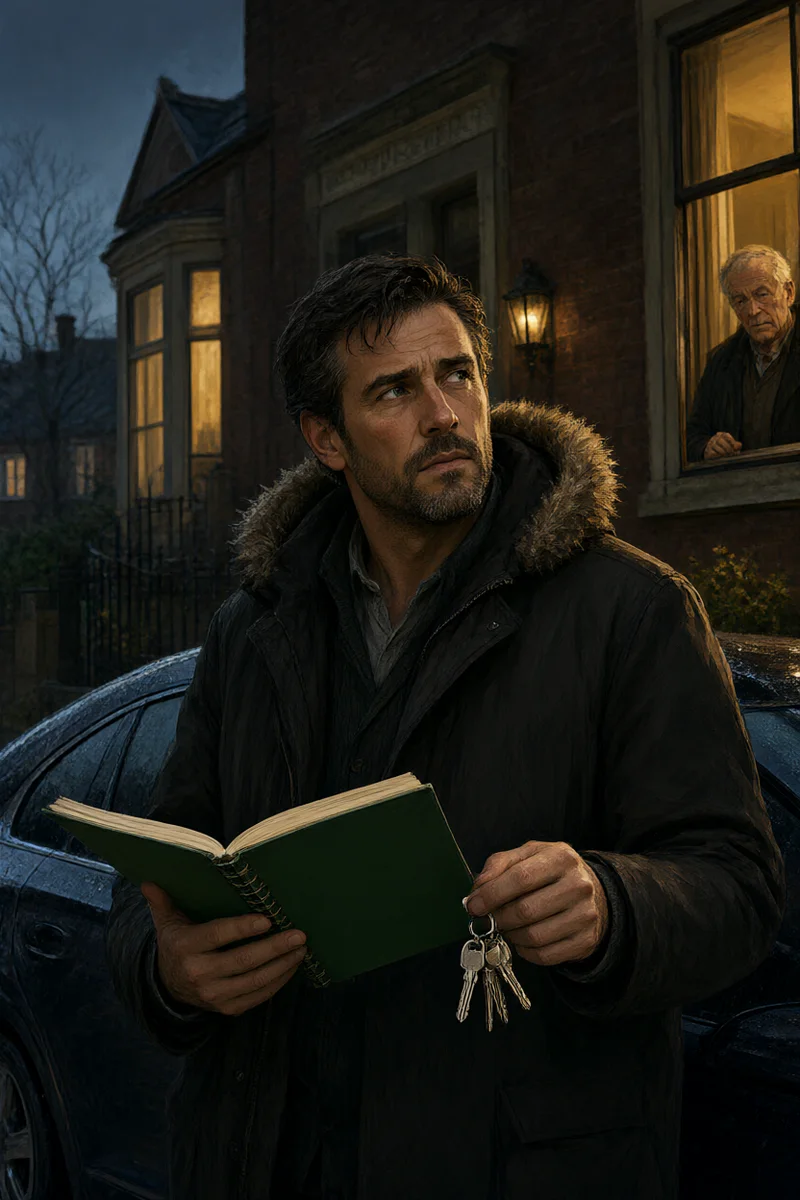
 The Week Notebook
Chapter 4
Monday
Monday was a disaster, and it was entirely his.
He took the day as leave and let himself into the shop at eight with the first key on the ring. By eleven he had paid Sandra by bank transfer instead of cash, which offended her deeply, and sent an invoice for a reupholstered wing chair to the wrong Mrs. Pattinson. He could not find the tax login on the back page because it was not on the back page; it was on the inside of the back cover, in pencil.
Rosalind came through from the workroom at noon with tacks in her mouth and a hammer in her hand and watched him for a while without saying anything. Then she took the tacks out.
“Your father says he told you about Carrick.”
“He told me to ask you.”
His mother sat down on a footstool still in its calico. She was sixty-one, small and wiry, with forearms like a man's from forty years of pulling webbing tight.
“That autumn the shop was going under,” she said. “Your father had been sober less than a year and none of us knew if it would hold. The bank wrote to say they'd remortgage the house once and once only. And two letters came in the same week. One was your fees for second year. The other was Elspeth's place at Carrick, with no grant because of your father's salary, which we weren't seeing much of by then.” She turned the hammer over. “There was enough for one.”
“So you picked me.”
“I didn't pick anybody. She came down here with both letters in her hand and she said, ‘Des is further along.' Eighteen years old. And I let her say it.” Rosalind's mouth went thin. “I thought she'd go the year after. Then there was always a reason she couldn't. And she was so good at it all, Desmond. She was so good at being here.”
He had no answer to that. He had been twenty, and he had come home at Christmas and seen his little sister in a polyester tunic from the hygienist's course at the tech, and he had not asked one question about it.
On Wednesday he swapped his afternoon list with a colleague who would hold it over him for months, and was standing at the bus stop on the high street when the 4:10 pulled in.
Isla got off with her bag over one shoulder and saw him and stopped dead on the bottom step. The driver had to ask her to move.
“Auntie Elsie told you,” she said.
“She wrote it down.”
His daughter looked at him and took her time about it. She had Neve's eyes and his own habit of deciding how much to say before she said it.
“I didn't want to be another thing,” she said.
“You're not a thing.” He took her bag. It weighed about as much as she did. “What's happening with Amber?”
She told him, walking up the stairs to Elspeth's flat, and it took the whole way up and most of a packet of crackers, and some of it made him want to drive to the school that minute. Elspeth wasn't home. There was a note on the counter about the oven.
At half eight Isla packed her French away and said, quite casually, “You know she's not going now.”
“What?”
“Auntie Elsie. I heard her on the phone to Gran last night. She's writing to the school in Carrick to ask for another year.” Isla zipped her pencil case. “She said Monday was a disaster and the whole thing would fall apart in a week.”
The End









