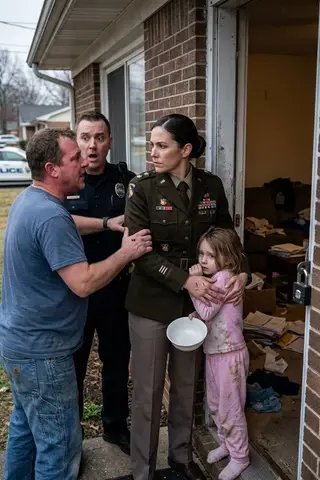
 Major Mom Returns 3 Weeks Early from Deployment
Chapter 22
The Silent Signal
Within forty-five minutes of Hannah’s initial sighting, a perimeter lockdown had been silently initiated around the bluffs without alerting the nocturnal intruders. Officer Marcus Bell arrived in an unmarked cruiser, parking three blocks inland before advancing on foot through the wooded nature sanctuary with two tactical patrol officers. Meanwhile, Detective Sarah Vance coordinated real-time satellite imagery with the Coast Guard’s maritime tactical command post in Portsmouth.
Hannah met them at the rear garden gate, holding a digital tablet displaying thermal frequency readouts and tactical hydrophone feeds that had intercepted the divers' low-frequency acoustic communications. The divers had anchored their waterproof flotation canisters against the submerged granite foundations of an abandoned nineteenth-century colonial boathouse that jutted into the estuary beneath Hannah’s rear lawn.
"They aren't laying surveillance gear, and they aren't dumping waste," Hannah whispered, her voice crisp and lethal as she oriented Bell and Vance to the three-dimensional terrain map. "They are using ground-penetrating sonar scanners calibrated to penetrate reinforced subterranean masonry. They're searching for an entrance."
Vance adjusted her tactical vest, her expression grim. "An entrance to what? This house was built in 1892. The town historical records only show standard root cellars and civil-defense coal chutes."
"Town records show only what civilian architects were permitted to file," Hannah countered, her dark eyes flashing in the faint green glow of the tablet screen. "My late Aunt Eleanor served forty years as a senior cryptographic analyst for the Office of Strategic Services and the fledgling Defense Intelligence Agency during the Cold War. She didn't leave me this estate simply because she loved Victorian architecture. She chose me because she knew I possessed the training to protect what was buried underneath it."
Hannah opened a classified Department of Defense historical infrastructure file she had unlocked using her Pentagon clearance earlier that night. On the screen was a declassified 1961 blueprint stamped with the seal of the United States Naval Security Group. The historic Chesapeake home had been constructed atop a decommissioned coastal monitoring redoubt—a hardened subterranean communications bunker built into the subterranean bedrock during World War II to intercept German U-boat radio transmissions entering the Chesapeake Bay.
When Richard Nolan had formed Crestline Maritime Holdings, he had partnered with an international black-market cartel known as the Cerberus Maritime Group, a syndicate specializing in high-value smuggling and sensitive military hardware trafficking across the Atlantic seaboard. The syndicate had paid Richard millions in offshore retainer fees not to develop hotels, but to acquire the bluff and break into the buried bunker, where cold-storage emergency communications hardware and vintage military cryptographic ledgers were rumored to remain sealed behind six-foot reinforced concrete walls.
"Julian Cross thought the bearer bonds on the yacht were the prize," Hannah explained, her voice steady and implacable. "He was a middleman. Cerberus doesn't care about money; they care about the Cold War naval transponder archives sealed below my living room floor, which contain sovereign coastal frequency keys that foreign intelligence services would pay tens of millions to possess."
"So when Richard went down," Bell concluded, tightening the strap of his tactical carbine, "the cartel decided to bypass the corporate lawyers and come take it by force."
"They believed this house was undefended, occupied only by a lone woman and a child," Hannah said, chambering a round into her tactical sidearm with a smooth, decisive click. "Let's demonstrate how catastrophically mistaken they are."
The End









