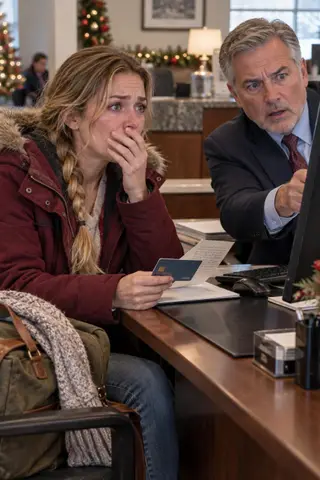
 Kicked out of the house on Christmas Eve while dressed for 22-degree weather, a young woman accessed her late grandfather's bank account and saw a figure that left the…
Chapter 2
The Secret Legacy of Grandpa Owen
Grandpa Owen had been the only true anchor in Rachel’s tumultuous, emotionally sterile childhood. While her father was a cold corporate climber obsessed with status and appearance, and her mother was an anxious perfectionist who measured her children’s worth by their external achievements, Owen had been warmth, laughter, and unconditional acceptance. He was a retired high school woodshop teacher and a veteran who wore flannel shirts year-round and smelled faintly of cedarwood and pipe tobacco.
When Owen passed away three years ago at the age of eighty-four, the grief had nearly broken Rachel. He had left her his vintage pocket watch, a stack of hand-carved wooden animals, and a small, nondescript greeting card handed to her privately during his final weeks in hospice care.
Inside that card, written in Owen’s shaky, cursive handwriting, were words she had memorized by heart:
“For when you really need it, Rach. Don’t open it early, and don’t tell your mother or Richard. They think money solves character, but I know character solves money. Trust yourself, my girl.”
Tucked securely behind that note was a plain, unmarked bank debit card issued by First Liberty National Bank—an institution with branches scattered across the state, but none particularly close to her suburban neighborhood.
At the time, Rachel had tucked the card safely behind her driver's license, treating it like a sacred talisman. She had never used it. In fact, whenever money had gotten tight over the past three years—even during her devastating breakup when she had been forced to sleep in her car for three nights—she had refused to touch it. She assumed there might be a few hundred dollars on it, perhaps a thousand at most—enough for a cheap motel room or a month's worth of groceries in a dire emergency. More than the money itself, the card represented a final, loving hug from her grandfather across the veil of death. It felt too precious, too sacred to spend on mundane bills.
But sitting in her freezing car on Christmas Eve with exactly $22.40 to her name, shivering uncontrollably as the heater struggled against the bitter chill, Rachel realized she had finally crossed the threshold of what her grandfather meant by “when you really need it.”
She was homeless. She was penniless. She was locked out of her own life by the people who were supposed to love her unconditionally.
"Okay, Grandpa," she whispered into the dark, frosty cabin of her car, a tear slipping down her cheek and catching on her chin. "I need it. I really, really need it now."
The problem was logistics. It was Christmas Eve night. Every bank branch in the state was locked, shuttered, and wrapped in holiday silence. The digital banking apps required a username, password, and account numbers that were completely unknown to her, as she had never activated the card online. She couldn't even check the balance at an ATM without a PIN, and Owen had never written the PIN down—or had he?
She pulled the card out of her wallet under the dim amber glow of the car's overhead dome light. It was sleek, made of a heavy matte black composite material with silver lettering that didn't look like any standard debit card she had ever seen. On the back, written in her grandfather’s familiar blue ink on a small white strip of adhesive tape, was a four-digit number: 1948.
1948. The year Grandpa Owen and Grandma Clara had married.
Her heart did a frantic, hopeful flutter. Could it really be that simple?
She knew she couldn't test it tonight. With nowhere else to go and her bank account virtually empty, Rachel had to find a safe haven to endure the brutal winter night until the sun rose and Christmas morning brought the opening of the financial institutions.
She put the car in drive, navigated out of her parents' affluent, silent subdivision, and drove toward the only place she knew would be warm, bright, and open twenty-four hours a day: The Silver Spoon Diner, located off the interstate on the gritty industrial edge of town.
The diner was a neon-lit beacon of grease, coffee, and transient souls. Inside, the air smelled of stale frying oil, cheap maple syrup, and bleached linoleum. A few weary truck drivers sat at the counter reading newspapers, and a lone waitress with tired eyes and a name tag reading Brenda leaned against the register, scrolling on her phone.
Rachel slid into a vinyl-padded corner booth near the back, pulling her worn jacket tightly around her shoulders.
Brenda walked over, wiping down the table with a damp, gray rag. "Rough night to be out, honey. You look like you've seen a ghost."
"Just a long Christmas Eve," Rachel forced a weak smile. "Can I just get a black coffee? The cheapest one you have."
"Refills are free," Brenda said kindly, her hardened exterior melting slightly as she looked into Rachel’s exhausted, red-rimmed eyes. "You want a slice of cherry pie with that? On the house. Looks like you need some sugar in your system."
"Thank you, Brenda. Just the coffee is fine for now."
Rachel sat in that corner booth for hours. She watched the digital clock on her phone tick past midnight, marking the official arrival of Christmas Day. While families all over the city were waking up to sparkling trees, wrapped packages, and the warm laughter of loved ones, Rachel sat alone in a neon-lit diner, nursing a lukewarm mug of bitter coffee, counting her remaining coins, and wondering how her life had derailed so completely.
Yet, beneath the crushing weight of heartbreak and exhaustion, that strange, cold spark of determination continued to burn inside her chest. She wasn't going to crawl back to her parents. She wasn't going to beg for forgiveness for a crime she didn't commit. Tomorrow morning at nine sharp, when the First Liberty National Bank downtown opened its doors after the holiday closure, she was going to find out what Grandpa Owen had left behind.
The End









