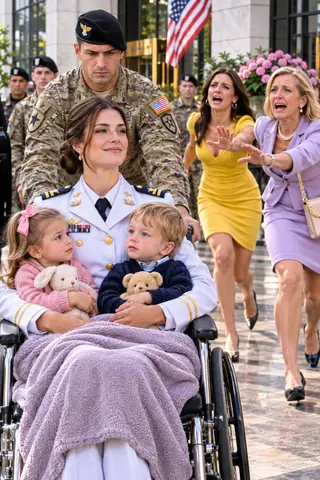
 Injured Army Colonel Cuts Off Her Ungrateful Parents After They Choose Pickleball Over Her 1-Year-Old Twins
Chapter 1
The Breaking Point in Room 412
The sterile white walls of Walter Reed National Military Medical Center seemed to close in on me, pressing against my bruised ribs with every shallow, agonizing breath. I stared up at the pale ceiling tile, tracking the faint smudge near the ventilation grate. Outside, the world kept moving, unaware that my entire universe had fractured right along with my pelvis.
Three days earlier, an official reconnaissance mission in a hostile zone had gone sideways. I won’t recount the details of the explosion or the smoke and chaos that followed—suffering from military operational security restrictions and a body screaming in pain was enough. When I finally blinked back to consciousness beneath the blinding operating room lights, the surgeon delivered the verdict with a heavy sigh: a severe pelvic fracture, multiple cracked ribs, and a rehabilitation process that would take months before I could walk unassisted.
For nearly twenty years, I had been Colonel Elena Carter. I had led infantry platoons through treacherous territory, made split-second tactical decisions under fire, and carried the weight of my soldiers' lives on my shoulders. I was trained to endure, to adapt, and to overcome.
Yet, lying in that hospital bed, tears pricked my eyes not from my own injuries, but from the terrifying realization that I was utterly helpless.
My husband, David, had passed away a year ago in a tragic accident, leaving me to navigate single parenthood with our one-year-old twins, Leo and Maya. My military support network had scrambled to arrange emergency temporary care through trusted friends and base childcare programs, but those resources were finite. Within a few days, I would need reliable, full-time help while undergoing surgeries and intensive physical therapy.
Naturally, my mind turned to the people who brought me into this world. Surely, my parents—who lived comfortably in a sprawling suburban home just two hours away—would step up in a time of crisis.
With shaking hands, I reached for my cell phone on the bedside tray and dialed my mother.
She answered on the second ring, the background noise filled with the familiar, cheerful clatter of a social gathering.
"Mom," I said, my voice tight with pain. "I need you and Dad to come down and watch the twins for a few weeks."
There was a sharp, dramatic sigh on the other end of the line. The kind of sigh that communicated profound annoyance rather than maternal concern.
"Elena, seriously?" my mother snapped, lowering her voice as if stepping away from a crowd. "I still need time for pickleball. Your sister’s match is coming up, and I have my doubles clinic this afternoon."
For a split second, I genuinely thought it was a dark joke.
"Mom, I’m calling you from a military hospital," I replied, forcing my voice to remain steady despite the agony in my chest. "I’ve been seriously injured."
"And we are not your personal babysitters, Elena," she retorted sharply. "You always expect the world to stop turning just for you."
"I got hurt while serving on an active mission!" I shouted, wincing as the sudden motion sent a searing spike of pain through my ribs.
"There’s always some crisis with you," she dismissed coldly, showing zero curiosity about my health or the safety of her grandchildren. "Your sister never bothers us like you do. Figure it out yourself."
Click.
The line went dead.
For several agonizing seconds, I lay completely still in the dark, quiet room. The rhythmic beeping of the heart monitor felt like a mock heartbeat counting down the seconds of my fading patience.
Then, a cold, calculated clarity washed over the pain.
I thought about my entire life. I thought about the sacrifices I had made, the deployments I had survived, the holidays I had missed, and the countless sleepless nights I had endured. And then, I thought about the people who had just told me to figure it out.
My parents lived in a magnificent four-bedroom home with a manicured lawn.
I paid for it.
My mother drove a luxury SUV to her pickleball matches.
I leased it through a corporate account.
Their annual country club memberships, their medical insurance policies, their exotic vacations to Cabo and Maui, their property taxes, and every single luxury they enjoyed—all of it was funded entirely by me.
When their roof collapsed during a severe storm three years ago, I covered the forty-thousand-dollar bill without blinking. When my father accumulated massive gambling and credit card debts, I quietly paid them off to save the family from embarrassment. And when my younger sister, Sarah, decided to launch an overpriced, boutique clothing line that crashed and burned within eighteen months, I absorbed the hundreds of thousands in losses, propping up her lifestyle under the guise of a "consulting salary."
They called me a burden. They called me a bother.
They had completely forgotten one crucial detail: the golden goose wasn't an endless fountain of free money. It was me.
A nurse entered the room, holding a clipboard and pausing when she saw the expression frozen on my face.
"Colonel Carter?" she asked softly. "Is there somebody you'd like me to contact? You look pale."
I stared down at the screen of my phone, watching the lock screen light up with a photo of Leo and Maya smiling innocently in their matching blue rompers.
"Yes," I whispered, a cold smile touching the corners of my lips.
"Who should I call?"
"My attorney."
The End









