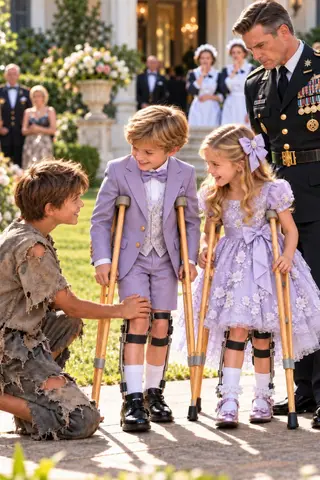
 I Mocked a Homeless Boy at a Military Gala: 'Heal My Twins and I'll Adopt You'
Chapter 6
The Army Medical Board Intervenes
News of what happened at the charity gala didn't stay inside the ballroom for long. Within forty-eight hours, the story had leaked through military channels, transforming from whispered rumors into an official flashpoint that sent shockwaves all the way up the Pentagon chain of command.
By Thursday morning, our quiet suburban home was surrounded by sleek black sedans.
Three military doctors from Walter Reed National Military Medical Center, accompanied by two military police officers and a legal attaché, stood in our living room. Their expressions were a tense mix of professional skepticism, clinical bafflement, and institutional panic.
"Colonel Vale," Dr. Harrison, the head of orthopedic research, said sharply, adjusting his wire-rimmed glasses. "We reviewed the updated scans of your children taken yesterday morning. According to every established law of human physiology, this recovery is medically impossible. The nerve pathways were severed. The bone density was critically low."
"And yet, Doctor, they ran a hundred yards across our lawn this morning," I replied coldly, standing cross-armed in front of the fireplace.
Claire walked into the living room, carrying a tray of coffee, with Lila and Leo trailing behind her—both of them skipping, laughing, and showing zero signs of the heavy metal braces that now sat rusting in our garage trash can.
Dr. Harrison stared at them, his jaw tightening. He then turned his intense, clinical gaze toward the corner of the room, where Noah sat quietly on the sofa, reading an old comic book with a box of crayons by his side.
"Where is the boy?" Harrison demanded, stepping forward. "We need to run comprehensive neurological, genetic, and blood panels. Is he a biological anomaly? A genetic mutant? This phenomenon must be studied and cataloged for national defense applications."
The word anomaly triggered something dark and protective deep inside my chest.
"He is not a guinea pig, Doctor," I barked, stepping directly into Harrison's path, my height and decades of command authority bearing down on him. "He is my son now. The adoption paperwork was fast-tracked and signed by a federal judge yesterday afternoon. He stays right here."
"Colonel, you don't understand the implications—" Harrison started, raising his voice.
"No, you don't understand," I interrupted, my voice dropping to a low, dangerous growl. "For two years, your brilliant specialists gave me fancy medical jargon and told me to accept defeat. A homeless child showed more heart, more power, and more humanity in ten seconds than your entire multi-billion-dollar medical institution did in twenty-four months. Get out of my house."
The End









