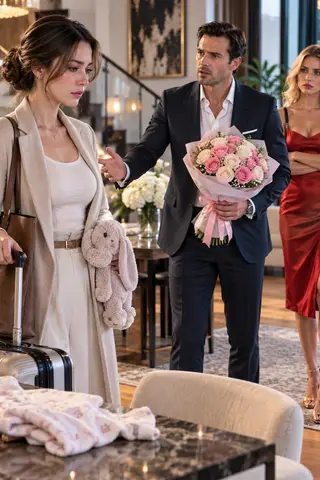
 I Left My Ungrateful Husband At Our Anniversary Dinner
Chapter 1
The Anatomy of a Doormat
Fifteen years of being the anchor for a family of anchors had left calluses on my soul. That was the phrase that kept echoing in my mind as the October rain battered the rotting window frames of my late father’s farmhouse outside Versailles. It was 3:00 a.m., and the small propane heater was rattling like a tin can full of bolts, but the chill in the air was nothing compared to the ice settling in my chest.
Let's rewind, because people like Russ Merritt—my charming, endlessly entitled husband—love to paint a picture where they are the misunderstood visionaries and their spouses are the rigid wardens holding them back. For a long time, I let him paint that picture. I wore the badge of "Commander Ellie" like a badge of shame, apologizing for my organizational charts while quietly paying off his mother's assisted-living facility fees out of my state pension every single month.
People think emergencies are sudden. They think an emergency is a tornado touching down in a valley, a levee breaking at midnight, or a wildfire leaping a highway. Working twenty-two years for the state emergency-response agency taught me otherwise. Real emergencies are slow-motion train wrecks. They are the accumulation of small, structural failures that everyone ignores because fixing them requires admitting the foundation is cracked.
Russ’s foundation had been cracked since the day I met him. Back then, he was the charismatic guy with a quick smile, a local building supply business that looked slightly more successful than it actually was, and a family that treated him like the sun god Apollo incarnate. His mother, Dolores, had raised three children: Wayne, who treated his semi-truck like a rolling ashtray and his bank accounts like someone else's problem; Joanne, whose divorces came with the predictability of changing seasons; and Russ, the golden boy who was always "just one big contract away" from empire status.
I had spent my entire adult life building systems that survived actual natural disasters. But for the last fifteen years, my full-time job had been saving the Merritt family from their own financial illiteracy. When Wayne needed a new transmission for his rig, my savings account bled. When Joanne needed to make mortgage payments to save her suburban split-level, the money mysteriously appeared from a "generous loan" that Russ claimed he secured. It never occurred to Joanne to look at the check and see my maiden name printed faintly in the corner.
And Russ? Russ saw my financial literacy as an unlimited infinite-ammo cheat code in a video game.
"We’re married, El," he had told me four months ago, standing in our granite-topped kitchen while holding a glass of scotch, asking for a cool hundred and fifty thousand dollars to secure a commercial timber and drywall contract for Hartley Bridge—the biggest project his company had ever touched. "You don’t need all this paperwork."
I had looked at him, standing there in his custom-tailored designer jeans, smelling of sandalwood and self-assurance. I loved him once. Or perhaps I loved the version of him that existed only in my hopeful imagination—the man who would eventually grow up and realize that a partnership meant carrying equal weight. But love, I realized as I sat wrapped in my father’s mothballed wool quilt, is not a renewable resource when it’s being constantly funneled into a bottomless pit of entitlement.
I had insisted on paperwork anyway. Neil Carter, our accountant, a man who looked like he had been pressed between the pages of a ledger book since birth, had drawn up the bridge loan agreement. One hundred fifty thousand dollars of my personal money, accumulated long before Russ and I ever shared a zip code. Expiration date: this coming Monday. No verbal extensions. No fuzzy math.
When Russ made that "joke" at our anniversary dinner—looking out over a table of people whose lifestyles were propped up entirely by my discretion—he didn't just insult me. He dropped the mask. He signaled to his entire clan that my dignity was currency they were free to spend.
So I spent his business instead.
The End









