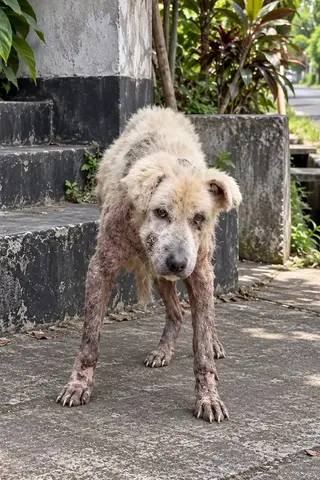
 His Owner Abandoned Him After 10 Years, But What This Loyal Dog Did Next Will Break Your Heart
Chapter 7
Into the Operating Room
The morning sun rose over the clinic, casting sharp beams of amber light across the tile floor. By 7:30 AM, the surgical suite was a hive of controlled, methodical activity. Sterile surgical packs were laid out across stainless-steel counters, anesthetic monitors were calibrated, and the air smelled heavily of surgical scrub and antiseptic.
I stood scrubbed and gowned in sterile blues beside Dr. Evans, assisting as a surgical technician while we prepped Ossi on the operating table.
The old dog lay peacefully under general anesthesia, his breathing regulated by the mechanical ventilator attached to his endotracheal tube. Without the tension of chronic pain, his face looked remarkably serene, though the severe distortion of his right jaw stood out starkly under the glaring overhead surgical lights.
"All right, let's begin," Dr. Evans said calmly, snapping on his sterile surgical gloves. "Scalpel, please."
The procedure started with a careful, precise incision along the gumline of the swollen lower jaw. The moment the tissue parted, a thick wave of dark, infected fluid drained away, captured immediately by the surgical suction tube. The smell of chronic necrosis filled the sterile air, a grim testament to what Ossi had been enduring for months.
"There it is," Dr. Evans muttered, leaning closer with surgical forceps. He reached deep into the compromised tissue pocket. With a soft metallic clink, he pulled out a jagged, blackened fragment of bone—the remains of the pork bone that had started the entire nightmare ten weeks ago. It was wedged tightly between two molars, having punctured the gum tissue and driven deep into the jawbone, causing severe bone death and chronic infection.
"No wonder he couldn't eat properly," the surgical tech whispered, shaking her head. "That must have felt like a knife twisting in his jaw every time he moved."
"Worse," Dr. Evans replied grimly. "It was a slow-motion infection eating away his mandible. Let's start the debridement."
For the next two hours, the operating room was a masterclass in surgical precision. Dr. Evans meticulously scraped away every speck of dead, necrotic bone, flushed the deep tissue pockets with antibiotic saline, and carefully extracted the shattered molar that had anchored the foreign object. Because the bone damage was extensive, he performed a complex soft-tissue flap closure to cover the exposed mandible and promote healthy granulation.
Every minute on the clock felt like an hour. My heart hammered against my ribs, watching the multi-parameter monitor display Ossi’s heart rate and blood oxygen levels. He was an elderly, frail dog undergoing major reconstructive surgery, and the margin for error was razor-thin.
"Heart rate is holding steady at ninety," the technician called out reassuringly around the two-hour mark. "Blood pressure is stable."
"Good," Dr. Evans breathed, placing the final, delicate suture in the gumline. "We're wrapping up. Excellent work, team. Let's reverse the anesthesia and get him into recovery."
As the ventilator was disconnected and Ossi was gently transferred back onto his warmed recovery gurney, a profound wave of relief washed over me. The surgery was over. The poison was out of his body. Now came the true test: waking up.
The End









