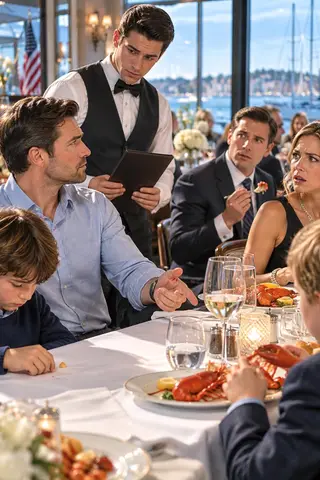
 "He’s Used to Going Without": How A Billionaire Dad Served Revenge Cold After Family Humiliated His 10-Year-Old Son!
Chapter 34
The Trial in the Valley of Dust
While Caleb was defending the artisans of Carrara, an unexpected crisis tested the younger generation back in the Western Hemisphere.
At 4:18 AM on a Thursday in late spring, a magnitude 7.4 earthquake struck the remote, mountainous coastal region of northern Peru, triggering devastating landslides that wiped out arterial roads, collapsed power grids, and cut off twenty-two mountain villages from municipal emergency response networks. The regional schools, constructed from fragile unreinforced masonry, had crumbled into fields of suffocating dust, leaving hundreds of children without shelter, clean drinking water, or communication with the outside world.
Within three hours of the disaster alert, the Caleb Academy mobilized. But this time, it was neither Leo nor Caleb who commanded the relief initiative.
Toby Vance, now seventeen years old, stood at the center of the academy’s computational design hangar, directing twenty senior students with the crisp, calm authority of a veteran logistics commander. Beside him stood Maya, her architectural drafting displays showing modular, flat-pack timber relief shelters designed for rapid assembly.
"The Peruvian civil defense roads are blocked by mudslides," Toby announced, his voice cutting through the hum of 3D printers and CNC joinery machines. "Commercial helicopters can't penetrate the narrow cloud-covered gorges. We are deploying the Sovereign Mesh Aero-Node array. Four autonomous solar-powered gliders will establish a high-bandwidth localized communication umbrella over the valley within six hours."
Gavin and I stood on the mezzanine walkway above the hangar floor, watching our children work. Gavin’s eyes were wet with quiet, profound pride. Less than five years ago, Toby had been a terrified boy clutching a dirty backpack in the rain; today, he was orchestrating an international emergency deployment with absolute mastery.
"Look at him, Leo," Gavin whispered, his voice thick with emotion. "He didn't inherit my greed. He inherited your mind, your resolve, and Caleb’s heart."
"He built that mind himself, Gavin," I replied, resting my hand on my brother’s shoulder. "Because he had a father who showed him what real redemption looks like."
Thirty-six hours later, Toby and Maya touched down via chartered cargo plane in the staging hub of Chiclayo, accompanying forty modular emergency response units constructed from lightweight, interlocking cedar and carbon-composite trusses. Working alongside local Peruvian rescue teams in the earthquake epicenter of Chachapoyas, the twins deployed emergency satellite comms, constructed five modular field hospitals, and built sixteen rapid-assembly communal classrooms using the zero-nail joinery techniques Caleb had documented in his open-source journals.
When international news cameras finally reached the disaster zone three days later, expecting to film chaos and despair, they found hundreds of displaced children sitting safely inside warm, brightly lit timber pavilions, eating hot meals, while Maya helped young survivors sketch their experiences on fresh pads of paper to process their trauma.
A reporter from an international wire service approached Toby, thrusting a microphone into his face. "Young man, who authorized this operation? Are you with the United Nations or the Red Cross?"
Toby adjusted his safety helmet, wiped dust from his brow, and looked directly into the lens with a calm, unshakeable confidence that mirrored Caleb’s exact spirit.
"We are the Caleb Academy," Toby replied clearly. "Nobody authorized us. When people are suffering, you don't wait for permission to care. You just show up, and you build."
The End









